Executive Produced by Steven Spielberg and partly scripted by Eric Bogosian, this very short lived cop drama was essential viewing for me. Taking a now treaded narrative- i.e. the daily travails and friendship of Los Angeles cops-, and crafting something special was not an easy task. Starring Matt Craven, Blair Underwood, Cole Hauser and David Keith, "High Incident" only ran one year and even the almighty powerful Spielberg couldn't save its dismal ratings. And the biggest shame of all? Ending the show on such a cliffhanger- with several stars in comas or battling for their lives after a massive shootout- proved that the cast and crew believed they had more fuel in the tank.
4. The Job (2001)
Denis Leary and executive producer Peter Tolan would reach larger acclaim with another show on this list later, but "The Job" could be considered its training ground. Assembling a diverse cast and spending of their episodes on digressive matters such as being taken hostage in the restroom by an escaped criminal in the police station or the preoccupation with how dull his badge is compared to others, "The Job" was vintage Denis Leary. It only lasted 19 episodes, but "The Job" is light years ahead of current fare such "Brooklyn 911".
3. The Shield (2002-2008)
A bit more appreciated than others on this list, "The Shield" still doesn't receive the kudos it deserves. Placing himself near the top of anti-heroes alongside Tony Soprano, Michael Chiklis' portrait of dirty LA cop Vic Mackey colors himself irredeemable right from the opening scene when he commits murder. The next six seasons are spent not only trying to cover up his own criminal transgressions AND hold a family together, but take down some of the city's toughest drug dealers. "The Shield" is compulsively watchable and tension inducing, not afraid to spotlight its lead character's coal-black moral center.
2. Curb Your Enthusiasm (1999-)
This is the one show on this list I may be mis-informed about, yet I just don't know of anyone....ever that talked about it. It may be highly regarded.... I just don't know about it. As a fan of "Seinfeld", I was genuinely interested in creater Larry David's foray on HBO, hoping for some of the same humor, instead getting an entirely new misanthropic outlook on everything from sleeve cuffs to hookers for the HOV lane. "Curb Your Enthusiasm" takes shots at everyone and anything, and I love Larry David for it.
1. Rescue Me (2004-2011)
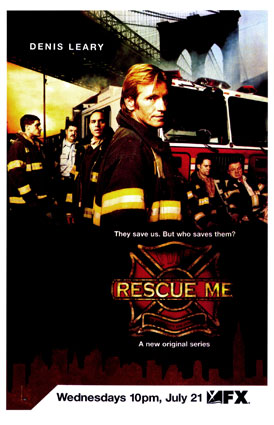
After the demise of "The Job", Denis Leary and friend/producer Peter Tolan (and a majority of the cast) came to FX with this masterpiece of a television show about New York City firefighters. Haunted by dead friends and shadows of September 11th, "Rescue Me" weaved an eight year run that embedded the viewer with poignant, involving and wildly funny moments from the lives of these men and women. Highly recommended if you weren't already a fan.
I suppose it's unfair to compare the fictional end of days scenario with the real life force of nature that was Hurricane Katrina, but both "The Walking Dead" and "Treme" deal with the apocalypse in very moving and heartfelt ways.... specifically how a select group of people scheme and survive when faced with the most preposterous of odds. Still, here' a few words on each.... just in case you're NOT watching them and I can implore you to do so.
Based on a graphic novel, I was with "The Walking Dead" from the very beginning. At first, I was expecting a George Romero horror-fest, unsure of how confidently AMC would handle the series but anticipating, at the very least, an entertaining time. Over the course of two seasons, the show not only proves that no main character is safe, but it has expertly established a foundation of human emotion that often builds to terrifying proportions upon each episode's finale. Like the brother to brother face off in Sam Raimi's "A Simple Plan", "The Walking Dead" often instills its greatest chills and horrifying gasps from the violence inflicted from human to human rather than the hungry undead. It has become mandatory viewing each week. It also forces me to shutter myself off from social media in lieu of reading a spoiler- as was the case on an episode two weeks ago. If that isn't evidence of a large cult following, than I don't know what is.
Likewise, HBO's "Treme", created by "The Wire" scribe David Simon, takes as its main setting post-Katrina New Orleans, fashioning a roundelay of characters suffering to survive and acclimate. There's the small business owner (a wonderful Kim Dickens), the affluent intellectual family (John Goodman and Melissa Leo), the troubadour musicians and a family dealing with the disappearance and maltreatment of their son after being incarcerated. Like "The Wire", Simon and his team of writers give ample time to each story, allowing them to breathe, criss crossing them back and forth upon each other and creating a vibrant blueprint of life directly after the disaster. Like "The Walking Dead", there's anger, confusion and resentment, but the overriding theme is one of survival and community. Choreographed in-between the human drama is the resilient nature of French Quarter jazz and impromptu jams. The shared musical experience is, at times, infectious. Just when the oppression of the federal government's lack of expediency becomes to much or a character laments the destruction of her business' tattered roof, "Treme" washes all the sadness away with a longeur that features blaring horns and swinging trombones. It's not long before we're taken back to the drama, but the idea that another horn session is right around the corner creates a strong sense of healing. "Treme" is terrific in the way it balances both.
By all accounts, I really shouldn't enjoy Jody Hill's "Eastbound and Down". I've made my stance pretty clear here in the past- modern comedy, with the exception of a few pieces here and there, has gone down the tubes. It's all improvised sketches expanded to (boring) feature length premises or misogynistic and cruel. "Eastbound and Down" is all of that- with Will Ferrell as a producer to boot- but it also strikes some pretty deep down moments of empathy while maintaining a steadfast view of a true sociopath.
The idea, now finished in its second season, follows a once good relief pitcher for the Atlanta Braves named Kenny Powers and his (mal)adjustment back into society. As the vulgar, cocksure Powers, Danny McBride sets his tirades to autopilot and his confident showmanship up to 11. Moving back home with his brother (the excellent John Hawkes) and re-kindling a flirtation with his high school girlfriend April (Katy Mixon), Powers chooses to be a gym teacher as his new post-baseball profession. Every self-absorbed, largely delusional figure has to find himself a sidekick, and here enters dim witted fellow teacher Stevie (Steve Janowski) to join Powers in his many adventures around suburban North Carolina. What follows is less an episodic series than a trenchant, brutally funny portrayal of Powers' attempts to cash back in on his limited success and win back his former girlfriend. Creator and sometime director Jody Hill has assembled a cast and crew that fully understands the absurdity of the situation, refusing to pull any punches and keeping the tone as black as possible. For example, the first time Powers sees April after years, the camera slowly zooms in on her face in a likely sweet moment of reconnection before it alters the zoom onto her breasts. Dirty yes, but its these harsh, unsuspecting moments consistently break the monotonous and reclassify "Eastbound and Down" as an uncompromising study of a dark heart.
Season 2, which picks up right after Powers has an "oh shit" moment in the finale of season one refreshes itself with a change of venue (Mexico) but refuses to soften the character of Kenny Powers. He connects with an amateur baseball team, finds romance with another beauty that he surely doesn't deserve (Ana de la Reguera) and traces for roots of his past. But while the first season spends a majority of its time establishing the bleak worldview of Powers, season 2 breaks through the nihilism a bit. In one scene of an episode directed by David Gordon Green, a bit of haphazard tenderness seeps into the closing moment as Kenny and Vita (de la Reguera) ride a roller coaster. The expression of free-falling bliss on Vita's face and Kenny's half-hearted acceptance of being in that moment with her resemble the shaggy-dog honesty that Green formalized in his early film efforts such as "All the Real Girls" and "George Washington". Alongside Wayne Kramer's evocative score, this scene more than makes up for any of the jokes that fall short or any scenes that run on just a bit too long while McBride improvises his vulgar dialogue.
I'm just beginning the first season of "Boardwalk Empire", another tent pole HBO success that, most likely, gives Jody Hill and co-writer Ben Best more of a creative leash with "Eastbound and Down". Rarely talked about... at least in the circles I travel anyway..."Eastbound and Down" is a show that deserves to be discovered. While Larry David has the market cornered on subtle aggravation and social quirkiness, Kenny Powers is the real psychopath. But at least his baseball card is still worth at least five dollars.
A few months ago, I started a series of posts dedicated to calling out some lost films not yet released on DVD. Through the kindness of some blog readers as well as dear friends, I've managed to catch up with a few of these films on bootleg DVD or old VHS tapes (all, mind you, without paying a dime for them... thank you again). And now Turner Classic Movies is really stepping up their programming. It's not that I haven't been looking, but over the past 6 months to a year, TCM has seemingly mixed up their programming to feature some real oddities and gems. The inclusion of their TCM Underground Friday night slot is a much appreciated welcome to the treasure trove of the exploited, weird and cheesy, but it's something more than that. Among the hard to find Billy Wilder, William Wellman or Anthony Mann classics, TCM has tossed in screenings of Hal Ashby's "The Landlord" (which was on one of my lists), Blake Edward's "The Carey Treatment" and a host of other not on DVD efforts. Now in January, in addition to their spotlight on the Russian Revolution (which will bring about a rare look at John Huston's "The Kremlin Letter" as well as more mainstream stuff like "Reds" and "Ninotchka"), they go and program two, two Jerzy Skolimowski films from the 70's- one of them being "The Shout" which was listed on my third Produced and Abandoned post. With that, we also get to see his 1970 film "The Deep End" which I've read or heard little about. Bravo TCM.
I highly doubt that Robert Osborne is reading my blog, but it's fun to see that my cinematic subconscience is sending waves out into the universe. Maybe TCM is just picking up on them. Whatever it is, I'll keep sending them if they keep showing great movies.
Over the past few weeks, I've been entranced by these Levi Jeans commercials being shown at my local Cinemark theaters. I know that commercials have long been a breeding ground for popular filmmakers (Fincher, Gondry, Jonze and even Scorsese back in the day), and these spots tend to prove that rule. Directed by Cary Fukunaga, whose "Sin Nombre" is still floating around in art house theaters and has now become a must-see for me, these ads are breathtaking in the way they combine otherwordly images and spoken word. Spot 1, titled "America" is the best of the two, but both ads are real knockouts.
Spot #1
Spot #2
Here's hoping Fukunaga can carry forward the cinematic intensity of these commercials and make good in Hollywood.
And, as we all know, another corporation named Nike has been redefining the syntax of television advertising for so many years now, here's a few of my favorites:
In keeping with my long history of being the last person to ever catch onto the various waves of popular culture on TV, I humbly submit another overlooked gem that I've discovered in its unfashionable second run (i.e. DVD). It's Showtime's "Brotherhood"- a show commonly referred to as bargain basement "Sopranos" since it deals with a Northeastern family (Rhode Island, not Jersey) struggling against their complicity with the fringes of the mafia in similar ways to Tony Soprano and his multi-layered six season run. The big difference with "Brotherhood", though, is its attention to the moral gray areas that accompany the Caffee family since one brother, Tommy (Jason Clarke) is deeply rooted as a local politician while the other, Michael (Jason Isaacs) returns home the prodigal son after seven years and immediately resumes his conquest to create a criminal organization. Dividing its time between bustin' heads on the streets and filibusters deep within the halls of civic duty, creator Blake Masters and main writer Henry Bromell (known for directing/writing the film "Panic" with William H. Macy) strike a hearty comparison that either trade isn't too far removed from the other. It's not a completely original idea, but "Brotherhood" creates a strong sense of knowledge about both worlds that seeps off the screen in fascinating textures.
It's probably inevitable that a series such as this (created after "The Sopranos" and by a rival network no less) would sustain middling excitement. Even going into the first episode, I wasn't optimistic that "Brotherhood" would grasp my attention. But, comparisons to "The Wire" in how the show succinctly presents intelligent glances into city government without losing touch with the more human elements (namely Tommy's family and complex wife, played by the beautiful Annabeth Gish) ultimately coaxed me to give the series a shot. I'm certainly glad I did. This isn't "The Sopranos", but there's always room for different interpretations to a similar story, and "Brotherhood" excels at creating the same type of immersion into a culture (this time Irish Catholic dominated Providence, Rhode Island) that David Chase managed with his earlier trendsetter. More low key but no less ambitious, "Brotherhood" tangles with the Biblical- titling its episodes after Bible verses- and sheds equal screentime on so many tangents of this family and their chosen paths (good or bad) that it reaches a sublime mixture of personal and educational. Just as focused and intelligent as Tommy is on his own personal movement within local and state government, writer Blake Masters rounds out his gangster brother, Michael, with just as much intelligence and dedication in his own pursuit of incorporating the less-than-honest denizens of the neighborhood. Needless to say, the show is gearing up for a Cain and Abel like explosion that will pit brother against brother. I'll be watching. And I hope more converts join the ranks.
Some days I can flip through the 150+ channels I've got and scream. One hundred and fifty channels and nothing on. How is that possible? But, I suppose if that's the worst of my troubles, I should be one thankful SOB.
But.... with the addition of an HD package I acquired recently, that's all changed. I'm talking about three little channels known as MGMHD, Universal HD and HD Net. Talk about an eclectic line-up. Over the past month, I've stumbled across movies as diverse as the following:
Ghost Warrior (1984)- B movie about a samurai warrior who is frozen for 400 years and then brought back to life in early 80's Los Angeles. Cheesy, but violent fun. Part of their Ninja New Year's celebration!
Between the Lines (1977)- Little seen indie film about the dissolution of a small Boston newspaper starring John Heard, Jeff Goldblum and Lindsay Crouse. Film Comment wrote about this movie last year and its especially prescient outlook on modern day newspapers.
The Delinquents (1957)- Robert Altman's debut film... more of an after school special, really, that documents the demise of a clean cut all American boy when he becomes entangled with local hoods.
In addition to those rarely seen, home video distribution-less films, these three channels provide showings of others- Bob Rafelson's "The Postman Always Rings Twice", a Jeff Bridges double feature with "The Big Lebowski" and "Cutter's Way", the under appreciated war movie "The Siege of Firebase Gloria", Lindsay Anderson's experimental 1968 film "The White Bus", and for those interested, a day full of Steven Seagal films. In addition to this list of impressive features, Universal often shows obscure TV shows. I'm currently in the middle of David Milch's "The Big Apple", which was his venture after "Homicide" and way before "Deadwood". All in high definition glory. If you have the opportunity and your local cable/satellite provider offers these channels, jump on the chance. You won't regret it.
In a year of terrific performances from around the globe, the absolute best may very well be on the small screen. As John Adams- lawyer, proponent of freedom, oral instigator, pioneering political head and the eventual second President of the United States- Paul Giamatti immediately wraps your interest around his dynamic performance. No less galvanizing, though, is Laura Linney as Abigail- wife, mother, confidant and backbone. Together, they make Tom Hooper's 7 part HBO mini-series a treasure to behold. Saying this series had me from the first episode is a bit misleading. Being a historical nut, I'd read parts of the David McCullough biography the series is based on, but visualizing it and placing modern actors inside the convoluted life of Adams is another thing. Yet, from the opening moments and ensuing grand courtroom speech, "John Adams" is a stirring achievement. Watching the fire in Giamatti's eyes as he delivers certain speeches or the compassionate reaction shots of Linney- this is really a love letter to their long marriage... a marriage interrupted by war and duty, but a marriage nonetheless.
Don't expect a large scale epic that concerns itself with bloody battles of the Revolution, though. In fact, during the actual fighting, John Adams was an ambassador in foreign lands, scurrying around trying to understand the gaudy customs and mannerisms of France or swerving through sickness in gloomy Denmark. "John Adams" is, instead, a low-key character driven reflection of this great man's tireless pursuit for American Independence. While ancillary characters such as George Washington (David Morse), Benjamin Franklin (Tom Wilkinson) and Alexander Hamilton (Rufus Sewell) are given brief interludes, the focus of this series is squarely on Adams and his relationship to Abigail first and foremost and then his best friend/enemy Thomas Jefferson (a wonderful Stephen Dillane). And the fact that "John Adams" can maintain such a fierce intensity with words rather than bullets is a direct compliment to the production values and Emmy award winning performances that drive the central themes.
While some may look at the dry nature of the series and ignore it (9 hours about a president? no thanks!), I'm not sure what more I can say. Either this type of thing is your bag or it's not. Regardless, if one gives it a chance, I guarantee the series' intricate plotting, warm acting and emotionally involving storyline (especially the final episode that evoked a small lump in even my throat) is more interesting than 75% of the 2 hour movies released so far this year. "John Adams" is yet another towering example of the illuminating creativity being generated on the small screen.
My love for HBO series needs no explanation here. I hope I've done that thoroughly in the past. And it just keeps developing. Since 2003, there's been no shortage of fictional and non-fictional works detailing our presence in Iraq post September 11th. With "Generation Kill", the creators of the brilliant "The Wire" (David Simon and Ed Burns) again step into a war zone littered with bureaucratic bullshit, idiotic chains of command and procedural headaches. From a police lieutenant who spends more time ogling Hustler in his office to the wrong turn of an army captain that lands his unit 25 miles off course, Simon and Burns completely seem to understand the fallacies of those higher up the food chain and they've made a veritable celluloid history out of these dunces. In "Generation Kill", there's respect and empathy for the common soldier as they serve as a Greek chorus to the screw-ups in charge. While we get to know and appreciate their sense of humor, we're also inundated with their overwhelming boredom during the first week of the Iraq invasion. It's not long that we want them to kill somebody as much as they want to. But, "Generation Kill" has more pressing matters on its mind- such as the right time to take a shit in the desert, exactly how friendly fire comes about, and how one soldier's demeanor abruptly shifts after his supply of Ripped Fuel runs out. This series may not satisfy the bloodthirsty crowd of the "Full Metal Jacket" devotees, but it certainly feels like the more representative picture of modern warfare. And remember, this is certainly not Vietnam.
Full of sharp characterizations and heavy on the military-speak (which in some cases takes a few episodes to figure out), "Generation Kill" is heavy on the insider vibe. Perhaps the only reason it translates to someone who didn't serve in the military is due to the presence of Rolling Stone reporter Evan (Lee Tergesen) whose memoirs the 7 part series is based on. As a cypher of ordinariness, Evan is our opportunity for someone to slow down the proceedings and say "umm, what does that mean?" In a battalion of adrenaline-rushed, self appointed "criminals back home", Evan (and we) watch as First Recon marines press further and further into Iraq. The quagmire of civil war, lawlessness, sickness and faulty military judgements mounts. While not completely condemning the military, "Generation Kill" creates several evocative members of the crew. There's Sgt. Colbert (Alexander Saarsgard) who recognizes the aloofness of fellow soldiers and spends most of the series trying to cover the ass of his subordinates so they make it home alive. There's Corporal Person (a wonderful James Ransome, recognizable from Season 2 of "The Wire") who dishes out most of the show's humor as a fast talking, wisecracking, movie/song quoting machine who deserves his own talk radio show rather than fighting a war in the Middle East. And there's Dock (Jonas Lotan) who tries his hardest to provide good medical care for wounded Iraqi children shot by trigger happy marine Trombly (Billy Lush). It's this disconnect between the desire to spread some type of good and the blind obedience to military order that stirs the center of "Generation Kill". And, like the best "war movies", it manages to create an unnerving sense of violence that any one of these characters could catch a bullet in the Kevlar at any minute. There's plenty of mistakes, but the idea that these guys are doing a service for their country and putting their lives on the line is never far removed... which makes those mistakes even more incredible. In that regard, some people may say that Baltimore got off a little easier than Iraq in Simon and Burns' uniquely trenchant portraits of law and order.
I'm a TV junkie. The ironic thing is though... I watch very little TV broadcasts upon first premier. While the sitcom schedule is in full swing during weeknights, I'll spend my time watching baseball or the continual flow of DVD's that arrives at my home via Netflix. With the exception of very few shows in the last five years, I've always played catch-up on DVD. With the window of release shrinking between first-run and DVD production, it just makes sense. The idea of getting hooked on a show and then having to wait an entire week to see more is a pretty frustrating idea. I'd rather have control of the entire season and take my time with it or devour it in one sitting. I caught up to "The Wire" after nearly three seasons. With "24", I watched sporadic episodes during the first season (and we all know how chaotic that can be) and then started over and patiently waded through each season upon release to DVD. "Generation Kill" is currently waiting for me on two discs "tivo'd" by family. So, with those admissions of procrastination out, is it any wonder that I'm probably the last person on the planet to finally dig into "The Office"?
After tearing through the first two seasons on disc over the past couple weeks, I finally understand what all the fuss is about. I completely understand the 'adorability' of Jenna Fischer as Pam. I "get" why Rainn Wilson is so popular and inspires snickers whenever he turns up on-screen in movies ("Juno"). And I'm fully ready to proclaim "The Office" as yet another high watermark in the rapidly evolving culture of modern sitcom comedy. Like "Arrested Development", this is comedy for the ADD crowd... and that's by no means an insult (though with movies, that statement is truly condescending). The visual gags, the quick reaction shots and the witty dialogue come so fast that if one turns away, they're liable to miss the funniest moment of the episode. I admire comedy that works competently- comedy that relies on reaction shots and silence to garner the biggest laugh. "The Office" excels in it. But buried amongst the laughs, there also lies real heart. While boss Michael Scott (Steve Carell) continually makes me want to rip his face off, at times his character breaks through with an emotional reverberation that balances the obnoxious with the human. Examples such as his sealing the deal with a prospective client (Tim Meadows) over dinner at Chili's by shedding his insecurities and acting like a normal guy or the way he walks the young daughter of Human Resources employee Toby (Paul Lieberstein) to her car after forming a gentle bond during the "Bring Your Daughter To Work" episode give us glimpses into a fully realized character. He can repulse or surprise at any second. "The Office" is full of these dynamic moments.
Though there are plenty of characters to like, I think my favorite is Stanley, played by Leslie David Baker. Sure, I'm becoming increasingly wrapped up in the sexual tension between Pam and Jim (John Krasinski) that, I hear, is building towards a huge kiss that had all the fans rejoicing, but it's Stanley who gravitates around the edge of the frame and cracks me up with every single line reading. His world weary, supremely pissed off demeanor feels like so many people I know. In the words of Danny Glover, if anyone is "too old for this shit", then it's Stanley. Here's a man who just wants to come in, do his work, eat his lunch and do his crosswords. If that's not the realistic American work ethic, I don't know what is. While "The Office" is full of larger-than-life caricatures, Stanley feels authentic. And that's the greatness of "The Office"- it never sacrifices comedy for authenticity. I bet 1 in 5 people who watch the show think "wow, that's my office". The show may have been culled from a distinctly British outlook, but Steve Carell and company have transformed it into a remarkably apt take on small town America... insecurities, indecision and all. Did I also mention it's incredibly funny?
With David Simon's series "The Wire" coming to a close on HBO earlier this year, thus ends one of television's most intriguing and sweeping examinations of an urban American city ever put on the screen (big or small). The verisimilitude it captured- from street level dealers to the corridors of city hall and back- was risky yet it paid huge dividends to its audience, refusing to give any establishment the short end of the stick and remaining intelligent throughout. At times iconic towards its city and many other times embarrassing, "The Wire" was certainly not condescending and I imagine any city in America would've been proud to hold the framework for this fine series. It landed its share of black eyes, but also commended the unique, hard working and diligent individuals within its concrete jungle whether they were crooks, cops, politicians, teachers, dock workers, news writers or bartenders. And above all, "The Wire" understood that these individuals create and give life to the city that it celebrates. You could find wisdom, honor and intelligence in the lowliest of the low and the highest of the high. It had a story to tell each season, of course, but the truth was always in the details and I'm glad that creator Simon was able to allow some people to make it out alive as the curtain fell on Baltimore.
My own personal introduction to "The Wire" came later than some. During the initial airing of Season 3 on HBO, I decided to rent the first disc of Season One and give it a chance. From that first viewing, I was hooked. I think the hook came in a relatively early scene when a drug addicted homeless man named Bubbles (Andre Royo, who would eventually become the graceful figure of redemption in the series and discussed later) was giving undercover police a lesson in how to infiltrate the drug-ridden ghettos of Baltimore's western side. As an undercover cop was gloating on how prepared he was for his deceptive mission on the street, Bubbles quickly pointed out that he was still wearing his wedding ring. A junkie would've already sold the ring for cash. Then Bubbles looked at the cop's sneakers and chided them for not being beaten up enough. A real homeless man would have glass shards and broken vile glass all over his shoes from walking in the streets everyday. A simple observation yes.... but one that echoes the resilient truth in every episode of "The Wire" and one that most cop shows ignore or gloss over. There was always plenty of time for these natural observations in "The Wire" and it made me feel vindicated that I was watching something very close to the truth.
Season One concentrated on the Baltimore drug trade, building an intricate network of dealers, pushers, young kids and devoted cops on Baltimore's western side. The long streets with dilapidated brownstones and short steps out front became the central locale. I have to admit... these images of the brownstones throughout all five seasons of "The Wire" remains the most prescient image in my mind... so much so that when I recently visited Baltimore and we took a wrong turn outside of downtown Baltimore and ended up on one of these identical streets, my heart jumped a little at seeing something in person that had been manufactured continually on-screen. Season Two alternated its locale, jumping from the urban environment to the Baltimore port where a canister of dead Eastern European women turns up on their dock. It may've seemed like a bold move since Season One concluded with a host of loose ends, but it was yet another example of "The Wire" jettisoning the normal expectations of serial television and re-iterating that not everything ends in justifiable measures. Like life, things are messy and unfulfilled. Season Three strayed back to the unfinished business of Season One as the cops re-open their investigation on street level drug pushing. Then, Season Four pulled what could be called the series most effective coup. The cops and drug dealers were pushed to the background and the city's school system and political machine were thrust to the fore front. With the introduction of councilman Carcetti (Aidan Gillan) "The Wire" traded in its brilliant observations of police procedure and morphed into one of the most telling depictions of political campaigning I've ever witnessed. If you get your jones watching obscure documentary features on the political process ("Our Brand Is Crisis", "The War Room" or Downey Jr's "The Last Party"), then Season Four definitely should hold rank in your viewing queue. Besides the political arena, Season Four spotlighted a group of young boys growing up in the ghetto and faced with a collapsing economic school system. Perhaps the smartest aspect of Season Four is showing exactly how urban environments gravitate certain individuals into a culture or lifestyle. These are all intelligent boys, but their options are limited. Season Four slowly exemplifies how even the brightest can turn towards bad choices. And it's in this season that "The Wire" explodes into something greater than serial television. It becomes social realism.
So where to go with Season Five? Back to the streets naturally. Integrated into yet another drug investigation (since the "crown" of the drug dealers is continually passed from weakest to strongest) is the inner-workings of the Baltimore Sun press. With a firm grasp of Baltimore politics in tow from the previous season, Mayor Carcetti faces a whole slew of corruption and back-stabbings within city halls. And then there's lead detective Jimmy McNulty (Dominic West) chasing a serial killer AND a drug kingpin. While Season Five is responsible for juggling three distinct story lines now, it also has the added pressure of satisfying its loyal fan base as the series comes to a close. With the onslaught of criticism and controversy about HBO's other David series (need I mention it?) "The Wire" faced a dicey path. And given the messiness of the series previous history, nothing was certain. Yet Season Five managed to etch out moments of grace and tenderness as each character (close to 50) slowly faded into the background of Baltimore's facade. Some will carry on duties as Baltimore's finest. Some will seek other opportunities and some will rise up to fill the bloody shoes of those lost in the concrete battleground of the brownstones. But, the lingering promise that the city is a little better now than when we found it is hard to shake. If nothing else, "The Wire's" heart and redemptive soul can be found in the lowly character of Bubbles. Situated on the precipice of drug addiction oblivion throughout most of the first three seasons, the last few episodes reveal him as a recovering addict slowly acclimating back into society. The final image of Bubbles, as he sits down to dinner with his sister and her little girl, instills an awesome feeling of complexity and finality to the series. Cases are opened and closed. Political favors are dispensed. Careers are bolstered and finished. But the ultimate experience of "The Wire" is soundly represented in the quiet character arch of this once homeless drug addict who has found a peaceful agreement with his life. Like the looming city of Baltimore- which receives a meditative succession of images from country to city in the closing moments- maybe the bad times are gone. Whatever happens, I'm extremely glad I was able to share in these experiences for over five years.
I've been meaning to write something about "Rescue Me" season 4 for awhile now, and this You Tube clip provides the right amount of motivation. Quickly rising to the ranks as one of my very favorite all time TV comedies (right behind "Arrested Development"), Denis Leary's incarnation of NY firefighter Tommy Gavin is sheer genius. While season 4 takes the laugh meter down just a bit compared to the previous 3 seasons, it still remains a solid mixture of quick hitting comedy and tense drama. The noticeable extension of the show and its growth in season 4 comes, unexpectedly, from it's attention to technical flurries of brilliance. In one episode, the team of firefighters is stumbling through a nondescript office building, carrying on their usual casual conversations, avoiding smoke and fire, getting lost in the corridors and finally helping a woman give birth... all of this handled in one stunning 6 minute long take that feels like something out of Cuaron's "Children Of Men". OK, maybe its not quit that spectacular, but it's still a ballsy move for a 42 minute television episode.
Then you've got the closing musical numbers that typically provides the exit. I'm not sure when or where musical epilogues began ("Sopranos" maybe??) but "Rescue Me" constantly marries the perfect song with a great moment on-screen. In the clip added below, the images coincide with The Twilight Singers "The Lure Would Prove Too Much", frontman "Greg Dulli's" now defunct band. Leary was so impressed with the band's 2006 release, "Powder Burns", that he's included two seperate songs on the show's soundtrack. "Powder Burns" is a hell of an album. If you like what you see, I urge you to start with Leary's "The Job" from 2000-2001, a short-lived series produced by Leary and creative partner Peter Tolan. Working in the same vein as "Rescue Me" but with lead characters as cops, the faces of that series make an impressionable parade through "Rescue Me". Three cheers for FX.
With the exception of David Mamet, I can't think of another writer who makes the profane sound so poetic. But instead of long rambling dialogue pieces that supports the classically old world 19th century view of the South Dakota denizens of "Deadwood", series creator David Milch has transferred the vulgar to modern day California- and more specifically to the rag-tag surfing culture that inhabit a small tract of beach front property known as Imperial Beach. Blending adept humor, mysticism, ensemble melodramatics and some downright 'out there' plot strands, "John From Cincinnati" is a unique viewing experience. Even when I had no idea where the thing was headed, it kept me embroiled in whatever direction it chose to take. With today's cluttered TV schedule and the overwhelming pressure to create a knockout series after the first episode, that alone is reason enough to celebrate this genre-bending effort from Milch.
With over half the cast from "Deadwood" making a re-appearance in "John From Cincinnati", the ambitious narrative follows the ramifications and drama that ensue when an otherworldly man named John (Austin Nichols) shows up in the beach community of I.B. Home to a family of washed out ex-competition surfers led by elder figure Mitch Yost (Bruce Greenwood), his nervous and jittery wife Cissy (a wonderful Rebecca DeMornay) and their grandson Shaun (Greyson Fletcher) who also happens to be the next great thing in a long family line of great water athletes, strange occurrences begin happening. Mitch levitates a foot off the ground for no reason. Shaun makes a remarkable recovery after a particularly vicious surfing accident. Shaun's father, Butchie (Brian Van Holt) who gave him up to his parents as a baby and retreated into a life of heroin addiction after his own surfing career came crashing down, doesn't feel the need to cop anymore when John's around. Birds kept as pets by neighbor Bill (Ed O' Neill) take on telepathic abilities and breathe life back into dead people. There's also a stable of hanger-ons, motel dwellers, doctors and girlfriends that pay witness to the many miracles that seem to happening in Imperial Beach, some of them turning into 'vision-seers' themselves. Basically, there's alot of weird shit going down in I.B. Added to the mixture of supernatural calamity is Link Stark (Luke Perry), a surfing corporation owner who desperately wants to sign young Shaun Yost to his label and whose presence stirs up feelings of regret, greed and maternal instincts due to his past experiences with the Yost family.
There are many more characters floating around the periphery of the minimal settings (run down motel, surf shop, the Yost home and the white sands along the beach) and each one adds dimension and energy to the proceedings. There's a transplanted drug dealer (Dayton Callie aka Charlie Utter in "Deadwood") and his dim witted strong arm Palaka (Paul Ben Victor) who transform into guardian angels of sorts. There's a doctor (Garrett Dillahunt), who becomes personally involved with the Yost family after his witnessing of a miracle and becomes the voice of intelligent reason. Everyone begins to revolve around young Shaun Yost, whose unimposing 14 year old surfer character acts as the catalyst that brings everyone together. Is John an angel? An alien? The series never really makes that clear, but it's his character that proves the most confusing. He's stabbed several times throughout the ten episodes (and never dies), seems 'programmed' to only speak and parrot whatever is said to him, and holds enigmatic spells over people, such as Cass (Emily Rose). Her relationship with John leads her to lock herself up in her hotel room and obsessively review video shot on her video camera. I could go on, but the show continues to play with logic and expectations. The more I type, the more I may alienate new viewers who might shy away from the unconventional approach. "John From Cincinnati" is certainly a singular vision, free of expected series development and traditional plotting. It's not quite "Twin Peaks", but let's call it a distant cousin.
Excluding the show's weird charm, it's also wildly funny. Rebecca de Mronay as Cissy, the chain-smoking, worrisome grandmother (who still looks incredible) delivers more balled up fury than a chained tiger, most of the time at her zen-like husband, Mitch (Greenwood). A welcome return to form is Ed O' Neill who plays the retired ex-cop neighbor to the Yost family- he's a man grappling with life after a long career and the loss of his wife who still thinks he can pick up the phone and call the young guys on the force for help. His recurring grimace and "jesus christ.. jesus christ" disgust with everything modern suggests that Al Bundy is not far removed from the proceedings. Aside from the humor, there's something compulsively watchable about "John From Cincinnati". While it's tone is hard to nail down, there's the idea that something is going to happen even when very little does. Milch and co-created Kem Nunn have taken the fringes and corners of an idea and stretched them across nine hours. While it may not be required viewing for some, I found the corners and fringes of this dysfunctional sect of people utterly interesting.
When one gets down to it, the message of "John From Cincinnati" is relatively simple. It's there in the film's opening scene when John tells Mitch Yost "you should get back in the game Mitch Yost". In hindsight, he's not talking about surfing, but something much greater. Milch just takes some very weird twists and turns to get there. And those left field moves, ultimately, cancelled the show's future. As it stands now, we'll have to appreciate the show for what it is... a brilliant one-off that proves HBO can stretch it's wingspan, but audiences aren't always ready to close their eyes and make the jump. And as a replacement for HBO's "The Sopranos", airing one week after the finale of that show's grandstanding run, where else was there to go but down?
Bonus: the extremely catchy opening title sequence, courtesy of Joe Strummer.
Season 6 of "24" is a shining example of a great series that doesn't quite know when to stop. Allow me to preface all this by saying I've been a fan of the show for many years now, even defending the many episodes where daughter Kim (Elisa Cuthbert) was continually put in peril by kidnappers, demented baby-sitting fathers, and yes even a wild tiger. I mean, honestly, the situations were far-fetched, but she looked so good being caught between a rock and a hardplace that I couldn't help but forgive her (and all that has been erased by loathsome career choices like Captivity.) Bottom line, while the series often took exaggerated detours, Kiefer Sutherland as Jack Bauer and his frenetic chase for American righteousness was always just short of electric. He commanded the screen with authority and the contrast between his tense field exploits and the personal drama of peers at CTU and the White House made for a winning combination of well-edited gunfire and menacing political skulduggery.
But, in Season 6, I felt like I was forcing myself to watch each and every episode. The mechanics felt rote, the personal tension felt awkward and even the timing of the show's trademark counting clock felt stretched to the point of unbelievability. Without giving too much away for those who haven't seen the latest season, Los Angeles finds itself again fighting off the hatred of Islamic extremists carrying suitcase nukes and CTU finds themselves heading the search for the terrorists. There are some new faces, but the show's reliance on Sutherland kicking ass and taking names is mired behind soap opera theatrics (or maybe it was ALWAYS this way and season 6 was bad enough to finally call attention to itself). There are some interesting diversions thrown Jack's way this time and needless to say, the calamity hits very close to home for him. My real problem with season 6 is the lazy way emotions and narrative are strung together. I couldn't count how many times I rolled my eyes or let out an "uggh" when ex-Vice President Logan and his loony tunes wife pop up for a mid-season cameo. Or we're made to suffer ponderous back stabbings inside the underground bunker of President Palmer (yes, that's right.. the OTHER Palmer... his brother who seems to have been elected in 2 years only due to his last name) as power grabs are executed like chess moves. And I haven't even mentioned the entrance of Jacks' brother, father and ex-girlfriend who just happens to be the wife of his brother. I know.. I know.. I'm even confusing myself. If anything, Season 6 feels like a parody of itself. There's very little tension mounted from any of the show's numerous twists and turns and with the introduction of each new face (Ricky Schroeder, Powers Boothe, James Cromwell), I could feel myself being removed further and further from the genuine excitement I used to get from "24". Perhaps the scale has gotten too big, and the consequences too great. The first two seasons (and I could argue for 3 and 4 as well) dealt with huge issues, but they worked through with plausibility. Remember how economical the narrative was in the first few seasons and how much we cared for the characters? Case in point- in season 1 when Jack is asked to assassinate candidate Palmer, I remember thinking how in the hell are they going to write themselves out of this one. And they did. You can name the same thing from many moments throughout the next couple of seasons. In Season 6, the breaks come with a resounding "huh".
Even the timeline of Season 6 is sketchy. For the first time in the show's history, I question the amount of time taken with so many plot points. Perhaps watching the season back to back on DVD, eliminating the week long hibernation and memory loss between episodes, opens one up to the illegitimate flow of time more evenly (although I've watched all of them since season 2 this same way, and the implausibilities were not this glaring). One episode ends and the next starts (seemingly within 1-3 seconds of its timeline), and they've already swept the entire crime scene, downloaded any incriminating evidence off a computer hard drive and ran background checks one 101 known business associates? This occurred continually throughout season 6, and when you don't buy into something after the first minute, its hard to regain your acceptance of everything that follows. Season 6 tackles world war, international crisis and nuclear explosions, but as the show's story grows exponentially, it loses the vitality and originality of its predecessors. Season 6 does redeem itself, slightly, in the last few episodes when it unleashes Jack Bauer into a frenzy of gunfire and personal vendettas. But, everything up until that point, remains a ghost of itself.
Having said all of this, I'll still tune into Season 7 if there is one. Part of the magnetic draw with shows like 24, besides the feeling that 'I-was-there-when-nobody-cared-about-this-show' way back in 2001, is the strong fan base they've established over the past 6 years. It wasn't long ago when I remembered how great this show was. Perhaps, with a new season, Sutherland fresh off his jail stint, and an end to a lengthy writer's strike, "24" will find some of the magic of season's past and toss off a truly energetic and fresh premise for its prime-time rebirth. If nothing else, maybe bring Kim back to get lost in the valley or something in one of these tight-fitting shirts?
Showtime appears to be giving HBO a run for its money in the adult drama category. I just finished up the first season of Showtime's "Dexter". While not quite on par with some HBO fare, this is still one very good television series. Starring Michael C. Hall (David from "Six Feet Under"), "Dexter" follows the very dark story of a Miami forensics lab expert who nighthawks as a serial killer, dispensing his own brand of vigilante justice while at the same time cooling the internal clickings that drive him to commit murder. It's an odd choice for a protagonist, but once America falls under the charms of an overweight hit man and his jovial bunch in the guise of Tony Soprano, I guess the sky's the limit for conflicted anti-heroes. And, honestly, while "Dexter" takes a couple of episodes to process its uneven tone and bleak Bret Easton Ellis style of empty voice-over, the show really begins to grow on one. Not only does it illuminate itself as a wrenching and funny black comedy, but its a police drama that works as well. Just when you feel the series is drawing itself into a corner, there a plausible side alley that opens up and fits neatly into the story. What at first appears like a plot hole, soon evolves into an intelligently constructed exit device. But there's more than one character at work here. The supporting characters (like in all great series) are just as fleshed out as Dexter himself. There's his police sister (a character played with exuberance and sensitivity by Jennifer Carpenter, mrs. "Exorcism of Emily Rose" herself, I role I didn't even pick up on until checking out IMDB) and girlfriend (Julie Benz), both important and influential figures in Dexter's life. Not only does he constantly worry about controlling his homicidal impulses, but forces himself to lead a normal life and tuck away his dark side. If that wasn't enough, a majority of the first season details his cat-and-mouse relationship with a fellow serial killer who drains his victim's blood and leaves neatly severed pieces in unique figures around Miami. This killer opens up a game with Dexter, challenging him as each new victim turns up. This all sounds very CSI-induced, but there's an extreme charm to the morbid affairs. Hall plays Dexter perfectly, eventually inviting us to sympathize with a character forced to manipulate his world and cover up an unnatural side. Anyone who's ever smiled when they didn't feel like it or forced to conform in a room where they certainly don't want to be can identify (partially) with the show's theme of Jekyll and Hyde emotions. "Dexter" is now out on DVD and for the more adventurous (beware, the blood in this show is quite shocking), I think you won't be disappointed in Showtime's attempt to expand the character driven series into new realms.
In watching and surveying the first 2 seasons of David Simon's HBO series "The Wire", I can't relay how in awe I am of the show's continued intelligence, characterizations and attention to procedural details. Though drastically different (with season 2 branching off into more intimate territories of crime and fraud on the Baltimore dock yards), both seasons make a statement that's been echoed here and in media print worldwide- that TV offers, hands down, the best environment to create and evolve a multi-layer narrative that stretches across so many boundaries of human interaction and growth. Characters appear and disapper, just like friends and acquantences in real life. Plot points are carried over several years. Weakness, motivation and all the other usual tropes are much clearer because we live with the characters for so long, eventually identifying pieces of ourselves in them. Modern TV is the visual answer to the novel. I'll never give up reading, but with epic television shows, it makes things a little easier if I don't read every day.
So, back to "The Wire". What strikes me most about seasons 1 and 2 (and I won't go into detailed plot synopsis because, quite simply, I could never do the series justice and half the fun is finding out for yourself) is how sprawling investigations are flamed higher and higher after insignificant incidents. Take these for example: 1) in season 1, a state's witness is murdered after he testifies on the stand against one of the mid-level players in an expansive drug operation run by heavy Avon Barksdale. Now, ordinarily, in the projects of Baltimore where "The Wire" takes place, a murder is something to scoff at. The detective appropriation board is already overflowing with cases that are unsolved. But it's the indefatiguable persistance of Detective Jimmy McNulty (Dominic West) that opens the case wider. He goes to his judge friend, makes a few comments, and suddenly the entire Baltimore police force is scurrying to cover their own ass and solve this single murder. Loose lips certainly sink ships. An investigation is begun, and for the next 12 episodes, McNulty and a varied task force of equally dedicated officers ferociously hunt down every lead, exhaust every possibility and unturn every stone until the crime syndicate is toppled over. And while "The Wire" spares no expense in documenting the detailed steps of the investigation, it also brilliantly illuminates the versimilitude that exists in the heirarichal ladder of the Baltimore police force and their political counterparts. The dynamics of big city institutions are portrayed with a sense of truth. I look forward to seasons 3 and 4, in which I understand the Baltimore school system is brought under a jaundiced eye. 2) the second seemingly innocent kindle to a larger fire happens after a local dock worker, Frank Sobotka (Chris Bauer) outbids a local police major (already at each other's throats due to deep-seated nationality differences) and gets the better spot to showcase a stained glass window in their church. The Major puts together a detail to investigate where Sobotka earns that much money. The detail soon becomes entertwined with low-level drug dealers, international smuggling and murder.
Season 1 entranced me from the beginning. Not only does it represent what it surely feels like to pace through a slow-moving investigation, but it takes time to flesh out minute details that often gets lost in the wham-bam shuffle of other crime thrillers. For instance, when an officer decides to accept an undecover job and go inside the low-rise apartments to make a buy, the group's confidential informant makes a few casual remarks- "Is that your wedding ring? Take it off. A real drug fiend would've pawned that months ago. Let me see the bottom of your tennis shoes? Their not dirty enough. If you're a real drug fiend and you live in the low-rise, then the bottom of your shoes are full of broken glass from the drug capsules." That's what great stories do- they take ordinary situations and layer them in knowledge. Season 1 is full of knowledge. And while season 1 spends a majority of its time on the investigation, it also sheds emotional light on the family turmoil that face alot of the crew. McNulty is suffering through a disintegrating marriage and Lt. Daniels (played by the wonderfully stoic Lance Reddick) has to defend his every move when coming late at night for dinner. Likewise, Detective Kima Griggs (Sonja Sohn) has the double whammy of being involved in a same sex relationship, so she's dealing with the pressures of a homophobic environment as well as the stress her job entails. After all, she's a fiend for action, so when there's a door to be broken through, she's usually the first one inside. Season 1 not only speaks the truths of the street, but it reaches some pretty nice emotional highs as well.
In season 2, "The Wire" takes a deep breath and shifts gears from the poverty, drug-stricken Baltimore low-rise apartment housing to the blue collar shores of the dock yards in which international smuggling, low-level drug dealing and labor union corruption are just a few of the easy targets. And even though the thrust of the series lies in a police investigation that surfaces once a shipping canister of dead bodies is found on the dock of Frank Sobotka, the real heart of season 2 rests on the tragic consequences that a blue collar family suffers because of the investigation. Not only does "The Wire" begin to work outward (docks, labor corruption, Eastern European crime lords) but it strikes the most potent notes when it works inward towards the Sobotka clan. And all over a stained glass chruch window. Season 2 reminds me of the way Coppola's "Godafther 2" turned suddenly into an epic family chamber piece. The greatest casualties in Season 2 are the off spring. Confused, despondent and looking for more money than the 20 hours a week that the dock provides, Sobotka's son, Ziggy (James Ransone) and his cousin Nick (Pablo Schreiber) become involved in the low level drug trade and, eventually, topple their father's shaddy dock dealings. And its all the more tragic because Frank Sobotka, at heart, isn't a terribly bad person. He gets involved with bad people (Greek crime lords played menacingly well by Paul Ben Victor and Bill Raymond) and suffers the consequences of organzied crime. And that's the beauty of "The Wire"- every side of the story is beautifully realized. Equal time is given to the strong bond that hovers over the dock workers. More time is probably spent inside the local beer tavern where the dock workers hang out every night than any police office. One gets the sense that in Season 2, creator and writer David Simon is expanding outward and hitting notes of something intimate, something that is more than painting good and bad. And when the last line is spoken in Season 2, one gets the sense that old stomping grounds (i.e. the low level high rise) will again become an active plot point. Like in real life, evil is never destroyed. It only manifests itself in another form. I look forward to where Season 3 takes me.
My TV watching continues to grow exponentially. I’ve recently been turned onto 2 new shows that have gotten their fair share of critical acclaim, but for whatever reason, never found room on my television set.
The Wire- now in its fourth season, “The Wire” is a dense and telling look inside the procedural bureaucracy of a Baltimore police department as they struggle to topple the drug trade in a sprawling apartment complex. Juggling 20 or so characters from all levels of the power structure, it’s probably one of the most informative series in years about the details of the business (both judicial and criminal). It’s also very smart, relying on the viewer to fill in small details as the series grows. Like the best episodic series, “The Wire” is equal to an epic novel, laying out the structure for a grand chessboard of movers and shakers over long periods of time. HBO continues to leverage their thirst for intelligent adult programming, and this is certainly one of the best.
Battlestar Galactica- When I traveled home for the holidays, my brother persuaded me to borrow his season 1 box set of the Sci-Fi channel’s series “Battlestar Galactica”. He told me it’s nothing like the original, only building on that show’s basic narrative structure in inventive and entertaining ways. I watched the 3 hour mini-series pilot and was hooked. And I’ve quickly come to learn what makes for rapturous viewing- take hotties from different nationalities and put them in space. You’ve got the pretty Asian pilot, the blonde tom-boy ace fighter pilot, the attractive girl next door mechanic, and a 6 foot tall luscious blond who gets to portray the evil killing machine in a slinky red dress. But seriously, this is a fantastic show that blends great CGI with enthralling characters. You can read a virtual week by week analysis at The House Next Door on both shows, and kudos to that blog (and my brother) for opening up new doors of requisite viewing. I’ll go play catch up now.
And you thought I was kidding about the pretty women?
With the amount of blockbuster television shows produced by HBO each year, it could be easy for a 30 minute comedy to slip through the cracks against the more epic-themed and dramatically composed character pieces of “The Sopranos”, “Rome” and “Deadwood”. But “Curb Your Enthusiasm” hasn’t been lost, but widened and grown in popularity with each new season on HBO. This is one of my favorite shows ever produced. Each episode is written with precision and wit, where one little line of dialogue in the first 2 minutes will almost certainly come into play (often with potentially disastrous results) in the last 2 minutes. Writer and star Larry David has an uncompromising knack for creating plotlines that snake around themselves and come full circle in hilarious and unpredictable ways. I’ve heard friends and critics say Larry’s character in “Curb Your Enthusiasm” (if you can call it a character since Larry plays himself as himself) is an asshole… and that encompasses so much of what works for the show. Larry continually takes shots at himself and very rarely does anything work out for him. The latest season pits Larry in some of the more conflicting situations of the show’s history, giving him a search for his possible real parents (the theory being that he’s adopted) and placing himself amidst a moral quandary, one in which he must decide whether to give his friend, Richard Lewis, a life saving kidney transplant. The mileage out of both of these subplots is gradually tightened into a season finale that is so brilliant, I won’t even give you a tease as to what happens. See it for yourself. And if the above poster doesn't tell you that Larry David has a supreme sense of humor about himself, then you don't get it.
Sunday, June 11, 2006
Anyone who remembers the short-lived televison series called "The Job", which ran on ABC for only 6-8 episodes during the spring of 2001, will fondly recall these moments that gravitated Denis Leary from stand up comedian to full bodied actor, complete with venemous diatribes and side splitting humor. Each episode of this 30 minute series was a mini-masterpiece of situational comedy. The times spent frentically bouncing between his wife and girlfriend and the infamous episode where Leary is trapped in the restroom of a police station with a crazed gunman solidified Leary's conviction of creating a new kind of televison comedy- one without strict rigors of plot. The fun within "The Job" were the tangential conversations that carried on for 3-4 minutes and the show's (almost) disdain for plot resolution. At times, nothing happened in this show, but it was funny as hell. Now, Leary and producer Peter Tolan are back with "Rescue Me" on FX. Now in it's third season, I didn't catch on to this show until late last year. Like so many fantastic marketing coups in the home video market, FX wisely released the first 2 seasons on DVD shrewdly before the season's new episodes, giving us slackers the opportunity to catch up before a new barrage of humor and emotion were layed out on the screen. And those recurring faces from "The Job"- Lenny Clarke as his uncle Teddy and Diane Farr as Laura Miles, the first female firefighter in the house- immediately signal that "Rescue Me" is more than a new series, but a fresh progression of things started four years ago on "The Job". "Rescue Me" is endlessly entertaining, casually shifting gears between rapid-fire dialogue that strikes the funny bone and sobering moments of dramatic invasions. This is a show that's dares you to pick up on things the first time. There are scenes where one liners are tossed at random, barely giving us a chance to catch our breath from laughing before another line is dropped. If nothing else, "Rescue Me" is best when it captures the macho casualness exuded by six guys as they sit around a small table, smoking and chatting. Fighting fires is secondary to the documentation of how this group of guys interacts. Chasing pussy, weaseling out of a given circumstance and gay jokes are MUCH more important in this world. Still, "Rescue Me" succeeds on the charms on its acting and writing. It's bracing and energetic television that deserves to be seen. Oh, and "The Job" complete series (19 episodes) is now available on DVD.