I appreciate the response given by fellow bloggers and their 15 favorite horror films. Below you'll find a link to each site, and I'll update it daily.
My 15 stands as these:
1. Night of the Living Dead (1968), dir. George Romero- This was one of the first horror movies I remember watching, and more directly, watching through the slits of my fingers as I held them over my eyes. Even today, Romero’s black and white zombie-fest is light years ahead of the social commentary and the gory bleakness of modern horror films. “Night of the Living Dead” is a perfect example of a filmmaker creating the right movie at the right time with an ample understanding of its context in history.
2. Demons (1985), dir. Lamberto Bava- Carrying on the horror tradition of his father, Mario, this Italian zombie movie (like Romero’s above) constantly exerts a sly gesture of political and cinematic winks, while remaining wholly true to its gore-induced roots. A group of people are trapped inside a movie theater while flesh eating zombies claw away at them. While fellow Italian filmmakers were creating horror films whose splintered narratives made them feel choppy (see any Lucio Fulci film) Bava’s intention was clear- entertain. And in the process, he infused new life into a deflated genre. Extremely bloody and sometimes shocking.
3. The Texas Chainsaw Massacre (1974) dir. Tobe Hooper- Besides the obvious reasons, Hooper’s masterpiece feels unlike any other horror movie- raw, unfiltered, dirty… all of the things that give this movie a “lived in” feel. Hooper never quite regained his chops after this debut, but the existing result is a terrifying and perverse portrait of madness that fits perfectly into any midnight movie extravaganza. This is the kind of film that forces you to take a shower after watching it.
4. Ju-On (2004) Takashi Shimizu- Only 2 years ago and the J-Horror movement was beginning to take shape. Now, Hollywood has drained the life out of the genre, substituting teen cleavage for harsh psychological thrills and abrasive editing in place of subtle, jarring movements in the corner of the frame. And while it’s hard not to partially blame Shimizu for this (seeing as how he re-directed 2 of his Asian films for Hollywood with Sarah Michelle Gellar), this 2004 J-Horror film really pushed these films into the limelight. Tremendously creepy and eerie, Ju-On works best in a dark movie theater with the sound cranked up and no where to hide from the images. While the film’s story- ghosts in a big bad haunted house- lacks some spark, the energy of the film lies in the small scares and the suffocating mood that slowly boils as the film rolls along.
5. Dawn of The Dead (1979) dir. George Romero- Mass consumerism- both human and un-human- is the real shocker here. While Romero’s sequel is certainly just as socially pointed as the first, Dawn of the Dead spares no limb as a group of survivors fight to stay alive inside a shopping mall. This is fun from start to finish, with more humor and interesting observations than 10 horror films combined.
6. Don’t Look Now (1973) dir. Nicholas Roeg- While there are very few outright scares in Roeg’s 1973 psychological thriller, there is that final scene when Donald Sutherland suddenly finds the thing he’s been chasing for the previous 2 hours… and it’s a downright disturbing moment, and some of cinema’s most devastating final images. Before that though, Roeg amps up the psychological tension to an unbearable level, utilizing sound and mirror reflections to chilling lengths. This is one of the true gems of the 1970’s.
7. The Evil Dead 1 and 2 (1983 and ’87) dir. Sam Raimi- So I cheated here a bit and lumped together two films at once, but can you blame me? Both of Raimi’s hyper-energized flicks cull two distinct generations of horror into two wonderfully realized projects. By morphing the zombies of Romero into the low-budget antics of the independent film movement of the early 80’s, Raimi essentially re-defined the genre in moving and incredibly inventive ways. The reaction shots of Bruce Campbell throughout these films is reason enough to find them, but it also satisfies the gore hound in anyone.
8. House of 1,000 Corpses (2003) dir. Rob Zombie- One of the most disturbing horror (and grindhouse) films of the last 10 years, Rob Zombie’s descent into madness recalls all the B-movie excesses he soaked up as a youngster, but nothing could prepare you for the assaulting final 30 minutes of this film, where sanity and good taste go flying out the window. A group of teens are stuck (where else) in the country when they come across a truly sadistic family who make them their own play toys. Like “The Texas Chainsaw Massacre”, director Zombie has opted for seedy, dirty settings that graphically underscore the malignance of the film’s attitude.
9. Pulse (2004) dir. Kiyoshi Kurosawa- If there’s a common theme among a majority of the films on this list, its mood. Kurosawa has mood in spades. While very few of his films are categorically horror, his films often express a deep rooted sense of dread, and none so brilliantly as “Pulse”. What would happen if spirits from another world use the internet to transfer their presence into our world and slowly bring about the demise of our society? “Pulse” never easily identifies itself, but images of dark rooms as a contorted shadow looms towards us or the solemn quiet that builds throughout certain scenes are highly unnerving. This is one that crawls under your skin, collects in your head and rattles around for days.
10. The Thing (1982) dir. John Carpenter- I rented and watched Carpenter’s version on a whim one day. What I found was an utterly disgusting and disturbing series of images and transformations that changed my perception about Carpenter’s directing skills. There are so many surprises and gross-outs in this film, that it doesn’t seem fair to other horror films. Plus, like “Invasion of the Body Snatchers” and Cronenberg’s earlier efforts, Carpenter was able to scare and create a snide comment on things sexual and political.
11. The Haunting (1963) dir. Robert Wise- Atmospheric and undeniably eerie, Wise accepted this project as a worker under contract and turned it into an instant classic by maintaining smart camera angles and accentuating the presence of the gothic house in which the film’s main characters reside. The final moments, and a face in the attic, are impressive.
12. In the Mouth of Madness (1995) dir. John Carpenter- I know at least a couple of Carpenter flicks has to make the list, I just imagine it’s not the one that will make plenty of them. While I have respect for “Halloween”, I saw it too late in life to recognize its greatness beyond being one of the slasher trendsetters for later generations, and “In the Mouth of Madness” rocked me to the core upon first viewing. Sam Neill plays a novelist whose novel begins to turn people insane as well as calling to life the novel’s nightmarish narrative. While the film’s denouement turns a little tepid, there are some imaginative and jarring moments- a boy riding a bike over and over at night time namely- that gives you a few goosebumps.
13. The Shining (1980) dir. Stanley Kubrick- Ahh those lovely low angle tracking shots. Kubrick, like Polanski, was a director who understood the ramifications of camera placement. That and those weird, eerie red headed twin girls. It’s almost a cliché to list “The Shining”, but it’s a film of immense intellect and wonderful pacing that elicits some twisted moments.
14. Nosferatu (1922) dir. FW Murnau- Black and white is just creepier. While Herzog was able to capture some of the unnerving intricacies of “Nosferatu” in color, the poetry and engraved images of Max Schreck crawling around the screen as the original vampire can never be duplicated. Sensual and scary, Murnau had to speak in purely visual ways, and he created a masterpiece that has stood since the early 20’s.
15. Shivers (1974) dir. David Cronenberg- A bunch of parasitic mutations invade the bodies of people in an apartment complex and turn them into horny zombies. Sounds like the stuff of genuine B horror movie, but Cronenberg’s debut is much more than that… and probably the most overt attack on sexually transmitted disease ever placed on film. While a majority of Cronenberg’s films use genre to comment on other things, “Shivers” speaks volumes while maintaining a tongue in cheek attitude.
And joining in on the fun is Weepingsam over at his blog. He conducts a list of oldies but goodies and even manages to throw some theory into the mix.
Adam over at DVD Panache also throws up a list and his number 1 will probably surprise you.
Evan Waters at Club Parnassus scares up a top 15 at his site as well.
Dennis at Sergio and the Infield Fly Rule gives us a link to a list he created last year with the promise of a new one any day now! In the meantime, his blog has been on a Halloween roll anyway, documenting some lost classics and giving us some great old posters to feast our eyes on.
And last but not least for now, Moviezzz at his busy blog has also added a list.
Updated 10-31! Dennis at Sergio Leone and the Infield Fly Rule has included a new list, detailing his 13 underrated and lost horror classics. He then goes further and lists 13 more, then tops off the whole affair with a "guest writer's" favorite 13. Great stuff.
Monday, October 30, 2006

Friday, October 27, 2006
3 Films
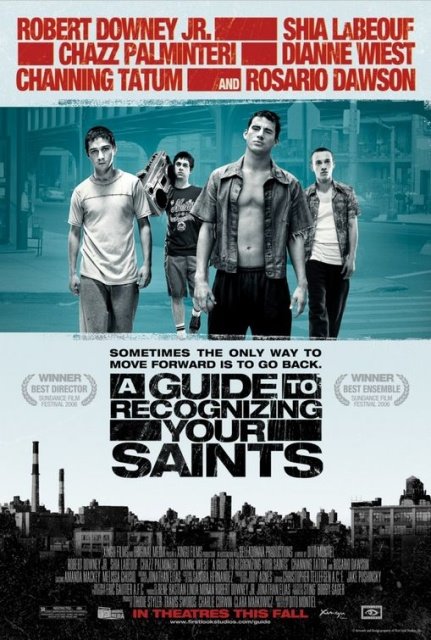
A Guide To Recognizing Your Saints
First time director Dito Montiel’s “A Guide To Recognizing Your Saints” is a harsh autobiographical look back at his youth on the mean streets of Astoria, Queens in the mid 1980’s. From the film’s opening moments, Montiel introduces us to an intimate world of family and friendship that totally blindsided me by its greatness. Opening in 2005, Dito (played in adulthood by Robert Downey Jr in yet another devastatingly perfect incarnation) lives as a writer in Los Angeles who’s just written the film’s title. He receives a phone call from his mother (Dianne Wiest) letting him know that his father, Monty, (Chazz Palminteri) is sick and won’t go to the hospital. This, of course, opens up a floodgate of memories for Dito as he flashes back to his younger, wilder days and hops a plane for home. We quickly meet his close group of childhood friends, Antonio (Channing Tatum) is the volatile Robert DeNiro of the group- and while this comparison seems naïve, Turner embodies a hulking character whose violence and strong headed machismo resonates deeply throughout the film- Nerf (Scott Campbell), Joey (Kyle Benitz) and Mike (Martin Compston) a transplanted Scottish boy who plants the seeds of journey into young Dito (Shia Lebouf). And where would a story like this be without first love, tenderly rendered by Diane(Melonie Diaz) the pretty girl whom Dito sneaks up the fire escape for nightly. The conflict comes from familiar sources too, such as the clash of cultures within the neighborhood that pits these five against a Puerto Rican group whose graffitti vandalism encroaches on their turf. But handled more subtly is the dynamics between Monty and Dito- we often get the sense that Dito and his father are more friends than father and son and Monty seems over-affectionate to Antonio, who himself suffers from an abusive relationship with his own father. There are moments in “A Guide To Recognizing Your Saints” that roll along with such force and emotion, that Montiel feels like a natural born filmmaker, infusing his personal heartache into strong characters breathing within a vivid time and place. Montiel’s handling of edits, sound, and music are also powerful, such as a scene in Dito’s kitchen between his father and group of friends that explodes into stark images and quick cuts to black. Montiel also handles the return home of Downey Jr. with care and vulnerability, searching for small answers that come in revelatory conversations with his mother and grown up Dianne (played by Rosario Dawson). And while such personal material can be hard to translate without lapsing into melancholy, Montiel finds a way to craft a clear eyed version of his life, allowing strong acting and electric filmmaking to take over the balance of the experience. I love finding unheralded gems such as this. The name of Robert Downey Jr. brought me to the theater and I discovered a true talent in Dito Montiel who has crafted one of the finest directing debuts in several years.
The Prestige
With five films under his belt, its been amazing to see director Christopher Nolan grow as a filmmaker (although to be honest, with a film like "Memento" as your second film, I suspect there was very little growth, simply the need for discovery for a talent already in progress). "The Prestige" takes its cue from the fractured narrative of "Memento", pitting two magicians (Hugh Jackman and the consummate Christian Bale) against each other in narcissistic and ultimately violent methods of one-up-manship. Even though we've already experienced one feature this year charting the contrivances of 19th century magicians in Neil Burger's "The Illusionist", Nolan's film is a bit more cynical and looks a helluva lot better. And then you have David Bowie embodying Nikolas Tesla... who could ask for more? "The Prestige" is thoroughly enthralling and continually forces you to pay attention as it skips back and forth in time and place.
Marie Antoinette
Sophia Coppola's "Marie Antoinette" is a nice companion piece to "Lost In Translation"- both films deal with anachronisms, a person impeding on a culture with observer-like status, often caught with a what-the-hell-am-I-doing-here stare. And like "Lost in Translation", Coppola feels right at home in documenting the listlessness of her main characters, freeing the narrative from strict plots and subplots, employing her camera to leisurely capture stunning images of life in a constant motion even when there's no purpose. I didn't want a history lesson, and "Marie Antoinette" certainly isn't that. Kirsten Dunst flits through the film in airy, charming ways. Her Marie is a kid in a candy factory, thrust into royal stature without any sense the implications her spending and nonchalant days in the country will eventually have on her people. And, gladly, those days of violent overthrown= are rendered in just 5 minutes of screentime at the end of the film. We've seen too many historical lessons, and Coppola's film, instead, chooses to create a punk rock version of the French queen, full of gorgeous sets and humble humor (and some startling images timed to 80's hits).
Thursday, October 19, 2006
Calling all lists!
OK, so this is my feeble attempt at kickstarting a blog-a-thon of sorts. I'm inviting all fellow bloggers to post a list of their 15 favorite horror films on their respective blogs. Now I say "favorite" but one can interpret to mean "scariest", "most disturbing", "the films that scarred me for life".. whatever floats your boat. On October 30th, I'll publish mine here and include links of the blogs that decide to participate. You can either e-mail your link to Henryhill51@aol.com or reply here in the comments section by October 29th.
Wednesday, October 18, 2006
Tuesday, October 10, 2006
The Departed
I’m terrible at writing about a filmmaker that I adore quite like Martin Scorsese. It’s so easy to get wrapped up in the hyperbole. And I’m afraid I can’t avoid that pitfall here. His latest, “The Departed” is an electric experience, scurrying back to the violent streets that once made him famous. This is Scorsese at his most playful. Like “Bringing Out the Dead”, “The Departed” throws caution to the wind and belts out a wildy energetic pace that’s matched in strong, calculated performances from all involved. That’s all I can muster to write about this one so far. I watched it twice over the weekend and can’t wait to experience it again. If only every year I could have a Malick film and a Scorsese film top out my favorites of the year.
Exploitation Pick! Blood Sucking Freaks
I’ll lay my intentions bare- I love exploitation and grindhouse flicks. I think one has to take into consideration two aspects when one watches these types of films: 1) they’re usually a product of their environment. What I mean by this is that you cannot expect more than a limited budget, horrendous dubbing, poor acting and a diabolical (if not cheap) sense of humor. These types of films were often produced with little funding, limited equipment and actors on loan or leave from more mainstream projects. In fact, this crudeness derived from minimal means often lends an air of perverse sleaze to the entire project. 2) They hardly ever take themselves seriously. The best future for a grindhouse film was to find an interactive audience in a New York slum theater and play for 2-3 months to the lowest common denominator of the movie-going public. That was the measure of success with this genre. With that in mind, the overwhelming goal of the grindhouse film was not to make explicit any political or social messages (although that was a joyous byproduct of some of the best) but to simply entertain. The reason that Troma films are more entertaining than say, films such as “See No Evil” or “The Darkness” is that they don’t ever take themselves too seriously. The emphasis is on entertaining rather than scaring. So, with that said, I’ve made it my pre-new year resolution to see as many of these flicks as possible. Films like “Blood Sucking Freaks”, “Don’t Go In the House”, “The House on the Edge of the Park”, “Thriller, a Crude Picture”, “The Candy Snatchers”, “Isla films”.. the list is endless. And what better way to initiate this resolution than with Joel Reed’s “Blood Sucking Freaks”. This film epitomizes the above criteria- filmed in 10 days in the basement of Reed’s house with actors on loan from soap operas and various other low budget projects and using every last bit of film (i.e. certain exterior shots giving off that sputter that indicates the cameraman was using ends of film reels). Seamus O Brien plays Sardu, the ringleader of a troupe of rejects that orchestrates off-off-Broadway shows of the macabre using real life victims. His right hand man, Ralphus (played by a black midget with an afro named Luis de Jesus) is sheer delight from start to finish, whether he’s enjoying a decapitated woman’s head giving him oral pleasure or throwing pieces of chicken into the cage of naked women held hostage, de Jesus is a walking comedy, sincerely playing up the weirdness of his character. And I wonder if this is where the inspiration for the character played by Dennis Hopper in “The Texas Chainsaw Massacre 2” springs from? Black midgets with afros aside, “Blood Sucking Freaks” rolls along with little regard for consistency or logic. In one scene, while a police detective talks to a famous football player (played by Niles McMaster) about the disappearance of his girlfriend, why does the football player have his shirt off, combing his hair in front of a mirror? And why doesn’t the detective question this? Because in the world of exploitation, you learn to question nothing. “Blood Sucking freaks”, filmed in New Jersey in 1976, capsizes the mores of decency and explodes across the screen with giddy dementia. Isn’t that what exploitation is all about? Rent it now.
I’m terrible at writing about a filmmaker that I adore quite like Martin Scorsese. It’s so easy to get wrapped up in the hyperbole. And I’m afraid I can’t avoid that pitfall here. His latest, “The Departed” is an electric experience, scurrying back to the violent streets that once made him famous. This is Scorsese at his most playful. Like “Bringing Out the Dead”, “The Departed” throws caution to the wind and belts out a wildy energetic pace that’s matched in strong, calculated performances from all involved. That’s all I can muster to write about this one so far. I watched it twice over the weekend and can’t wait to experience it again. If only every year I could have a Malick film and a Scorsese film top out my favorites of the year.
Exploitation Pick! Blood Sucking Freaks
I’ll lay my intentions bare- I love exploitation and grindhouse flicks. I think one has to take into consideration two aspects when one watches these types of films: 1) they’re usually a product of their environment. What I mean by this is that you cannot expect more than a limited budget, horrendous dubbing, poor acting and a diabolical (if not cheap) sense of humor. These types of films were often produced with little funding, limited equipment and actors on loan or leave from more mainstream projects. In fact, this crudeness derived from minimal means often lends an air of perverse sleaze to the entire project. 2) They hardly ever take themselves seriously. The best future for a grindhouse film was to find an interactive audience in a New York slum theater and play for 2-3 months to the lowest common denominator of the movie-going public. That was the measure of success with this genre. With that in mind, the overwhelming goal of the grindhouse film was not to make explicit any political or social messages (although that was a joyous byproduct of some of the best) but to simply entertain. The reason that Troma films are more entertaining than say, films such as “See No Evil” or “The Darkness” is that they don’t ever take themselves too seriously. The emphasis is on entertaining rather than scaring. So, with that said, I’ve made it my pre-new year resolution to see as many of these flicks as possible. Films like “Blood Sucking Freaks”, “Don’t Go In the House”, “The House on the Edge of the Park”, “Thriller, a Crude Picture”, “The Candy Snatchers”, “Isla films”.. the list is endless. And what better way to initiate this resolution than with Joel Reed’s “Blood Sucking Freaks”. This film epitomizes the above criteria- filmed in 10 days in the basement of Reed’s house with actors on loan from soap operas and various other low budget projects and using every last bit of film (i.e. certain exterior shots giving off that sputter that indicates the cameraman was using ends of film reels). Seamus O Brien plays Sardu, the ringleader of a troupe of rejects that orchestrates off-off-Broadway shows of the macabre using real life victims. His right hand man, Ralphus (played by a black midget with an afro named Luis de Jesus) is sheer delight from start to finish, whether he’s enjoying a decapitated woman’s head giving him oral pleasure or throwing pieces of chicken into the cage of naked women held hostage, de Jesus is a walking comedy, sincerely playing up the weirdness of his character. And I wonder if this is where the inspiration for the character played by Dennis Hopper in “The Texas Chainsaw Massacre 2” springs from? Black midgets with afros aside, “Blood Sucking Freaks” rolls along with little regard for consistency or logic. In one scene, while a police detective talks to a famous football player (played by Niles McMaster) about the disappearance of his girlfriend, why does the football player have his shirt off, combing his hair in front of a mirror? And why doesn’t the detective question this? Because in the world of exploitation, you learn to question nothing. “Blood Sucking freaks”, filmed in New Jersey in 1976, capsizes the mores of decency and explodes across the screen with giddy dementia. Isn’t that what exploitation is all about? Rent it now.
Wednesday, October 04, 2006
Music To the People!
Thanks Brad for sending me this. I know a few people out there who will appreciate the selection. You're one click away from internet radio around the globe. Dutch alternative station? It's there. Brazilian reggea? It's there. God bless the Internet. Highlight this link, save it, use it.
Friday, September 29, 2006
RIP Mr Nelson

News came late on Tuesday evening about the death of professional golf legend Byron Nelson at age 94. The next day, his passing was unjustifiably marginalized by the diva-esque dramatics of another local professional athlete (whose name I won’t even bothering mention, but not because I’m bitter, but because I’m a staunch Tennessee Titans fan). Sad. Lord Byron Nelson will be missed both as a presence in the golf world and for his unwavering support of local Dallas athletics.
The remarkable aspect of Nelson’s career is thoroughly documented in print. the PGA Tour.com website sums up his career in retrospect with the fact that his records set within the golf world in 1945 sum up a truly remarkable season. That year, he won 18 tournaments, capturing 31 of 54 events during the years of 1944 and 1945. He won a total of 52 events in his career, winning Major Championships in 1937 (Masters), 1939 (US Open), 1942 (Masters) and 1940 and 1945 (PGA).
Compare that with the scratching and clawing that Tiger Woods has done this year by winning 5 in a row, and that feat stands as an even greater accomplishment, especially when one takes into consideration the rudimentary construction of equipment and balls in his day.
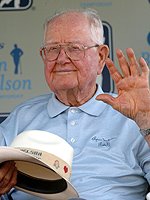
My own experience with Nelson was a little personal. His PGA tour event, the Byron Nelson Invitational, occurs every spring here in Dallas. About 7 years ago, I attended the tournament and made it my first ever professional golf event. A good friend and I wandered around for a couple of hours and then grew weary of the inconsistent views on various holes. We made our way to the eighteenth fairway and found ourselves a spot on the side of the fairway about 275 yards from the tee box and approximately 150 yards from the expansive eighteenth green. Not only did we have a perfect view of 90% of the golfers as they drove the ball down the fairway (about 10 feet from Tiger when he stuck it in the rough and about 20 feet from Phil Mickelson) but we could peer up the fairway and, with binoculars, see the tent that Lord Nelson and his wife called home for those 4 days, perched ever so preciously off the back of the green in clear view of the days action. Of course, it was customary for the golfer to finish his round, exit the green and immediately pay his regards to Lord Nelson up in his make shift skybox. The respect and emotion of the players as they shook his hand and spoke a few words was palpable. It was a once-in-a-lifetime thing to see. The event was also memorable for me because I was hit in the forearm by a golf ball from player Ben Crane, and had a 3 foot view of the shot as he played his second shot (alas, I was not on TV). He would finish 2nd in the event. Still, even a shot in the body with a golf ball doesn’t out weigh the memorable tradition that comes with being part of an event sponsored by the good will and good graces of such an enormous personality within the world of golf.
Thursday, September 21, 2006
Out There Video

The joys of DVD are wild and varied. Between companies like Blue Underground and Anchor Bay, long lost cult classics are seeing the light of day. Another upstart video production company, Tartan Video continually dazzles the market with releases that alternate between Asian gems (known as Asia Extreme) to American grindhouse experiments. Within the last eight months, Tartan video has released films onto commercial American shelves (i.e. Blockbuster video) that expose visions from internationally recognized auteurs like Chan Wook Park and Takashi Miike. But the real niche of Tartan video is the odd surprise from lesser known gems, such as Kelvon Tong's "The Maid" and Kong Su-Chang's "R-Point". Tartan video also seems to own the distribution rights to a majority of Kim Ki Duk's work. Though I'm not a fan of Duk's usually obscene and intellectually challenged ouevre, the opportunity to hold this negative opinion of this Korean filmmaker is, in itself, largely due in part to the surprising availibility of his work. How can one expect to carry any opinion about something without ever having the opportunity to view it? That's the real advantage given to cinema lovers from Tartan video- love it or hate it, at least they're one of the few distribution companies giving audiences glimpses at the alternative.
As mentioned above, Tartan video doesn't limit itself to Asian oddities. In it's vast catalog also exists a variety of lost classics, either due to rights, content, or the lack of a viable audience outside of New York's Times Square. Probably the most indispensable release from them within the last year was Victor Janos "Last House On Dead End Street". Filmed and released (barely) in 1977, this grindhouse classic came and went. Generally regarded as the film of a madman, the director's name, Janos, never appeared on another film. Some people believed the story and images were based on fact. Some of the film's porn loops, interspersed throughout the film, may have been actual images from this director's own snuff film. The truth was that "Last House On Dead End Street" was financed independently from Roger Watkins, a porn producer who worked up into the 80's. The bottom line is that the film itself- a host of bad acting, stark brutality and poor editing- ingrained all that was nasty and vile about the American grindhouse cinema. It represented the opposite of traditional American film- financed, produced and marketed to the lowliest common denominator of the movie-going public and dumped into theaters in certain red light sections of large cities. Now seen, largely, as the fore runner to the independent movement of the late 80's and early 90's, a majority of these films truly didn't deserve a release. But the ones that survive, such as "Last House On the Left", now employ a home on smaller labels such as Tartan video. Once again, whether you decide to rent and give into the unrelenting nastiness on the screen is your own choice, but it's gratifying that it's there if you wish to.

If anyone senses a theme here, it's that I hold a fairly democratic view on things. More options, for better or worse, can never be a bad thing. When you look over the catalog of companies like Tartan or No Shame, which dedicates its release slate to an even higher degree of esoteric films than Tartan, one can't help but feel alive over the possibility of viewing choices outside the mainstream. Whether grindhouse or Italian crime films are your bag, baby, the option is there. Unlike niche markets or art house cinemas that dot the landscape in ever-growing minorities, at least 80% of my movie watching now occurs on DVD. This is not due to a lack of good 'new movies' as so many of the public loves to decry. I live within 10 miles of 2 art house theaters, but the choice of trudging out in traffic, paying eight dollars and having someone knee me in the back or spill popcorn on me pales in comparison to the small pleasures of lining up titles in my Netflix queue and discovering a new talent like Jun Hwung Jan's sci-fi head splitter "Save the Green Planet" or savoring the ugliness of the Paul Morrisey/Warhol "Blood For Dracula" and "Flesh For Frankenstein". That just sounds much better. Right? And all of the mentioned titles are available from Tartan. Check them out.
Sunday, September 17, 2006
4
The Black Dahlia
There's a frustrating dichotomy to the cinema of Brian De Palma. His films, often visually arresting, sometimes fall short due to his overheated passion for cinematic mythologies. The glorious failures of his career succumb to an outdated sense of cinema that don't play well in modern multiplexes. The best of his career, “Carlito’s Way”, “The Untouchables”, “Blow Out” and “Obsession”, survive due to a number of anomalies- respectively the sheer presence of Al Pacino, the noble set piece of a train station and a Canadian bridge, the precise tension of the thriller narrative juxtaposed with bravura editing, and ripe sexuality blown to excessive proportions. Whether De Palma is channeling Hitchcock or not, he’s a modern filmmaker deeply in love with a style and a voice that long ago left the aisle. And that’s probably why his latest, “The Black Dahlia” feels like a mis-fire. Everyone is playing it straight, as if this really were 1947. Scarlet Johansson fairs a lot worse than the male leads (holding a cigarette ever so daintily, and saddled with some of the film’s worst dialogue) and De Palma is never able to hold a steady tone throughout. The final fifteen minutes veers wildly into ‘camp’ territory, feeling much closer to the acidic finale of “Sunset Boulevard” than the 120 minute thriller that has come before it. De Palma wants to create a 2006 film reincarnated from the black and white noir world of the 40’s, and the film itself suffers from his wild impulse to copy the past. There are several inventive ideas here though- namely the 360 degree crane shot up over a building, lingering on a body in a grassy field, a woman walking by and discovering the body and back around the alley onto a car in which the film’s two leads, Josh Hartnett and Aaron Eckhart, sit. De Palma hasn’t lost his flair for the technical, but some heart and emotional investment in the characters becomes stale. And, I couldn’t forgive myself if I didn’t mention the work of Mia Kirshner here as Elizabeth Short. Her role is no more than 10 minutes of screen time, composed in grainy black and white images from a screen test she supposedly shot before becoming Los Angeles’ great unsolved mystery, but her performance brims with sexuality and warmth. If you don’t know who she is, I beg you to check out her early Canadian films, Exotica and Love and Human Remains. But be warned, I saw her first. I certainly intend to dedicate some space to her in an upcoming article. Perhaps "The Black Dahlia", much like De Palma's recent "Femme Fatale", will grow on me with time. There's a madness at work here- the way the actual murder becomes a subtext for perverse (unspoken) love triangles and deep-seated insecurities between Hartnett, Johannson and Eckhart.... the way sexual impulses, both homosexual and heterosexual, seethes throughout every frame... the introduction of a Hollywood family that grows weirder with each passing minute....confronted with this upon a first viewing can be a harsh experience when one halfway expects a policier thriller mixed with that keen De Palma flair for long tracking shots and hidden glimmers of suspense. Instead, things get very screwy and, maybe, that's what De Palma wanted. Knowing that, next time maybe I can sit back and enjoy the retro ride for what it is.
Dead Man's Shoes
I've only seen one other film from director Shane Meadows, and I'd be lying if I didn't admit that his latest, "Dead Man's Shoes" has kindled an interest in seeking out his other 3 works. Starring Paddy Considine, he plays a soldier who returns home from the army and systematically begins to track down 6 men from the neighborhood who absused his mentally challenged brother. That's all to the plot. Director Meadows infuses nothing with great style, eliciting a dominating performance from Considine. Just watch the hatred brewing beneath the surface when one of the men he's hunting comes up to him on the street and they have a casual conversation. Considine exhibits great presence throughout the entire film and even though the ending feels like a letdown after the mood of the first 80 minutes, "Dead Man's Shoes" is a terrific little movie. It also boasts an outstanding and atmospheric soundtrack from bands such as Aphex Twin, Smog and The Earlies.
Half Nelson
Garnered with strong reviews since playing at Sundance back in January, Ryan Fleck's "Half Nelson" is one of those 'independent' type movies that usually gets praised for its incendiary topic (drug abuse) while maintaining a visual scheme full of handheld photography and artsy editing. Well, "Half Nelson" has all of that but the film succeeds exceptionally well in part due to the performances of Ryan Gosling as a teacher struggling with addiction and the 13 year old student who finds out about his heart of darkness. The key to the film's acceptance for me, though, lies in the untypically impressive performance of 13 year old Shareeka Epps, a young actress who doesn't do too much, yet creates an aura of realism about her presence throughout the film. Gosling plays a teacher in a Brooklyn high school and moonlights as a crack addict, trading meaningful relationships for a bar stool on a nightly basis. He also coaches the girl's basketball team and one night after practice, Drey (Epps) finds him smoking crack in the locker room. What follows could be easily dismissed as uncertain or ill-fated melodramatics, but Gosling and Epps make it work. There's a moment towards the end of the film where teacher and student meet in a very disturbing point in both their lives, and the scene works due to the honesty displayed from both actors. In fact, this is a film that understands the importance of building naturalism slowly- the way Gosling interacts with his students, the way a visit to a family dinner signals so much about the past and where we come from, and the disregard that we fling ourselves into when an old flame returns engaged to someone else- these are all great moments in one of the year's very best films.
Hollywoodland
The second vintage murder mystery taking place beneath the luminous Hollywood sign in 2 weeks, Allen Coulter's directorial debut surrounds itself with classy acting and elegant cinematography, but it's ultimately lifeless. Adrien Brody plays Louis Cima, a private detective attemtping to determine whether the death of Superman George Reeves (Ben Affleck, fresh off his "huh?" win as best actor at the Venice Film Festival for this performance) in 1959 really was suicide. Though the film rolls out several plausible examples, it eventually ducks all these possibilities and resigns itself to play it safe where Hollywood legend is concerned and emphasize the hopelessness of its two male characters- one already lost and the other (maybe) saved.
There's a frustrating dichotomy to the cinema of Brian De Palma. His films, often visually arresting, sometimes fall short due to his overheated passion for cinematic mythologies. The glorious failures of his career succumb to an outdated sense of cinema that don't play well in modern multiplexes. The best of his career, “Carlito’s Way”, “The Untouchables”, “Blow Out” and “Obsession”, survive due to a number of anomalies- respectively the sheer presence of Al Pacino, the noble set piece of a train station and a Canadian bridge, the precise tension of the thriller narrative juxtaposed with bravura editing, and ripe sexuality blown to excessive proportions. Whether De Palma is channeling Hitchcock or not, he’s a modern filmmaker deeply in love with a style and a voice that long ago left the aisle. And that’s probably why his latest, “The Black Dahlia” feels like a mis-fire. Everyone is playing it straight, as if this really were 1947. Scarlet Johansson fairs a lot worse than the male leads (holding a cigarette ever so daintily, and saddled with some of the film’s worst dialogue) and De Palma is never able to hold a steady tone throughout. The final fifteen minutes veers wildly into ‘camp’ territory, feeling much closer to the acidic finale of “Sunset Boulevard” than the 120 minute thriller that has come before it. De Palma wants to create a 2006 film reincarnated from the black and white noir world of the 40’s, and the film itself suffers from his wild impulse to copy the past. There are several inventive ideas here though- namely the 360 degree crane shot up over a building, lingering on a body in a grassy field, a woman walking by and discovering the body and back around the alley onto a car in which the film’s two leads, Josh Hartnett and Aaron Eckhart, sit. De Palma hasn’t lost his flair for the technical, but some heart and emotional investment in the characters becomes stale. And, I couldn’t forgive myself if I didn’t mention the work of Mia Kirshner here as Elizabeth Short. Her role is no more than 10 minutes of screen time, composed in grainy black and white images from a screen test she supposedly shot before becoming Los Angeles’ great unsolved mystery, but her performance brims with sexuality and warmth. If you don’t know who she is, I beg you to check out her early Canadian films, Exotica and Love and Human Remains. But be warned, I saw her first. I certainly intend to dedicate some space to her in an upcoming article. Perhaps "The Black Dahlia", much like De Palma's recent "Femme Fatale", will grow on me with time. There's a madness at work here- the way the actual murder becomes a subtext for perverse (unspoken) love triangles and deep-seated insecurities between Hartnett, Johannson and Eckhart.... the way sexual impulses, both homosexual and heterosexual, seethes throughout every frame... the introduction of a Hollywood family that grows weirder with each passing minute....confronted with this upon a first viewing can be a harsh experience when one halfway expects a policier thriller mixed with that keen De Palma flair for long tracking shots and hidden glimmers of suspense. Instead, things get very screwy and, maybe, that's what De Palma wanted. Knowing that, next time maybe I can sit back and enjoy the retro ride for what it is.
Dead Man's Shoes
I've only seen one other film from director Shane Meadows, and I'd be lying if I didn't admit that his latest, "Dead Man's Shoes" has kindled an interest in seeking out his other 3 works. Starring Paddy Considine, he plays a soldier who returns home from the army and systematically begins to track down 6 men from the neighborhood who absused his mentally challenged brother. That's all to the plot. Director Meadows infuses nothing with great style, eliciting a dominating performance from Considine. Just watch the hatred brewing beneath the surface when one of the men he's hunting comes up to him on the street and they have a casual conversation. Considine exhibits great presence throughout the entire film and even though the ending feels like a letdown after the mood of the first 80 minutes, "Dead Man's Shoes" is a terrific little movie. It also boasts an outstanding and atmospheric soundtrack from bands such as Aphex Twin, Smog and The Earlies.
Half Nelson
Garnered with strong reviews since playing at Sundance back in January, Ryan Fleck's "Half Nelson" is one of those 'independent' type movies that usually gets praised for its incendiary topic (drug abuse) while maintaining a visual scheme full of handheld photography and artsy editing. Well, "Half Nelson" has all of that but the film succeeds exceptionally well in part due to the performances of Ryan Gosling as a teacher struggling with addiction and the 13 year old student who finds out about his heart of darkness. The key to the film's acceptance for me, though, lies in the untypically impressive performance of 13 year old Shareeka Epps, a young actress who doesn't do too much, yet creates an aura of realism about her presence throughout the film. Gosling plays a teacher in a Brooklyn high school and moonlights as a crack addict, trading meaningful relationships for a bar stool on a nightly basis. He also coaches the girl's basketball team and one night after practice, Drey (Epps) finds him smoking crack in the locker room. What follows could be easily dismissed as uncertain or ill-fated melodramatics, but Gosling and Epps make it work. There's a moment towards the end of the film where teacher and student meet in a very disturbing point in both their lives, and the scene works due to the honesty displayed from both actors. In fact, this is a film that understands the importance of building naturalism slowly- the way Gosling interacts with his students, the way a visit to a family dinner signals so much about the past and where we come from, and the disregard that we fling ourselves into when an old flame returns engaged to someone else- these are all great moments in one of the year's very best films.
Hollywoodland
The second vintage murder mystery taking place beneath the luminous Hollywood sign in 2 weeks, Allen Coulter's directorial debut surrounds itself with classy acting and elegant cinematography, but it's ultimately lifeless. Adrien Brody plays Louis Cima, a private detective attemtping to determine whether the death of Superman George Reeves (Ben Affleck, fresh off his "huh?" win as best actor at the Venice Film Festival for this performance) in 1959 really was suicide. Though the film rolls out several plausible examples, it eventually ducks all these possibilities and resigns itself to play it safe where Hollywood legend is concerned and emphasize the hopelessness of its two male characters- one already lost and the other (maybe) saved.
Sunday, September 10, 2006
Short Cuts
Idiocracy
Mike Judge’s “Idiocracy” is not subtle satire or black comedy- it’s a fairly exaggerated yarn that intends to lambaste everything from corporate sponsorship to the rapid mutation of redneck families. And, while the film comes off as inept some times in look and tone, Judge strikes some pretty decent jokes along the way (such as a vending machine that shoots out food and says “here comes your giant ass fries” and then “for twenty bucks extra, do you want a giant ass taco?”) Luke Wilson plays Joe, an average military man who’s chosen for a special experiment due to his above average “averageness” and lack of family who’ll miss him. Maya Rudolph is a hooker who gets paid for her services. They think the army is planning on hibernating them for a year to test out the feasibility of preserving life. Things don’t go so well. The experiment is abruptly shut down and they’re left frozen for 500 years and when they awake, the world has dumbed-down dramatically and Joe and Maya become the smartest people on earth. The President is an ex porn star and WWE wrestling figure while society has degenerated into leaving huge piles of garbage around, and creating media that supply man’s basic needs- food and sex (such as a Masturbation channel and the idea that water is only found in toilets and the drink of choice is a Gatorade-like drink because “it has electrolytes!”) Like I mentioned earlier, Judge hits some striking moments with his humor throughout the film, but the presence of Dax Shepherd as Joe’s accomplice along the way brings things down dramatically and Maya Rudolph seems to be reaching in a lot of her performance. In “Office Space”, the acting was spot-on, creating vivid characters that arched the story along in unsuspecting and generous ways. In “Idiocracy”, Judge relies on the outrageous themes to overshadow the human element, and it wears out its welcome pretty fast. This isn’t a disaster, just a disappointment.
The Wicker Man
Another disappointment… oh hell who am I kidding- we all knew this one was bad. Neil Labute’s “The Wicker Man” enticed me by the fact it could present some unsettling moments and somehow enrich the bland 1973 film of the same title, but this was even worse than I imagined. I’ll say this once. I do not get Nicolas Cage. I can’t think of a single performance since his off kilter turn in “Peggy Sue Got Married” and his marginal stint in “Bringing Out the Dead” that I’ve liked. He seems false, unsure of himself in every performance. I scratched my head over enormous praise lauded him in films like “Adaptation” and “The Weather Man”, and wanted to close my ears every time he spoke in “World Trade Center”. Here he plays a California highway patrol police office lured to the Pacific Northwest by an ex-fiance who claims to be missing her daughter in a hippie-like commune. Sure…. I’d fly out there right away too. People start dying, Cage starts to go a little nutty and he yells at a woman via gunpoint to “step away from the bike!” And not a motorcycle, but a bicycle. Things get even worse when he puts on a bear costume and begins to run around the country side looking for this little girl. It’s awful I tell you. “The Wicker Man” is the type of film that movie-goers dread- it has little intelligence and even less care for giving the audience anything striking or original.
The Illusionist
Probably the best film of this little bunch has to be Neil Burger’s “The Illusionist”, boasting an all star cast of Edward Norton as the “magician” Eisenheim and Paul Giamatti as the chief inspector determined to uncover the supposedly naturalistic devices of Eisenheim’s tricks. Filmed with great care and beauty by Dick Pope and scored by one of my favorite composers, Philip Glass, “The Illusionist” builds terrific suspense out of a complex little story. Even though it eventually telegraphs its conclusion, the journey is highly enjoyable and Edward Norton and Giamatti display great chemistry
Mike Judge’s “Idiocracy” is not subtle satire or black comedy- it’s a fairly exaggerated yarn that intends to lambaste everything from corporate sponsorship to the rapid mutation of redneck families. And, while the film comes off as inept some times in look and tone, Judge strikes some pretty decent jokes along the way (such as a vending machine that shoots out food and says “here comes your giant ass fries” and then “for twenty bucks extra, do you want a giant ass taco?”) Luke Wilson plays Joe, an average military man who’s chosen for a special experiment due to his above average “averageness” and lack of family who’ll miss him. Maya Rudolph is a hooker who gets paid for her services. They think the army is planning on hibernating them for a year to test out the feasibility of preserving life. Things don’t go so well. The experiment is abruptly shut down and they’re left frozen for 500 years and when they awake, the world has dumbed-down dramatically and Joe and Maya become the smartest people on earth. The President is an ex porn star and WWE wrestling figure while society has degenerated into leaving huge piles of garbage around, and creating media that supply man’s basic needs- food and sex (such as a Masturbation channel and the idea that water is only found in toilets and the drink of choice is a Gatorade-like drink because “it has electrolytes!”) Like I mentioned earlier, Judge hits some striking moments with his humor throughout the film, but the presence of Dax Shepherd as Joe’s accomplice along the way brings things down dramatically and Maya Rudolph seems to be reaching in a lot of her performance. In “Office Space”, the acting was spot-on, creating vivid characters that arched the story along in unsuspecting and generous ways. In “Idiocracy”, Judge relies on the outrageous themes to overshadow the human element, and it wears out its welcome pretty fast. This isn’t a disaster, just a disappointment.
The Wicker Man
Another disappointment… oh hell who am I kidding- we all knew this one was bad. Neil Labute’s “The Wicker Man” enticed me by the fact it could present some unsettling moments and somehow enrich the bland 1973 film of the same title, but this was even worse than I imagined. I’ll say this once. I do not get Nicolas Cage. I can’t think of a single performance since his off kilter turn in “Peggy Sue Got Married” and his marginal stint in “Bringing Out the Dead” that I’ve liked. He seems false, unsure of himself in every performance. I scratched my head over enormous praise lauded him in films like “Adaptation” and “The Weather Man”, and wanted to close my ears every time he spoke in “World Trade Center”. Here he plays a California highway patrol police office lured to the Pacific Northwest by an ex-fiance who claims to be missing her daughter in a hippie-like commune. Sure…. I’d fly out there right away too. People start dying, Cage starts to go a little nutty and he yells at a woman via gunpoint to “step away from the bike!” And not a motorcycle, but a bicycle. Things get even worse when he puts on a bear costume and begins to run around the country side looking for this little girl. It’s awful I tell you. “The Wicker Man” is the type of film that movie-goers dread- it has little intelligence and even less care for giving the audience anything striking or original.
The Illusionist
Probably the best film of this little bunch has to be Neil Burger’s “The Illusionist”, boasting an all star cast of Edward Norton as the “magician” Eisenheim and Paul Giamatti as the chief inspector determined to uncover the supposedly naturalistic devices of Eisenheim’s tricks. Filmed with great care and beauty by Dick Pope and scored by one of my favorite composers, Philip Glass, “The Illusionist” builds terrific suspense out of a complex little story. Even though it eventually telegraphs its conclusion, the journey is highly enjoyable and Edward Norton and Giamatti display great chemistry
Friday, September 08, 2006
Sunday, September 03, 2006
Season 5- Curb Your Enthusiasm

With the amount of blockbuster television shows produced by HBO each year, it could be easy for a 30 minute comedy to slip through the cracks against the more epic-themed and dramatically composed character pieces of “The Sopranos”, “Rome” and “Deadwood”. But “Curb Your Enthusiasm” hasn’t been lost, but widened and grown in popularity with each new season on HBO. This is one of my favorite shows ever produced. Each episode is written with precision and wit, where one little line of dialogue in the first 2 minutes will almost certainly come into play (often with potentially disastrous results) in the last 2 minutes. Writer and star Larry David has an uncompromising knack for creating plotlines that snake around themselves and come full circle in hilarious and unpredictable ways. I’ve heard friends and critics say Larry’s character in “Curb Your Enthusiasm” (if you can call it a character since Larry plays himself as himself) is an asshole… and that encompasses so much of what works for the show. Larry continually takes shots at himself and very rarely does anything work out for him. The latest season pits Larry in some of the more conflicting situations of the show’s history, giving him a search for his possible real parents (the theory being that he’s adopted) and placing himself amidst a moral quandary, one in which he must decide whether to give his friend, Richard Lewis, a life saving kidney transplant. The mileage out of both of these subplots is gradually tightened into a season finale that is so brilliant, I won’t even give you a tease as to what happens. See it for yourself. And if the above poster doesn't tell you that Larry David has a supreme sense of humor about himself, then you don't get it.
Saturday, August 26, 2006
An Appreciation- Alan Clarke
Veteran British director Alan Clarke probably became more famous after American director Gus Van Sant pinched a few visual ideas (as well as a title) for his 2004 film “Elephant”, in which Van Sant elegantly and systematically tracks several students around the halls of Columbine high school on that fateful day. Clarke’s 1989 film, also called “Elephant” (as in the elephant in the room) concedes some of the same lofty ideas, complete with gloriously timed long tracking shots and a subject just as systematic- 16 different random acts of violence in Northern Ireland. No words, no names… just 16 vignettes of a man (or men) slowly stalking their unwitting prey through a maze of vacant buildings, alleyways, open fields and convenient stores, ending with a gunshot and a long, static take over the dead body. The idea sounds pretentious, but Clarke infuses the film with tension and such a precise sense of logistics, that “Elephant” slowly evolves into an experimental meditation on the limits of senseless violence. “Elephant” was Clarke’s last film. His first, entitled “Scum” (1979) stars a young Ray Winstone (obviously preparing for future roles that feature him as a one-man wrecking crew of fury and self-hate) as a young man sent to a reformatory. Like a few other Clarke films, the main theme here is the indoctrination of youth into a hopeless feeling of institutionalization and violent retribution, locked away from society and scrapping at the fringes of normal behavior. The story concerns Winstone and several other men as they learn to cope with life in this jail. At first, Winstone wants no trouble, but he soon learns that to be the “daddy” of this hell means life or death. Clarke strips away all pretensions, creating a sober, practical film that gives a touch of humanity to some vile people. The same cannot be said of Tim Roth as Trevor in “Made In Britain” (1982), who’s just vile. Making his screen debut, Roth plays Trevor the Skinhead with snarling, passionate conviction. Put into a half-way house for delinquents for ‘assessment’ he routinely sneaks out, continues to steal cars and break the business windows of Pakistani immigrants. Pre-dating the relentless handheld camera style of the Dardenne Brothers, Clarke’s film again delineates the line between youth and institutionalized authority. There’s a brilliant scene where a man lays out Trevor’s life on a chalkboard, rationalizing every aspect of his life. It’s probably the most honest presentation of where (and how easily) we may go wrong in life ever presented on the screen. Clarke’s penchant for long takes and lengthy steadicam shots again gets fair play in “Made in Britain” and it boasts a finale that is as nihilistic as its protagonist. Lastly, Clarke dabbled in the football genre with “The Firm”. Starring another brilliant lead performance by an actor totally in command of every nuance and spoken word, Gary Oldman plays Bex, a real estate salesman by day and violent football gang leader on weekends, prone to meeting their sporty rivals in abandoned tunnels and fighting until they pass out. The same subject was recently visited in Lexi Alexander’s “Green Street Hooligans” starring Elijah Wood, but Clarke’s version feels more lived in and authentic. All four of these films, originally made for British television (which shows the chutzpah that English TV holds for auteurs and serious stories… what do we have here- Twin Peaks is about it) are now available on DVD. Clarke made 3 more films before his death in 1990 (only 7 over a 25 year period), but the few he left behind are striking examples of a filmmaker carelessly exposing the indebted malignance of youth. See them at all cost.
Friday, July 28, 2006
Two Ladies
Clean
Filmmaker Olivier Assayas' "Clean" is a powerfully understated masterpiece, evoking calibrated performances from Maggie Cheung and Nick Nolte in a drama that could've fallen apart at any moment. Cheung plays a low level indie rock producer addicted to heroin. After the sudden overdose of her likewise mid-level rock star boyfriend (James Johnston), she's put in prison for possession and when she re-emerges, slowly attempts to piece her life back together, driven by the desire to make amends with her son who lives in Canada with his grandparents (Nolte). Assayas is a filmmaker who documents the mundane with fly-on-the-wall precision and Cheung carries the entire film, never straying far from the camera that seems perched on her beautiful shoulders. And though the plot mechanism seems like something just barely removed from a Lifetime channel entry (rehabilitation, child custody issues), the truth of "Clean" lies in the unexpected actions of Nolte, a man who understands the nobility of nuance acting. As grandfather and father, his quiet performance counteracts the energetic, nervy mannerisms of Cheung and their scenes together (especially the climactic one outside of a hotel) maximizes the falsity of so many other dramas dealing with the same issues. Assayas (a filmmaker of great authority at the young age of 42 with films such as "Irma Vep", "demonlover" and "Late August, Early September" under his belt) breathes vitality in every moment of "Clean". Just watch the ease with which he films Beatrice Dalle in a single take as she saunters around a pool table with a cigarette dangling from her mouth, or the care in which he rotates the camera lovingly around Cheung in the final studio recording scene- these scenes tempt me to compare Assayas with Godard in the 60's (something I never do). Both filmmakers are clearly imbued with the passion and vitality of femininity on screen, and their films reflect a calculated sense of time and place. With "Clean", the time is now and the place is the warm space of Maggie Cheung as she struggles to survive and redeem herself. Her redemption ranks as one of the more moving experiences in recent cinema.
Lady In the Water
Misunderstood? Poorly executed? Too fantastic to believe in these more hardened times of political corruption and Middle East turmoil? These are the slurs that could be thrown against M. Night Shyamalan's "bed time story" called "Lady In the Water". I don't think any of the above comments applies to his latest feature, a film that does require some suspension of disbelief in narrative, but winds through on such a moving and inventive note, that you have to give the director credit for slowly pushing his cinema away from the shock and awe of "The Sixth Sense" and migrating towards a more complex series of images and ideas. I think I'm one of the 5 people who thoroughly enjoyed Shyamalan's "The Village", a film so pointed in its political commentary of a society cutting itself off against the madness and instability of the modern world, that it could double as propaganda in less civilized times. "Lady In the Water" poses a different message- one of spiritual intervention and the need to forgive our past guilts and hang ups. Cleveland Heap (Paul Giamatti) is a superintendent in a sprawling apartment complex who begins to hear some one splashing in the pool one night. Upon inspection, he slips and falls into the pool, knocking himself unconscious. Upon waking, he sees a beautiful young girl (Dallas Bryce Howard) and the adventure begins. This is a film that requires that you believe in sea people known as 'narfs', giant grass dogs whose purpose is to kill the narfs and a giant eagle that will eventually come and try to save the narf. I'm not joking. All of this Grimm Fairy tale voodoo is presented in straight-forward fashion, and your degree of care about "Lady In the Water" depends on how much of the story you buy. I bought all of it. I respect Shyamalan for the numerous loopy ideas in play here. I admire him for slowing the tempo down a little, measuring certain scenes with a pace that gives cinematographer Christopher Doyle the opportunity to create some stirring images. And when the cathartic moment comes with Giamatti and Howard (in a scene that speaks on several levels about past and present)it's a tremendously bracing example of acting and emotion overtaking the flaws of the story. This is a film that will be called an artistic misfire (as audiences and critics alike are already doing) and that's a shame. It's too great for those shallow dismissals.
Filmmaker Olivier Assayas' "Clean" is a powerfully understated masterpiece, evoking calibrated performances from Maggie Cheung and Nick Nolte in a drama that could've fallen apart at any moment. Cheung plays a low level indie rock producer addicted to heroin. After the sudden overdose of her likewise mid-level rock star boyfriend (James Johnston), she's put in prison for possession and when she re-emerges, slowly attempts to piece her life back together, driven by the desire to make amends with her son who lives in Canada with his grandparents (Nolte). Assayas is a filmmaker who documents the mundane with fly-on-the-wall precision and Cheung carries the entire film, never straying far from the camera that seems perched on her beautiful shoulders. And though the plot mechanism seems like something just barely removed from a Lifetime channel entry (rehabilitation, child custody issues), the truth of "Clean" lies in the unexpected actions of Nolte, a man who understands the nobility of nuance acting. As grandfather and father, his quiet performance counteracts the energetic, nervy mannerisms of Cheung and their scenes together (especially the climactic one outside of a hotel) maximizes the falsity of so many other dramas dealing with the same issues. Assayas (a filmmaker of great authority at the young age of 42 with films such as "Irma Vep", "demonlover" and "Late August, Early September" under his belt) breathes vitality in every moment of "Clean". Just watch the ease with which he films Beatrice Dalle in a single take as she saunters around a pool table with a cigarette dangling from her mouth, or the care in which he rotates the camera lovingly around Cheung in the final studio recording scene- these scenes tempt me to compare Assayas with Godard in the 60's (something I never do). Both filmmakers are clearly imbued with the passion and vitality of femininity on screen, and their films reflect a calculated sense of time and place. With "Clean", the time is now and the place is the warm space of Maggie Cheung as she struggles to survive and redeem herself. Her redemption ranks as one of the more moving experiences in recent cinema.
Lady In the Water
Misunderstood? Poorly executed? Too fantastic to believe in these more hardened times of political corruption and Middle East turmoil? These are the slurs that could be thrown against M. Night Shyamalan's "bed time story" called "Lady In the Water". I don't think any of the above comments applies to his latest feature, a film that does require some suspension of disbelief in narrative, but winds through on such a moving and inventive note, that you have to give the director credit for slowly pushing his cinema away from the shock and awe of "The Sixth Sense" and migrating towards a more complex series of images and ideas. I think I'm one of the 5 people who thoroughly enjoyed Shyamalan's "The Village", a film so pointed in its political commentary of a society cutting itself off against the madness and instability of the modern world, that it could double as propaganda in less civilized times. "Lady In the Water" poses a different message- one of spiritual intervention and the need to forgive our past guilts and hang ups. Cleveland Heap (Paul Giamatti) is a superintendent in a sprawling apartment complex who begins to hear some one splashing in the pool one night. Upon inspection, he slips and falls into the pool, knocking himself unconscious. Upon waking, he sees a beautiful young girl (Dallas Bryce Howard) and the adventure begins. This is a film that requires that you believe in sea people known as 'narfs', giant grass dogs whose purpose is to kill the narfs and a giant eagle that will eventually come and try to save the narf. I'm not joking. All of this Grimm Fairy tale voodoo is presented in straight-forward fashion, and your degree of care about "Lady In the Water" depends on how much of the story you buy. I bought all of it. I respect Shyamalan for the numerous loopy ideas in play here. I admire him for slowing the tempo down a little, measuring certain scenes with a pace that gives cinematographer Christopher Doyle the opportunity to create some stirring images. And when the cathartic moment comes with Giamatti and Howard (in a scene that speaks on several levels about past and present)it's a tremendously bracing example of acting and emotion overtaking the flaws of the story. This is a film that will be called an artistic misfire (as audiences and critics alike are already doing) and that's a shame. It's too great for those shallow dismissals.
Monday, July 17, 2006
An Appreciation: Michael Haneke
There’s a revealing moment in the beginning of Michael Haneke’s 1997 “Funny Games”- a bourgeoisie family is traveling in their Expedition through the countryside playing a game of ‘guess what opera song is on the radio’. In between the calm singing of that style of music, a screaming death metal tune interrupts their game on the film’s soundtrack and the title “Funny Games” splashes across the screen in huge red letters. It’s this collision of domestic casualness and violence that seethes throughout Haneke’s cinema. His films confront and assault the viewer, which is not always a good thing, and only a handful of filmmakers successfully straddle this provocative line (Cronenberg and Gaspar Noe also spring to mind).
His first film, “The Seventh Continent” (1989) establishes a majority of motifs early including his predilection for objects over people, his rhythmic editing style coupled against hypnotic fades, distaste for narrative exposition and a reliance on television and video images that evoke strong reactions. A wealthy husband and wife, for inexplicable reasons, gradually descend out of society and take their unwitting daughter with them. This is explained only in a voiceover as the wife reads her final written letter to her in-laws. “The Seventh Continent” is metaphorical (there are only 6 continents) and it eludes to a state of mind that draws people towards cataclysmic decisions. The final 20 minutes, as Haneke methodically films the man and wife breaking their house apart with hammers and hands, are hypnotic and terrifying. As with so many future Haneke films, the violence is unsettling because he doesn’t gives the viewer a rational starting point. One could call his films true domestic horrors.
Next came “Benny’s Video” (1992) in which a young boy, fascinated by a home video clip of his family slaughtering a pig as well as violent action movies that run on a continuous loop on his bedroom tv, meets a girl in the local video store. He takes her home while his parents are away, awkwardly flirts with her, then uses his video camera to film his murder of her. Like many murders in future Haneke films, the desolation of the act is never seen, only heard (which makes it all the more terrifying as we’re forced to absorb the murders in his films on a much more visceral level, allowing our minds to fill in the horrid blanks). But the real vitality of “Benny’s Video” is not the first 45 minutes, but the final as his father and mother decide to cover up the murder for him. His mother takes him to Australia while his father stays home and disposes of the body. The scene as Benny’s parents rationalize the cover-up is actually more chilling than the murder itself. Once again, Haneke forces us to confront violence and its reverberations on an intelligent and cerebral level.
In 1994, Haneke released “71 Fragments of a Chronology of Chance”- a film that weaves several narrative strands together as the film’s characters eventually end up in a bank where a young man inexplicably enters and kills several people. If I’d seen this film earlier, it may have made more of an impact, but the idea of a multi-faceted drama whose characters bounce in and out at a seemingly random pace, echoes the heavy handed narratives of Altman and Paul Thomas Anderson. Still, the film’s final image- an overhead tracking shot as the killer stumbles across a busy street and back into his parked car in a gas station, leaves one with an emotionally distanced outlook on the proceedings that doesn’t minimize the rest of the film, but enhances it.
With “Funny Games” (1997) Haneke uped the ante of passionless violence unleased by young people on the upper class. A man, woman, boy and dog retreat to the French countryside. On their first day there, a young man arrives at their doorstep asking to borrow some eggs. Since the woman had seen this man in the neighbor’s yard earlier in the day, she lets him in. Soon, another man shows up. What begins as annoyance soon towards violent as the two young men invade the house, beat up the father and begin playing manipulative games with the family. It’s in “Funny Games” that Haneke’s understanding of the medium comes full circle. The way he uses long shots (one take lasting 11 minutes that is a devastating and gut wrenching scene), mannered dialogue and old fashioned suspense (as the family’s son makes a short-lived escape into the neighbor’s house) exemplify his emergence from obsessive object infatuation to a filmmaker more satisfied with the actors and the pace they lend a film. While his first 3 films displayed a keen sense of mood and place, “Funny Games” feels like Haneke trusted his actors a little more. Gone are the long shots of hands and objects, replaced with the tension of the human face.
Is next 3 films, “Code Unknown”, “The Piano Teacher” and “Time of the Wolf” may deserve another viewing. While all three are competent studies in isolation, and the various effects of violence, they feel like rigorous re-treads on topics done much better in the past.
Then, this year saw the release of “Cache”. One of the best films of the year, Haneke morbidly dares the viewer to relax. Right from the opening image- a static exterior shot of a house that slowly turns into a videotaped image- reverses our expectations of what is real and what is dated. This videotape turns out to be shot from an unknown source, and delivered to the owners of the house (brilliantly portrayed by Juliet Binoche and Daniel Auteil). More videos arrive. Georges (Auteil) begins to (maybe) piece together the intruder, deciding the perpetrator is his childhood friend, a young boy taken in by Georges’ family during the Algerian war. There are several “oh shit” moments within “Cache”. This is not a film that startles, but slowly crawls under your skin and begs you to question each and every image. “Cache” is truly an interactive movie, effectively warping each and every theme throughout Haneke’s career into an intelligently crafted masterwork. And much has been made of the film’s final scene… as the credits roll (when most filmmakers breathe a sigh of relief and fade to black) the camera watches a stream of people come and go from a school. In the left corner of the frame, 2 characters from the film meet and briefly talk. It’s not too hard to figure out in my estimation. Taken in context with Haneke’s fascination of violence propagated by youth, “Cache” is yet another clinical dissection of this theme. And while his predisposition of image over formal dialogue often overtakes the proceedings, this is one time that the image is more alive than any words possible. It opens up and out, creating a whole new interpretation of the previous 119 minutes. Isn’t that the greatest thing a movie can do?
His first film, “The Seventh Continent” (1989) establishes a majority of motifs early including his predilection for objects over people, his rhythmic editing style coupled against hypnotic fades, distaste for narrative exposition and a reliance on television and video images that evoke strong reactions. A wealthy husband and wife, for inexplicable reasons, gradually descend out of society and take their unwitting daughter with them. This is explained only in a voiceover as the wife reads her final written letter to her in-laws. “The Seventh Continent” is metaphorical (there are only 6 continents) and it eludes to a state of mind that draws people towards cataclysmic decisions. The final 20 minutes, as Haneke methodically films the man and wife breaking their house apart with hammers and hands, are hypnotic and terrifying. As with so many future Haneke films, the violence is unsettling because he doesn’t gives the viewer a rational starting point. One could call his films true domestic horrors.
Next came “Benny’s Video” (1992) in which a young boy, fascinated by a home video clip of his family slaughtering a pig as well as violent action movies that run on a continuous loop on his bedroom tv, meets a girl in the local video store. He takes her home while his parents are away, awkwardly flirts with her, then uses his video camera to film his murder of her. Like many murders in future Haneke films, the desolation of the act is never seen, only heard (which makes it all the more terrifying as we’re forced to absorb the murders in his films on a much more visceral level, allowing our minds to fill in the horrid blanks). But the real vitality of “Benny’s Video” is not the first 45 minutes, but the final as his father and mother decide to cover up the murder for him. His mother takes him to Australia while his father stays home and disposes of the body. The scene as Benny’s parents rationalize the cover-up is actually more chilling than the murder itself. Once again, Haneke forces us to confront violence and its reverberations on an intelligent and cerebral level.
In 1994, Haneke released “71 Fragments of a Chronology of Chance”- a film that weaves several narrative strands together as the film’s characters eventually end up in a bank where a young man inexplicably enters and kills several people. If I’d seen this film earlier, it may have made more of an impact, but the idea of a multi-faceted drama whose characters bounce in and out at a seemingly random pace, echoes the heavy handed narratives of Altman and Paul Thomas Anderson. Still, the film’s final image- an overhead tracking shot as the killer stumbles across a busy street and back into his parked car in a gas station, leaves one with an emotionally distanced outlook on the proceedings that doesn’t minimize the rest of the film, but enhances it.
With “Funny Games” (1997) Haneke uped the ante of passionless violence unleased by young people on the upper class. A man, woman, boy and dog retreat to the French countryside. On their first day there, a young man arrives at their doorstep asking to borrow some eggs. Since the woman had seen this man in the neighbor’s yard earlier in the day, she lets him in. Soon, another man shows up. What begins as annoyance soon towards violent as the two young men invade the house, beat up the father and begin playing manipulative games with the family. It’s in “Funny Games” that Haneke’s understanding of the medium comes full circle. The way he uses long shots (one take lasting 11 minutes that is a devastating and gut wrenching scene), mannered dialogue and old fashioned suspense (as the family’s son makes a short-lived escape into the neighbor’s house) exemplify his emergence from obsessive object infatuation to a filmmaker more satisfied with the actors and the pace they lend a film. While his first 3 films displayed a keen sense of mood and place, “Funny Games” feels like Haneke trusted his actors a little more. Gone are the long shots of hands and objects, replaced with the tension of the human face.
Is next 3 films, “Code Unknown”, “The Piano Teacher” and “Time of the Wolf” may deserve another viewing. While all three are competent studies in isolation, and the various effects of violence, they feel like rigorous re-treads on topics done much better in the past.
Then, this year saw the release of “Cache”. One of the best films of the year, Haneke morbidly dares the viewer to relax. Right from the opening image- a static exterior shot of a house that slowly turns into a videotaped image- reverses our expectations of what is real and what is dated. This videotape turns out to be shot from an unknown source, and delivered to the owners of the house (brilliantly portrayed by Juliet Binoche and Daniel Auteil). More videos arrive. Georges (Auteil) begins to (maybe) piece together the intruder, deciding the perpetrator is his childhood friend, a young boy taken in by Georges’ family during the Algerian war. There are several “oh shit” moments within “Cache”. This is not a film that startles, but slowly crawls under your skin and begs you to question each and every image. “Cache” is truly an interactive movie, effectively warping each and every theme throughout Haneke’s career into an intelligently crafted masterwork. And much has been made of the film’s final scene… as the credits roll (when most filmmakers breathe a sigh of relief and fade to black) the camera watches a stream of people come and go from a school. In the left corner of the frame, 2 characters from the film meet and briefly talk. It’s not too hard to figure out in my estimation. Taken in context with Haneke’s fascination of violence propagated by youth, “Cache” is yet another clinical dissection of this theme. And while his predisposition of image over formal dialogue often overtakes the proceedings, this is one time that the image is more alive than any words possible. It opens up and out, creating a whole new interpretation of the previous 119 minutes. Isn’t that the greatest thing a movie can do?
Sunday, July 16, 2006
The Appleseed cast- FLTGS
Has the Internet ever been so enjoyable than it is now? Blogs, interactive services like MySpace and now YouTube, a place where you can search for a relatively little-known band named The Appleseed Cast and get 1400 video clips? So, here's a clip of one of the many new bands I'm championing right now. I'll be seeing them live next Saturday in Denton.
Has the Internet ever been so enjoyable than it is now? Blogs, interactive services like MySpace and now YouTube, a place where you can search for a relatively little-known band named The Appleseed Cast and get 1400 video clips? So, here's a clip of one of the many new bands I'm championing right now. I'll be seeing them live next Saturday in Denton.
Friday, July 14, 2006
Mann Does It Again?
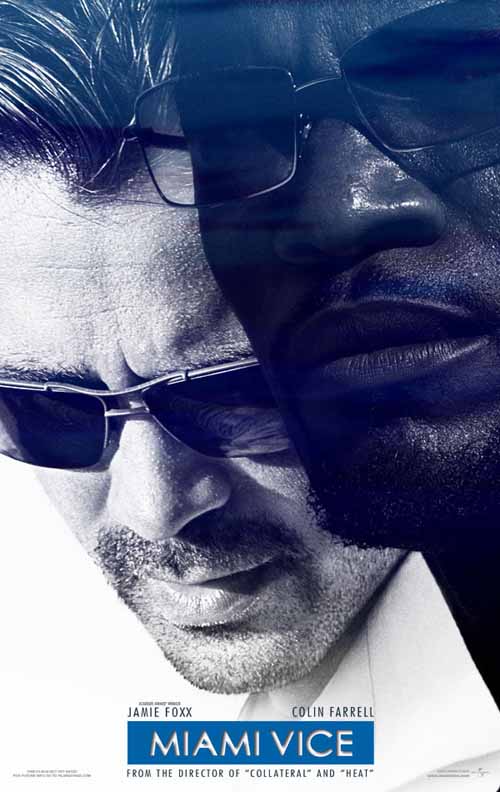
The early reviews are beginning to come in on Michael Mann's "Miami Vice". First, there was the strong buzz from Jeffrey Wells on his blog. Then, David Poland weighed in with his opinion. Now, Ain't It Cool News has another compliment to Michael Mann's latest digital crime thriller. Since early May, this film has been touted as the film of the summer for us serious minded film geeks. And who in a million years would've thought that a film entitled "Miami Vice" would get the blood boiling? But the bottom line is that Michael Mann (outside of Martin Scorsese and Paul Thomas Anderson) is a singular presence within modern filmmaking whose films oooze style, mood and exhilerating grace. Go back and watch the first 20 minutes of "Ali", as music, jump cuts and nervy handheld camerawork build to an electric crescendo. Pick any moment out of "Heat" or "The Insider". Stare at the beauty of the possibility of digital film in "Collateral". And for the really adventurous (as well as seeing where the roots of a character like Neil McCauley stems from) go back and watch Mann's 1981 mini-masterpiece "Thief" starring James Caan and Willie Nelson. That's right... Mann had the foresight to recognize the acting prowess of Nelson back in 1981. It's hard not to get excited over a new Mann film when you study his ouevre. Every film nails time and place perfectly. And, for the sheer logistics of a shoot-out, no one films things quite as brazenely and honestly as him. July 28th. Mark it on your calendar.
Wednesday, June 28, 2006
One of the Greats

Antonioni's "The Passenger
Michealangelo Antonioni’s “The Passenger”, originally released in 1975, was re-issued in theaters late last year. It’s clear that the film’s leading protagonist, Jack Nicholson, holds a special place in his heart for this existential thriller since he was the primary force behind the film’s re-release (and how often does an actor labor for something like that?). Filmed in languorous long shots that give more precedence to space than the emotions of the actors, this was Antonioni’s bid to capsulate his artistic, European senses into a somewhat commercially viable American vehicle. It succeeds on both levels- carrying forward Antonioni’s penchant for static, internalized filmmaking while never losing sight of the fact that it’s a minor league thriller with big actors (Nicholson and his unnamed girl, Maria Schneider). Nicholson plays David Locke, a journalist working in Northern Africa. After a long search through the desert for someone (or something) that never materializes, Locke returns to his hotel room and finds his neighbor, David Robertson (Charles Mulvehill) dead of a heart attack. Locke inexplicably changes identities with the man, keeping his appointments across the globe and leaving his old life behind. Locke soon discovers that he’s traded places not just with an ordinary man, but a man whose job is to sell guns for various organizations. Soon, Locke finds himself hunted both by his past (in the form of his wife once she receives his things and realizes his passport has been doctored) and Robertson’s shady business partners. Along the way, he enlists the help of a young girl (Schneider), fresh from he role in Bertolucci’s “Last Tango In Paris”.
Sounds like a globe-trotting thriller right? The glory of Antonioni’s film is not in the plot mechanisms…. Very little happens during certain parts of the film and there’s not a single gun fired. The real purpose of the film is to propagate Antonioni’s lust for the inexplicable. Like previous films in his career, there’s no reason for Locke to do what he does. He’s as well adjusted and popular as Lea Massari in “L’ Avventurra” (1960), Antonioni’s main female character who disappears 30 minutes into that film. The remainder of “L Avventurra’s” 2 hours is devoted to the search and bonding of this girl’s friends. In “The Red Desert” (1964), a woman (Monica Vitti) wanders around the city and engages in a tryst for no reason other than her angst in a provincial marriage. There are no outward motivations in “The Passenger” either. Antonioni elicits a fairly muted performance from Nicholson, giving him some passion in the form of Maria Schneider, but even then he cuts beyond their sex scene to expose them lying naked in bed in long shot. “The Passenger” cuts at much deeper ideas- space and time (there is not a single wasted shot in this film, each image opening up and out to give us glimpses of people scurrying about at the edges), frustration, and certainly the basis of identity. The fame of “The Passenger” is in the final five minute shot, which tracks slowly through a barred window and out into a dusty courtyard as every player in the game of Locke’s life collides in a quiet, unsettling moment. But even greater images, to me, include the overhead shot as Nicholson rides over a lake in a wire trolley cart and the traveling shot as Schneider asks, “Why do you run?” and Nicholson replies “turn around and look” and the car speeds down the road, the camera fixed on the trees and road that darts away behind them. There is more truth (and motivation) in that 10 seconds than a lot of films muster in 2 hours. This is one of the best films of the 1970’s.
The picture is not a trick. I doubt many people will know who this is. I just stumbled across this tonight. Film lovers can now geek out. The man is Andrew Sarris, respected film critic for the New York Observer and author of the invaluable book called "The American Cinema" which put forth, for American audiences in the late 60's, the radical French theory of director as "auteur". I've long respected this writer's opinions and outlook, and now we have the above collection of his Top Ten lists for the last 30 or so years. If anyone has seen more than 50% of the films on his lists, you truly are cool.
Sunday, June 18, 2006
Memories of Music
Much more than films, music is a form of entertainment that seems critic-proof. There are a few genuine turkeys produced every year (such as when you have Jennifer Love Hewitt or Robert Downey Jr. belting out classics), but the state of the music industry is so varied and so independent, that you have certain types of music that will find an audience no matter what. Case in point- check out metacritic and compare the ratings of all new compact disc releases versus new movie releases. See how the green of music far outweighs the yellows of film? If you release a four hour film that documents the mating rituals of a Brazilian hog, then it’ll get marginal distribution in 25-30 cities on 1 art house screen- which is a virtual gravesite for any film. But if a certain band makes a marginal breakout within the scene, they have gigs, they start touring with more well known bands and they get their cd printed into, maybe, 20,000 copies. And, this band is guaranteed airplay within a radio station that tailors to the tastes of a given audience. Unlike the film, the audience doesn’t have to discover this artwork through a 35 mile trek to the local art-house, they simply have to turn on a predisposed radio station (most likely set in a “favorites” mode) and have this new track of music delivered within the confines of a genre of music those appeals to the listener. And the joy of discovering a new musical talent is often more overpowering than discovering a new filmmaker because the music can travel with you. So, what does all this lead up to? I’m having a heyday right now churning through new music with ease. There is so much out there, buried online (another positive fact for the music industry, myspace and online music services give any computer owner a veritable Ipod) and elsewhere.
I can honestly say that I arrived at music much earlier than I did with movies. To this day (like everyone) I can think of a given song and immediately conjure up an image in my life to go along with that song. Road trips with friends, house parties and clubs- music truly does give us a soundtrack to life. It effectively dog-ears time and space, distilling and enhancing an emotion or a moment with rhythmic vulnerability. Two radio stations, both now sadly defunct, played a formative role in my life- Z Rock, 98.9 out of Austin, Texas and The X, 103.9 out of College Station. Z Rock was one of those late 80’s/early 90’s stations that changed with the tide once alternative rock came in. But in those 4-5 years that I listened to Z-Rock, I was exposed to hard rock and heavy metal that wallpapered the drinking nights at my friend Craig’s house. People poured in and out, but the only constant was Z-Rock. This is where I first heard the likes of Metallica, Pantera, Helmet, 80’s European heavy metal… much like MTV’s old “Headbanger’s Ball”, Z-Rock was the station that growing boys like myself listened to and imagined we were much tougher than we really were. Then, as I grew older and learned that music is sometimes more than adrenaline and screaming (not to demure the bands I just listed), I found my way to The X out of College Station. I remember finding this station by mistake. My job through school was in a retail store where we’d often clean up and stay until 11 or midnight. I’d often spend much more time adjusting the rabbit ears of the radio, desperately trying to affix a signal from outer space that would cut through the electrical wasteland of this department store rather than the tasks of cleaning at hand. And I quickly discovered that the radio worked much better posited on top of a box, peering out of the metal roofed toy stockroom than inside the store! And then, I could get 3 signals. Two country stations and The X. The music that streamed from the speakers was, in a humble word, life-altering. This is where I heard alternative and indie rock from a slew of bands that I’d never heard before. This is where I learned about The Pixies, The Toadies, Weezer, Afghan Whigs, The Cranberries, Bush, At the Drive In, They Might Be Giants and a host of other semi-marginal experimental bands who are now either dead, regarded as godfathers-of-indie-rock, or managers at Taco Bell. This is where I learned that music can be transcendent and edgy and a little different, full of odd vocal inflections, out of key and fuzzy, or simply more complex. Z-Rock and The X taught me a lot about music, and ultimately, about life. And when I hear The Cranberries “Zombie”, a flood of images rushes back to me. Good or bad, it’s always nice to reflect on younger times when you could run faster, jump higher and your stomach was a little flatter. And that’s the real power of music. The power to transform and transport. There is still great music being made, you just have to dig a little deeper. There are no more X’s and Z-Rock’s to serve it up. Everything has become more corporate. I regularly listen to 102.1 The Edge here in Dallas, and while the station tries hard, I can only take so much Green Day and Staind. The reaffirming factor about the Edge is the Sunday night line-up that features “The Adventure Club” from 6-9 p.m. in which they give springboard to a lot of great independent bands from across the country. Then, at 9 p.m. “The Local Show” gives musical props to local bands in the Dallas-Fort Worth area. These 4 hours on one night a week will never forgive the other 164 hours spent on mind-numbing Top 40 hits, but at least it shows that, sometimes, musical originality will explode on the radio. You just have to know when to listen. So, massive tangential conversations aside, here are a few of the new bands I’ve stumbled across:
The Appleseed Cast- “Peregrine”- probably the best album I’ve heard so far this year. This quartet from Kansas, featuring layered sounds of guitar and distinctive vocals, mesmerize from start to finish. If nothing else, a comment on the cd cover should inspire anyone to pick it up, calling The Appleseed Cast America’s closest thing to Radiohead. Check out a sample of their work here
Wolfmother- self titled- The likeability of this band depends on how much retro 70’s hard rock ala Led Zeppelin and Argent one can handle. For my tastes, they rock. This is nothing groundbreaking, but the vocals are strong and Wolfmother are a band who understand their roots without sinking into self mockery or condescension.
Black Tie Dynasty- “Movements”- A local Dallas Fort Worth band that are just now beginning to get some airplay with their single “Tender”, their sound is eerily reminiscent of Depeche Mode, and that’s not a bad thing. The rest of “Movements” is fantastic stuff. I need to check out their earlier stuff.
She Wants Revenge- self titled- If you’ve listened to Interpol, you’d quickly jump to the conclusion that She Wants Revenge is a splinter of that band’s members. Borrowing that band’s driving guitar style and somewhat flat vocals that passes as spoken word music at times, She Wants Revenge is something different and just beginning to make a mark in the musical world. Don't let the "emo" look fool you.
I can honestly say that I arrived at music much earlier than I did with movies. To this day (like everyone) I can think of a given song and immediately conjure up an image in my life to go along with that song. Road trips with friends, house parties and clubs- music truly does give us a soundtrack to life. It effectively dog-ears time and space, distilling and enhancing an emotion or a moment with rhythmic vulnerability. Two radio stations, both now sadly defunct, played a formative role in my life- Z Rock, 98.9 out of Austin, Texas and The X, 103.9 out of College Station. Z Rock was one of those late 80’s/early 90’s stations that changed with the tide once alternative rock came in. But in those 4-5 years that I listened to Z-Rock, I was exposed to hard rock and heavy metal that wallpapered the drinking nights at my friend Craig’s house. People poured in and out, but the only constant was Z-Rock. This is where I first heard the likes of Metallica, Pantera, Helmet, 80’s European heavy metal… much like MTV’s old “Headbanger’s Ball”, Z-Rock was the station that growing boys like myself listened to and imagined we were much tougher than we really were. Then, as I grew older and learned that music is sometimes more than adrenaline and screaming (not to demure the bands I just listed), I found my way to The X out of College Station. I remember finding this station by mistake. My job through school was in a retail store where we’d often clean up and stay until 11 or midnight. I’d often spend much more time adjusting the rabbit ears of the radio, desperately trying to affix a signal from outer space that would cut through the electrical wasteland of this department store rather than the tasks of cleaning at hand. And I quickly discovered that the radio worked much better posited on top of a box, peering out of the metal roofed toy stockroom than inside the store! And then, I could get 3 signals. Two country stations and The X. The music that streamed from the speakers was, in a humble word, life-altering. This is where I heard alternative and indie rock from a slew of bands that I’d never heard before. This is where I learned about The Pixies, The Toadies, Weezer, Afghan Whigs, The Cranberries, Bush, At the Drive In, They Might Be Giants and a host of other semi-marginal experimental bands who are now either dead, regarded as godfathers-of-indie-rock, or managers at Taco Bell. This is where I learned that music can be transcendent and edgy and a little different, full of odd vocal inflections, out of key and fuzzy, or simply more complex. Z-Rock and The X taught me a lot about music, and ultimately, about life. And when I hear The Cranberries “Zombie”, a flood of images rushes back to me. Good or bad, it’s always nice to reflect on younger times when you could run faster, jump higher and your stomach was a little flatter. And that’s the real power of music. The power to transform and transport. There is still great music being made, you just have to dig a little deeper. There are no more X’s and Z-Rock’s to serve it up. Everything has become more corporate. I regularly listen to 102.1 The Edge here in Dallas, and while the station tries hard, I can only take so much Green Day and Staind. The reaffirming factor about the Edge is the Sunday night line-up that features “The Adventure Club” from 6-9 p.m. in which they give springboard to a lot of great independent bands from across the country. Then, at 9 p.m. “The Local Show” gives musical props to local bands in the Dallas-Fort Worth area. These 4 hours on one night a week will never forgive the other 164 hours spent on mind-numbing Top 40 hits, but at least it shows that, sometimes, musical originality will explode on the radio. You just have to know when to listen. So, massive tangential conversations aside, here are a few of the new bands I’ve stumbled across:
The Appleseed Cast- “Peregrine”- probably the best album I’ve heard so far this year. This quartet from Kansas, featuring layered sounds of guitar and distinctive vocals, mesmerize from start to finish. If nothing else, a comment on the cd cover should inspire anyone to pick it up, calling The Appleseed Cast America’s closest thing to Radiohead. Check out a sample of their work here
Wolfmother- self titled- The likeability of this band depends on how much retro 70’s hard rock ala Led Zeppelin and Argent one can handle. For my tastes, they rock. This is nothing groundbreaking, but the vocals are strong and Wolfmother are a band who understand their roots without sinking into self mockery or condescension.
Black Tie Dynasty- “Movements”- A local Dallas Fort Worth band that are just now beginning to get some airplay with their single “Tender”, their sound is eerily reminiscent of Depeche Mode, and that’s not a bad thing. The rest of “Movements” is fantastic stuff. I need to check out their earlier stuff.
She Wants Revenge- self titled- If you’ve listened to Interpol, you’d quickly jump to the conclusion that She Wants Revenge is a splinter of that band’s members. Borrowing that band’s driving guitar style and somewhat flat vocals that passes as spoken word music at times, She Wants Revenge is something different and just beginning to make a mark in the musical world. Don't let the "emo" look fool you.
Sunday, June 11, 2006
Anyone who remembers the short-lived televison series called "The Job", which ran on ABC for only 6-8 episodes during the spring of 2001, will fondly recall these moments that gravitated Denis Leary from stand up comedian to full bodied actor, complete with venemous diatribes and side splitting humor. Each episode of this 30 minute series was a mini-masterpiece of situational comedy. The times spent frentically bouncing between his wife and girlfriend and the infamous episode where Leary is trapped in the restroom of a police station with a crazed gunman solidified Leary's conviction of creating a new kind of televison comedy- one without strict rigors of plot. The fun within "The Job" were the tangential conversations that carried on for 3-4 minutes and the show's (almost) disdain for plot resolution. At times, nothing happened in this show, but it was funny as hell. Now, Leary and producer Peter Tolan are back with "Rescue Me" on FX. Now in it's third season, I didn't catch on to this show until late last year. Like so many fantastic marketing coups in the home video market, FX wisely released the first 2 seasons on DVD shrewdly before the season's new episodes, giving us slackers the opportunity to catch up before a new barrage of humor and emotion were layed out on the screen. And those recurring faces from "The Job"- Lenny Clarke as his uncle Teddy and Diane Farr as Laura Miles, the first female firefighter in the house- immediately signal that "Rescue Me" is more than a new series, but a fresh progression of things started four years ago on "The Job". "Rescue Me" is endlessly entertaining, casually shifting gears between rapid-fire dialogue that strikes the funny bone and sobering moments of dramatic invasions. This is a show that's dares you to pick up on things the first time. There are scenes where one liners are tossed at random, barely giving us a chance to catch our breath from laughing before another line is dropped. If nothing else, "Rescue Me" is best when it captures the macho casualness exuded by six guys as they sit around a small table, smoking and chatting. Fighting fires is secondary to the documentation of how this group of guys interacts. Chasing pussy, weaseling out of a given circumstance and gay jokes are MUCH more important in this world. Still, "Rescue Me" succeeds on the charms on its acting and writing. It's bracing and energetic television that deserves to be seen. Oh, and "The Job" complete series (19 episodes) is now available on DVD.
Thursday, May 25, 2006
Alive and well
I've been decidedly absent from these pages lately and I apologize. I've spent the week in my hometown with family. While I love my family, I'm suffocating from the lack of Netflix and my local arthouse (damn it... Assayas "Clean" opened there this week. I can only hope it's still showing when I'm back in town on Tuesday). I've had to subsidize my cinematic viewing with a showing of Wolfgang Peterson's maddeningly under-characterized and overly aggressive "Poseidon" and the somewhat thrilling (but ultimately middling)"Da Vinci Code". Readers of the book will not be disappointed. And the most surprising thing about all of my ra-ra Hollywood viewings this week? I absolutely loved "Mission Impossible 3". Director J.J. Abrams fills the screen with meta action set pieces, allowing his mise-en-scene to thoroughly embroil the viewer in detailed and coherent shoot outs and explosions. He has created, probably, the best action film in the last five years. Ohh, and there's a brilliant portrayal of the villain by Philip Seymour Hoffman. Best....Villain....ever.
Thursday, May 04, 2006
List-o-mania #2
1999:
1. Magnolia (Anderson)
2. Lovers of the Arctic Circle (Medem)
3. The Adventures of Sebastian Cole (Williams)
4. The Insider (Mann)
5. Eyes Wide Shut (Kubrick)
6. Limbo (Sayles)
7. Three Kings (Russell)
8. Talented Mr. Ripley (Minghella)
9. The Messenger (Besson)
10. The Iron Giant (Bird)
2000:
1. Almost Famous (Crowe)
2. Traffic (Soderbergh)
3. Kikujiro (Kitano)
4. Requiem For a Dream (Aronofsky)
5. Wonderland (Winterbottom)
6. Late August, Early September (Assayas)
7. Way of the Gun (McQuarrie)
8. Keeping the Faith (Norton)
9. L’Humanite (Dumont)
10. Legend of Bagger Vance (Redford)
2001:
1. The Man Who Wasn’t There (Coens)
2. The Yards (Gray)
3. Mulholland Drive (Lynch)
4. Memento (Nolan)
5. The Royal Tenebaums (Anderson)
6. The Claim (Winterbottom)
7. Made (Favreau)
8. Chopper (Dominik)
9. Ali (Mann)
10. Eureka (Aoyama)
2002:
1. Gangs of New York (Scorsese)
2. The Bed You Sleep In (Jost)
3. Minority Report (Spielberg)
4. Punch Drunk Love (Anderson)
5. 25th Hour (Lee)
6. Insomnia (Nolan)
7. Sex and Lucia (Medem)
8. Narc (Carnahan)
9. Last Orders (Schepsi)
10. The Son’s Room (Moretti)
2003:
1. Mystic River (Eastwood)
2. Lost In Translation (Coppola)
3. Return of the King (Jackson)
4. demonlover (Assayas)
5. All the Real Girls (Green)
6. Irreversible (Noe)
7. The Dancer Upstairs (Malkovich)
8. In America (Sheridan)
9. Purple Butterfly (Le)
10. Cold Mountain (Minghella)
2004:
1. The Aviator (Scorsese)
2. House of Flying Daggers (Yimou)
3. Eternal Sunshine of the Spotless Mind (Gondry)
4. Spartan (Mamet)
5. Garden State (Braff)
6. Code 46 (Winterbottom)
7. The Life Aquatic (Anderson)
8. I’ll Sleep When I’m Dead (Hodges)
9. Crimson Gold (Pahar)
10. Collateral (Mann)
1. Magnolia (Anderson)
2. Lovers of the Arctic Circle (Medem)
3. The Adventures of Sebastian Cole (Williams)
4. The Insider (Mann)
5. Eyes Wide Shut (Kubrick)
6. Limbo (Sayles)
7. Three Kings (Russell)
8. Talented Mr. Ripley (Minghella)
9. The Messenger (Besson)
10. The Iron Giant (Bird)
2000:
1. Almost Famous (Crowe)
2. Traffic (Soderbergh)
3. Kikujiro (Kitano)
4. Requiem For a Dream (Aronofsky)
5. Wonderland (Winterbottom)
6. Late August, Early September (Assayas)
7. Way of the Gun (McQuarrie)
8. Keeping the Faith (Norton)
9. L’Humanite (Dumont)
10. Legend of Bagger Vance (Redford)
2001:
1. The Man Who Wasn’t There (Coens)
2. The Yards (Gray)
3. Mulholland Drive (Lynch)
4. Memento (Nolan)
5. The Royal Tenebaums (Anderson)
6. The Claim (Winterbottom)
7. Made (Favreau)
8. Chopper (Dominik)
9. Ali (Mann)
10. Eureka (Aoyama)
2002:
1. Gangs of New York (Scorsese)
2. The Bed You Sleep In (Jost)
3. Minority Report (Spielberg)
4. Punch Drunk Love (Anderson)
5. 25th Hour (Lee)
6. Insomnia (Nolan)
7. Sex and Lucia (Medem)
8. Narc (Carnahan)
9. Last Orders (Schepsi)
10. The Son’s Room (Moretti)
2003:
1. Mystic River (Eastwood)
2. Lost In Translation (Coppola)
3. Return of the King (Jackson)
4. demonlover (Assayas)
5. All the Real Girls (Green)
6. Irreversible (Noe)
7. The Dancer Upstairs (Malkovich)
8. In America (Sheridan)
9. Purple Butterfly (Le)
10. Cold Mountain (Minghella)
2004:
1. The Aviator (Scorsese)
2. House of Flying Daggers (Yimou)
3. Eternal Sunshine of the Spotless Mind (Gondry)
4. Spartan (Mamet)
5. Garden State (Braff)
6. Code 46 (Winterbottom)
7. The Life Aquatic (Anderson)
8. I’ll Sleep When I’m Dead (Hodges)
9. Crimson Gold (Pahar)
10. Collateral (Mann)
Tuesday, May 02, 2006
List-o-mania
So... in order to gather a more comprehensive idea of my cinematic tastes (and it is broad, if I may say so) I've decided to post a copy of my "favs of the year" from 1990 on. It's amazing, looking back at some of these lists, how much they've changed. A majority of them have been left intact, and only a marginal number of films have been added, but a couple have been drastically re-numbered (especially 1998... P.T. Anderson's two breathtaking masterpieces now top my list whereas Kasi Lemmons' more moderate and accomplished character piece has fallen). Hindsight is 20-20. If only I could have the luxury of seeing every film that comes out every year.. then I'd feel more comfortable with these lists, but we know that will never happen, so here goes: The first post is from 1990-1998. 1998-2005 will be up soon.
1990:
1. Goodfellas (Scorsese)
2. King of New York (Ferrera)
3. Cinema Paradiso (Tornatore)
4. Twin Peaks (TV- Lynch)
5. Henry, Portrait of a Serial Killer (McNaughton)
6. Miller’s Crossing (Coens)
7. Edward Scissorhands (Burton)
8. State of Grace (Joanau)
9. The Godfather Part 3 (Coppola)
10. Wild at Heart (Lynch)
1991:
1. The Double Life of Veronique (Kieslowski)
2. The Indian Runner (Penn)
3. JFK (Stone)
4. Zentropa (vonTrier)
5. Grand Canyon (Kasdan)
6. Homicide (Mamet)
7. Ju Dou (Yimou)
8. Bullet in the Head (Woo)
9. Barton Fink (Coens)
10. City of Hope (Sayles)
1992:
1. Laws of Gravity (Gomez)
2. Glengary Glen Ross (Mamet)
3. Bad Lieutenant (Ferrera)
4. The Player (Altman)
5. Bob Roberts (Robbins)
6. Reservoir Dogs (Tarantino)
7. All the Vermeers in New York (Jost)
8. A River Runs Through It (Redford)
9. Raise the Red Lantern (Yimou)
10. Last of the Mohicans (Mann)
1993:
1. Schindler’s List (Spielberg)
2. Short Cuts (Altman)
3. True Romance (Scott)
4. Fearless (Weir)
5. Age of Innocence (Scorsese)
6. Faraway, So Close (Wenders)
7. A Perfect World (Eastwood)
8. In the Name of the Father (Sheridan)
9. The Puppet Master (Hsiou-Hsien)
10. In the Line of Fire (Peterson)
1994:
1. Imaginary Crimes ( Drazan)
2. To Live (Yimou)
3. Cold Water (Assayas)
4. Trois Colors Trilogy (Kieslowski)
5. Forrest Gump (Zemeckis)
6. Last Seduction (Dahl)
7. Dangerous Game (Ferrera)
8. Clean, Shaven (Kerrigan)
9. Red Rock West (Dahl)
10. Hudsucker Proxy (Coens)
1995:
1. Casino (Scorsese)
2. Heat (Mann)
3. Seven (Fincher)
4. Smoke/Blue In the Face (Auster/Wang)
5. The Kingdom (vonTrier)
6. Funny Bones (Chelsom)
7. Kicking and Screaming (Stillman)
8. Shanghai Triad (Yimou)
9. Sonatine (Kitano)
10. Little Odessa (Gray)
11. The Day the Sun Turned Cold (Yim)
12. Clockers (Lee)
1996:
1. Breaking the Waves (vonTrier)
2. Swingers (Liman)
3. The English Patient (Minghella)
4. The Whole Wide World (Ireland)
5. Lone Star (Sayles)
6. Fargo (Coens)
7. The Funeral (Ferrera)
8. Irma Vep (Assayas)
9. Bottle Rocket (Anderson)
10. Basquiat (Schnabel)
11. Beautiful Girls (demme)
12. He Got Game (Lee)
13. Sleepers (Levinson)
1997:
1. Boogie Nights (Anderson)
2. Hard Eight (Anderson)
3. Kundun (Scorsese)
4. Eve’s Bayou (Lemmons)
5. Fireworks (Kitano)
6. La Scorta (Tognazzi)
7. Gattaca (Niccol)
8. Sweet Hereafter (Egoyan)
9. L.A. Confidential (Hanson)
10. Daytrippers (Mottola)
1998:
1. The Thin Red Line (Malick)
2. The Big Lebowski (Coens)
3. Saving Private Ryan (Spielberg)
4. The Truman Show (Weir)
5. Out of Sight (Soderbergh)
6. Zero Effect (Kasdan)
7. Chinese Box (Wang)
8. Pi (Aronofsky)
9. The Game (Fincher)
10. A Simple Plan (Raimi)
11. Lulu On the Bridge (Auster)
1990:
1. Goodfellas (Scorsese)
2. King of New York (Ferrera)
3. Cinema Paradiso (Tornatore)
4. Twin Peaks (TV- Lynch)
5. Henry, Portrait of a Serial Killer (McNaughton)
6. Miller’s Crossing (Coens)
7. Edward Scissorhands (Burton)
8. State of Grace (Joanau)
9. The Godfather Part 3 (Coppola)
10. Wild at Heart (Lynch)
1991:
1. The Double Life of Veronique (Kieslowski)
2. The Indian Runner (Penn)
3. JFK (Stone)
4. Zentropa (vonTrier)
5. Grand Canyon (Kasdan)
6. Homicide (Mamet)
7. Ju Dou (Yimou)
8. Bullet in the Head (Woo)
9. Barton Fink (Coens)
10. City of Hope (Sayles)
1992:
1. Laws of Gravity (Gomez)
2. Glengary Glen Ross (Mamet)
3. Bad Lieutenant (Ferrera)
4. The Player (Altman)
5. Bob Roberts (Robbins)
6. Reservoir Dogs (Tarantino)
7. All the Vermeers in New York (Jost)
8. A River Runs Through It (Redford)
9. Raise the Red Lantern (Yimou)
10. Last of the Mohicans (Mann)
1993:
1. Schindler’s List (Spielberg)
2. Short Cuts (Altman)
3. True Romance (Scott)
4. Fearless (Weir)
5. Age of Innocence (Scorsese)
6. Faraway, So Close (Wenders)
7. A Perfect World (Eastwood)
8. In the Name of the Father (Sheridan)
9. The Puppet Master (Hsiou-Hsien)
10. In the Line of Fire (Peterson)
1994:
1. Imaginary Crimes ( Drazan)
2. To Live (Yimou)
3. Cold Water (Assayas)
4. Trois Colors Trilogy (Kieslowski)
5. Forrest Gump (Zemeckis)
6. Last Seduction (Dahl)
7. Dangerous Game (Ferrera)
8. Clean, Shaven (Kerrigan)
9. Red Rock West (Dahl)
10. Hudsucker Proxy (Coens)
1995:
1. Casino (Scorsese)
2. Heat (Mann)
3. Seven (Fincher)
4. Smoke/Blue In the Face (Auster/Wang)
5. The Kingdom (vonTrier)
6. Funny Bones (Chelsom)
7. Kicking and Screaming (Stillman)
8. Shanghai Triad (Yimou)
9. Sonatine (Kitano)
10. Little Odessa (Gray)
11. The Day the Sun Turned Cold (Yim)
12. Clockers (Lee)
1996:
1. Breaking the Waves (vonTrier)
2. Swingers (Liman)
3. The English Patient (Minghella)
4. The Whole Wide World (Ireland)
5. Lone Star (Sayles)
6. Fargo (Coens)
7. The Funeral (Ferrera)
8. Irma Vep (Assayas)
9. Bottle Rocket (Anderson)
10. Basquiat (Schnabel)
11. Beautiful Girls (demme)
12. He Got Game (Lee)
13. Sleepers (Levinson)
1997:
1. Boogie Nights (Anderson)
2. Hard Eight (Anderson)
3. Kundun (Scorsese)
4. Eve’s Bayou (Lemmons)
5. Fireworks (Kitano)
6. La Scorta (Tognazzi)
7. Gattaca (Niccol)
8. Sweet Hereafter (Egoyan)
9. L.A. Confidential (Hanson)
10. Daytrippers (Mottola)
1998:
1. The Thin Red Line (Malick)
2. The Big Lebowski (Coens)
3. Saving Private Ryan (Spielberg)
4. The Truman Show (Weir)
5. Out of Sight (Soderbergh)
6. Zero Effect (Kasdan)
7. Chinese Box (Wang)
8. Pi (Aronofsky)
9. The Game (Fincher)
10. A Simple Plan (Raimi)
11. Lulu On the Bridge (Auster)
Tuesday, March 28, 2006
Italian faux-realism
"A Crime For 3 Sins"
Called "the most exciting and intricately plotted crime film since I don't know when!" by film critic Salvatore Fibrizio, A Crime For 3 Sins is finally being released on DVD.
Three low level crime men plan the perfect hold-up of an armored truck. Each does it for different reasons. Marco (Anthony Sante) is in desperate need of the money due to his gambling debts. Sal (Roberto Iolleni) plans on finally being able to use his wealth to steal his deaf-mute half sister away from their domineering father and create the perfect lifestyle where they can love each other openly and without fear of taboo retaliation. Tony (Alfred Mavala) banks on the money to, somehow, appease his wife and win her back from her many torrid love affairs with other men. But, complicating matters are Sgt. Azara (Federico Leulla), a dedicated and professional detective who gets wind of the heist due to the fact he's one of the many men sleeping with Tony's wife. Plus, shady associates of Sal's gambling debts find out about the plan and put their own execution of the heist in the works. Who will get to the money first? How will the seperate camps outsmart each other? And more importantly, will anyone walk away clean with the loot?
Directed with verve from acclaimed, reclusive filmmaker Dante Ferriota, this 131 minute version has finally been restored by NoShame DVD and given a proper release. Previously, only a severely truncated 94 minute version was available after the film's director pulled "A Crime For 3 Sins" from the Italian film market after a less-than-remarkable debut at the 1997 Venice Film Festival. Critics decried his uneven mixture of handheld cinematography coupled against Antonioni-like long takes, as well as the film's handling of it's matter-of-factly filmed themes of incest.
Finally, the director has re-emerged with his original print and all of it's biting glory can be found on NoShame DVD.
Sounds interesting right? I'm glad you like it. It's a made up synopsis of a movie that doesn't exist. Over at www.moriartylabs.typepad.com/moriartys_dvd_shelf/, he threw together a contest in which we created the plot outline of an Italian crime film and submitted it to his site. The best one would get a copy of a new film called "Uno Bianca", apparently a 3 hour crime film from the director who brought American audiences "Cemetary Man" a few years back, and a film that bares striking similiarity with Michael Mann's "Heat". I didn't win with the above synopsis, but I gave it a great college try. The most heartening thing about all of this is the resurgence of giallo, cult, and hard-to-find Italian films being released on DVD- including such illustrious titles as "Double Game", "Forbidden Photos of a Lady Under Suspicion", "Pyjama Girl Case", "The Black Belly of the Tarantula" and "Fifth Cord". Couple those with all of the recent Argento, Fulci and "What Have You Done With Solange" discs, and one begins to jump for joy in all of the genre's excessive perversions. NoShame DVD and Blue Underground are the companies behind these flicks, and one can only hope that they continue their distribution of the lost and forgotten.
Called "the most exciting and intricately plotted crime film since I don't know when!" by film critic Salvatore Fibrizio, A Crime For 3 Sins is finally being released on DVD.
Three low level crime men plan the perfect hold-up of an armored truck. Each does it for different reasons. Marco (Anthony Sante) is in desperate need of the money due to his gambling debts. Sal (Roberto Iolleni) plans on finally being able to use his wealth to steal his deaf-mute half sister away from their domineering father and create the perfect lifestyle where they can love each other openly and without fear of taboo retaliation. Tony (Alfred Mavala) banks on the money to, somehow, appease his wife and win her back from her many torrid love affairs with other men. But, complicating matters are Sgt. Azara (Federico Leulla), a dedicated and professional detective who gets wind of the heist due to the fact he's one of the many men sleeping with Tony's wife. Plus, shady associates of Sal's gambling debts find out about the plan and put their own execution of the heist in the works. Who will get to the money first? How will the seperate camps outsmart each other? And more importantly, will anyone walk away clean with the loot?
Directed with verve from acclaimed, reclusive filmmaker Dante Ferriota, this 131 minute version has finally been restored by NoShame DVD and given a proper release. Previously, only a severely truncated 94 minute version was available after the film's director pulled "A Crime For 3 Sins" from the Italian film market after a less-than-remarkable debut at the 1997 Venice Film Festival. Critics decried his uneven mixture of handheld cinematography coupled against Antonioni-like long takes, as well as the film's handling of it's matter-of-factly filmed themes of incest.
Finally, the director has re-emerged with his original print and all of it's biting glory can be found on NoShame DVD.
Sounds interesting right? I'm glad you like it. It's a made up synopsis of a movie that doesn't exist. Over at www.moriartylabs.typepad.com/moriartys_dvd_shelf/, he threw together a contest in which we created the plot outline of an Italian crime film and submitted it to his site. The best one would get a copy of a new film called "Uno Bianca", apparently a 3 hour crime film from the director who brought American audiences "Cemetary Man" a few years back, and a film that bares striking similiarity with Michael Mann's "Heat". I didn't win with the above synopsis, but I gave it a great college try. The most heartening thing about all of this is the resurgence of giallo, cult, and hard-to-find Italian films being released on DVD- including such illustrious titles as "Double Game", "Forbidden Photos of a Lady Under Suspicion", "Pyjama Girl Case", "The Black Belly of the Tarantula" and "Fifth Cord". Couple those with all of the recent Argento, Fulci and "What Have You Done With Solange" discs, and one begins to jump for joy in all of the genre's excessive perversions. NoShame DVD and Blue Underground are the companies behind these flicks, and one can only hope that they continue their distribution of the lost and forgotten.
Wednesday, March 15, 2006
The Art of the Chase
Sixteen Blocks
I have to commend Richard Donner's "16 Blocks". Not only does it prove to be a highly entertaining, frenetically paced action film, but it manages to shroud Bruce Willis with his first role wherein he gets the chance to look, act and feel like the years are wearing on him (unlike the stubborn 'machoness' that Harrison clumsily exudes in "Firewall"). Willis is asked to do nothing super-heroish in the film. He walks steadily with a limp, runs continually out of breath and looks like shit the entire film, carrying a pale complexion that leads one to wonder if he was actually drinking before Donner yelled action. "16 Blocks" is an old-fashioned film that unfolds in real time as Jack Mosley (Willis) has to transport Eddie Bunker (Mos Def) 16 blocks to appear in court. Of course, it turns out that the court date is to virtually bury several of New York's finest, and they (as well as the gargantuan sprawl of the city itself) stand in the way. David Morse (such a fine character actor) is one of those cops, and "16 Blocks" certainly takes a jaundiced eye at the New York police department. There's a scene in a small bar towards the beginning of the film (the first that David Morse appears in) where Willis learns of his ex-partners motivations. The tightness and economy of that scene is breathless, and it's a tone that Donner sustains throughout the remainder of the film. Nice stuff.
Running Scared
I wish the same economy and tightness was found anywhere in Wayne Kramer's "Running Scared". Now, an admission- I was drawn to this film from the slightly glowing review of Andres Sarris in ****** .com in which he wrote that the film is not as bad as others are saying. I'm not sure what Sarris saw in the overly aggressive and emotionally bankrupt motivations of this film, but it didn't strike me as anything more than yet another Paul Walker vehicle in which he gets to look tough and overract. I won't go into the narrative details, except the fact that it's virtually about the allure and criminal perversions that often accompany a handgun as it passes through various hands, a trope that usually offers interesting results, as in the way Bresson handles the subtle human calibrations as a bill makes it way through the landscape. But I apologize for even mentioning Bresson in any comparison to "Running Scared". This is a crushingly boring film, even though it features probably 95 minutes worth of action and bloodshed. If anything, the most memorable part of takes place towards the end in which all the film's nauseatingly empty characters end up in a hockey rink and take practice on Walker's face. At this point, my disinterest in the film turned into pleading for the film's full frontal assault to end. And the most inane part of the whole affair is the way Kramer's script dodges it's hyper-reality and twists towards a happy climax.
Pulse
Kiyoshi Kurosawa is quickly becoming a filmmaker that I shout out to anyone interested in Asian cinema- with slight caution. His film's won't give you nightmares through cheap scares… they creep up on you and disturb your senses in subtle ways. And even then, not all of his films are designed to disturb. They slowly immerse the viewer in dread-soaked visions that leave your eyes searching the corners of the frame. And they feature great humor, such as in "Doppelganger". "Pulse" is no exception. There is one scene where a woman slowly walks out the shadows towards a man hiding in the same dark room. She swaggers and almost stumbles in a highly supernatural way that chilled me to the bone. But "Pulse" is not really a ghost story. Instead, it's an apocalyptic caution drama doused in horrific overtones, featuring images that rattle around in your head for days (such as an airplace crashing off-screen and the single take as a woman leaps from a water tower.) The idea is this- isolation and loneliness as the key to world destruction. People slowly fade out of reality and become black gobs of soot in their final minutes. Sometimes, they re-appear inside computer screens, slowly reaching out to the living for some kind of connection, which is Kurosawa's sly comment on the disconnected-ness that world wide technology like the internet is supposed to eliminate. Even if all of the film's ideas aren't readily understood on first viewing, "Pulse" is still a masterpiece of world cinema that sells itself as horror and comes off as something more. Essential viewing.
I have to commend Richard Donner's "16 Blocks". Not only does it prove to be a highly entertaining, frenetically paced action film, but it manages to shroud Bruce Willis with his first role wherein he gets the chance to look, act and feel like the years are wearing on him (unlike the stubborn 'machoness' that Harrison clumsily exudes in "Firewall"). Willis is asked to do nothing super-heroish in the film. He walks steadily with a limp, runs continually out of breath and looks like shit the entire film, carrying a pale complexion that leads one to wonder if he was actually drinking before Donner yelled action. "16 Blocks" is an old-fashioned film that unfolds in real time as Jack Mosley (Willis) has to transport Eddie Bunker (Mos Def) 16 blocks to appear in court. Of course, it turns out that the court date is to virtually bury several of New York's finest, and they (as well as the gargantuan sprawl of the city itself) stand in the way. David Morse (such a fine character actor) is one of those cops, and "16 Blocks" certainly takes a jaundiced eye at the New York police department. There's a scene in a small bar towards the beginning of the film (the first that David Morse appears in) where Willis learns of his ex-partners motivations. The tightness and economy of that scene is breathless, and it's a tone that Donner sustains throughout the remainder of the film. Nice stuff.
Running Scared
I wish the same economy and tightness was found anywhere in Wayne Kramer's "Running Scared". Now, an admission- I was drawn to this film from the slightly glowing review of Andres Sarris in ****** .com in which he wrote that the film is not as bad as others are saying. I'm not sure what Sarris saw in the overly aggressive and emotionally bankrupt motivations of this film, but it didn't strike me as anything more than yet another Paul Walker vehicle in which he gets to look tough and overract. I won't go into the narrative details, except the fact that it's virtually about the allure and criminal perversions that often accompany a handgun as it passes through various hands, a trope that usually offers interesting results, as in the way Bresson handles the subtle human calibrations as a bill makes it way through the landscape. But I apologize for even mentioning Bresson in any comparison to "Running Scared". This is a crushingly boring film, even though it features probably 95 minutes worth of action and bloodshed. If anything, the most memorable part of takes place towards the end in which all the film's nauseatingly empty characters end up in a hockey rink and take practice on Walker's face. At this point, my disinterest in the film turned into pleading for the film's full frontal assault to end. And the most inane part of the whole affair is the way Kramer's script dodges it's hyper-reality and twists towards a happy climax.
Pulse
Kiyoshi Kurosawa is quickly becoming a filmmaker that I shout out to anyone interested in Asian cinema- with slight caution. His film's won't give you nightmares through cheap scares… they creep up on you and disturb your senses in subtle ways. And even then, not all of his films are designed to disturb. They slowly immerse the viewer in dread-soaked visions that leave your eyes searching the corners of the frame. And they feature great humor, such as in "Doppelganger". "Pulse" is no exception. There is one scene where a woman slowly walks out the shadows towards a man hiding in the same dark room. She swaggers and almost stumbles in a highly supernatural way that chilled me to the bone. But "Pulse" is not really a ghost story. Instead, it's an apocalyptic caution drama doused in horrific overtones, featuring images that rattle around in your head for days (such as an airplace crashing off-screen and the single take as a woman leaps from a water tower.) The idea is this- isolation and loneliness as the key to world destruction. People slowly fade out of reality and become black gobs of soot in their final minutes. Sometimes, they re-appear inside computer screens, slowly reaching out to the living for some kind of connection, which is Kurosawa's sly comment on the disconnected-ness that world wide technology like the internet is supposed to eliminate. Even if all of the film's ideas aren't readily understood on first viewing, "Pulse" is still a masterpiece of world cinema that sells itself as horror and comes off as something more. Essential viewing.
Thursday, March 09, 2006
Lists!
And while we're at it.... in conjunction with the recent survey of Peckinpah's films, what better way to ammend that than with a list of how I rank his films! In order from favorite:
1) The Killer Elite
2) The Wild Bunch
3) Ride the High Country
4) Junior Bonner
5) The Getaway- simply becaise Steve McQueen oozes coolness from every pore.
6) Bring Me the Head of Alfredo Garcia
7) The Ballad of Cable Hogue
8) Pat Garrett and Billy the Kid
9) Straw Dogs
10) The Deadly Companions
11) Cross of Iron
12) The Osterman Weekend
13) Major Dundee
14) Convoy- it means well....
1) The Killer Elite
2) The Wild Bunch
3) Ride the High Country
4) Junior Bonner
5) The Getaway- simply becaise Steve McQueen oozes coolness from every pore.
6) Bring Me the Head of Alfredo Garcia
7) The Ballad of Cable Hogue
8) Pat Garrett and Billy the Kid
9) Straw Dogs
10) The Deadly Companions
11) Cross of Iron
12) The Osterman Weekend
13) Major Dundee
14) Convoy- it means well....
Placing Peckinpah
There are very few pre-1990 filmmakers whose entire body of work can be seen by the average viewer. Studio rights, individual rights, bad prints (or lost prints)… these are just a few of the cinematic potholes that sink into our restoration and release process. DVD is a big proponent of the new fashion of multi-work releases and deluxe edition boxsets. In early January, Warner Brothers released the "legendary westerns" boxset which included "The Wild Bunch", "Ride the High Country", "Pat Garrett and Billy the Kid" and "The Ballad of Cable Hogue". With those four titles released, the entire canon of director Sam Peckinpah can be viewed and enjoyed within the comfort of your home. That's exactly what I did, and what follows is a small appreciation of the filmmaker's body of work.
So much is said about the violence of Peckinpah's films. That doesn't make any sense. I assume this is coming from people and pundits who were only privileged to see "The Wild Bunch" (1969) and "Straw Dogs" (1972), certainly two of his more polarizing films. and the ones that have been available on home video release the longest. While "The Wild Bunch" does belong in the halls of fantastic (and groundbreaking) movie-making, "Straw Dogs" was his follow-up to that masterpiece. "Straw Dogs" is a film in which Dustin Hoffman and his wife, Susan George, are continually assaulted both physically and mentally by the local community of the remote village they've settled in. In fact, "Straw Dogs" is still banned in the UK due to it's portrayal of a rape scene in which actress George eventually gives in and 'appears' to be enjoying the moment. Peckinpah dials down the physical violence just a bit, but he cranks up the psychological malaise. It's difficult to place "Straw Dogs" after "The Wild Bunch", and if the film doesn't succeed quite as well, it's because the performances of Hoffman and George are a little stilted. But what is clear from these two efforts is that Peckinpah finally found a stylistic voice. The success of "The Wild Bunch" gave him the levity to create a more interior work like "Straw Dogs". It charted a straight line within Hollywood in which he had the freedom to disappear in Mexico and take his time piecing together the melancholy haze that graces the visuals and mood of "Bring Me the Head of Alfredo Garcia". And they certainly gave him the chutzpah to barrel ahead and churn out nihilistic works like "Cross of Iron" and "The Osterman Weekend", films a little shoddy on look and tempo but striking in texture and creative authenticity. But, through all of this, are "The Wild Bunch" and "Straw Dogs" the reason there's not a more consistent and widespread demand for the works of Peckinpah to explode on modern viewers? Is he saddled with the monikor of "violent" because, as a culture, we're insatiable about pigeonholing our artists with one word? If one takes both of these dynamic and unsettling films out of his oeuvre, I wager that Peckinpah becomes more respected within the confines of the average viewer. Everyone understands the greatness of both these works on the industry in the late 60's and early 70's, but I think these two films also cast a shadow of distrust over the remainder of Peckinpah's career. It's easy to overlook the humor in many of his films, like in "The Killer Elite". It's easy to disregard the sensitive and congenial spirit pulsing through every look and gesture of Steve McQueen in "Junior Bonner". And it's irresponsible to view "The Ballad of Cable Hogue" as anything but a filmmaker coasting on pure delight in morphing the well-worn tropes of the western genre into a comedy of epic proportions. To so many, Peckinpah is forever remembered as the violent masochist who drank himself to death and focused on the dark corners of the human psyche. That is very unfair. Watch any other film besides "The Wild Bunch" and "Straw Dogs" and one will see a director enamored with humor, redemption, affection and trust. And at times, Peckinpah is much more satisfied with the playful listlessness of his characters on the screen rather than gun fire and rape.
But one cannot debate Peckinpah without bringing up his numerous forays into the western genre. It's the western that defines him. In fact, seven of his first nine films are westerns. And couple those with the wild streak of "Convoy" in 1977- in which eighteen wheelers could be seamlessly substituted for horses, and "Bring Me the Head of Alfredo Garcia" in which Warren Oates tramples around Mexico with a human head, dodging hired hitman- and you begin to see that these two works could also easily fall under the graces of the wild western tradition. It's not that the western is such an easy genre to tackle, but it gives filmmakers such a wide canvas to work with- both in look and allegorical character development. His first two films, "Ride the High Country" and "The Deadly Companions", are great westerns not because of what they present, but because of what they infer- the dying vestiges of a landscape concerned not with fighting Indians and shoot outs at the OK Corral, but with men fighting something inside themselves. Both films feature lead actors (Randolph Scott and Joel Mcrea, Brian Keith) as worn out figures in a land that slowly passing them by. The latest and best filmmaker to conduct this sort of redemptive strike at man-versus-the-western-landscape-as-savior is Tommy Lee Jones with his "The Three Burials of Melquiades Estrada". That film certainly wouldn't have been quite as pungent without the slow-to-burn moral compass guiding Brian Keith in "The Deadly Companions" and Warren Oates in "Bring Me the Head of Alfredo Garcia" as both Peckinpah characters pay their dues across the western vistas, wrangling their sins (a head and a child's body) in the form of a journey. Redemption, like revenge, is a common theme in all of Peckinpah's works, but he doesn't pull at the core quite as evocative as he does in "The Deadly Companions". In "Ride the High Country", Scott and Mcrea are brokeback (sorry, couldn’t resist) gunslingers who begin escorting gold to a small mining town, and end up violently protecting the virginal figure of Mariette Hartley. Again, like the best of the genre, Peckinpah circumvents the values and norms of the western, slowly turning the story inward, and in the case of his first two films, creates a rigid sense of individualism and timelessness that ends with his characters bowing out in poetic and humane fashion.
As far as style, that came about with "The Wild Bunch". Peckinpah's fascination with dragging out the images of bodies falling, cross-cutting amongst a single violent incident and prolonging the final blow started in 1968. There wasn't a hint of it in 1966 when he polished off "Major Dundee". And while this became a minor distraction in later efforts (especially in one fantastically designed bar room brawl in 1972's "Junior Bonner"), Peckinpah coalesced his editing trickery with "The Wild Bunch" and used it as a trope throughout the remainder of his work (as well as the recurring images of children bearing witness to various acts of violence and bloodshed). In fact, Peckinpah's claim to visual auterism is his manner of cross-cutting and frenetically inserting images against each other. That, above all else, is what aligns Peckinpah with so many peers of his generation. He was not the author of very many of his works. The few writing credits affixed to his name come from a partnership with another writer. Peckinpah was a visualist… a filmmaker who adapted the writings of others and marginally surfaced his sensibilities. He became a chameleon to a vast array of genres and styles, yet another characteristic of a director less concerned with vanity and more interested in telling as many stories as possible. Can you imagine the shock that must have followed the cathartic bloodletting of "The Wild Bunch" in 1968 when he released the playfully subdued "Ballad of Cable Hogue" two years later, giving Jason Robards one of his most charismatic and unpretentious roles? Or the sledgehammer see-saw effect that "Junior Bonner" must've had when it was released in 1972, sandwiched between "The Getaway" and "Straw Dogs". Or, as judging by a lot of critics reactions to his final film, "The Osterman Weekend", the release of an aggressively paranoid 70's thriller ten long years after that genre had run its gamut? That's why I love cinema; the ability to be constantly poked, prodded and challenged by my expectations of a filmmaker. I can think of no higher praise for Peckinpah than that.
So, with all that said… the purpose of this short writing is to explain that there is more than meets the eye when it comes to the dynamic career of Sam Peckinpah. All of these titles are available on DVD. Check them out.
So much is said about the violence of Peckinpah's films. That doesn't make any sense. I assume this is coming from people and pundits who were only privileged to see "The Wild Bunch" (1969) and "Straw Dogs" (1972), certainly two of his more polarizing films. and the ones that have been available on home video release the longest. While "The Wild Bunch" does belong in the halls of fantastic (and groundbreaking) movie-making, "Straw Dogs" was his follow-up to that masterpiece. "Straw Dogs" is a film in which Dustin Hoffman and his wife, Susan George, are continually assaulted both physically and mentally by the local community of the remote village they've settled in. In fact, "Straw Dogs" is still banned in the UK due to it's portrayal of a rape scene in which actress George eventually gives in and 'appears' to be enjoying the moment. Peckinpah dials down the physical violence just a bit, but he cranks up the psychological malaise. It's difficult to place "Straw Dogs" after "The Wild Bunch", and if the film doesn't succeed quite as well, it's because the performances of Hoffman and George are a little stilted. But what is clear from these two efforts is that Peckinpah finally found a stylistic voice. The success of "The Wild Bunch" gave him the levity to create a more interior work like "Straw Dogs". It charted a straight line within Hollywood in which he had the freedom to disappear in Mexico and take his time piecing together the melancholy haze that graces the visuals and mood of "Bring Me the Head of Alfredo Garcia". And they certainly gave him the chutzpah to barrel ahead and churn out nihilistic works like "Cross of Iron" and "The Osterman Weekend", films a little shoddy on look and tempo but striking in texture and creative authenticity. But, through all of this, are "The Wild Bunch" and "Straw Dogs" the reason there's not a more consistent and widespread demand for the works of Peckinpah to explode on modern viewers? Is he saddled with the monikor of "violent" because, as a culture, we're insatiable about pigeonholing our artists with one word? If one takes both of these dynamic and unsettling films out of his oeuvre, I wager that Peckinpah becomes more respected within the confines of the average viewer. Everyone understands the greatness of both these works on the industry in the late 60's and early 70's, but I think these two films also cast a shadow of distrust over the remainder of Peckinpah's career. It's easy to overlook the humor in many of his films, like in "The Killer Elite". It's easy to disregard the sensitive and congenial spirit pulsing through every look and gesture of Steve McQueen in "Junior Bonner". And it's irresponsible to view "The Ballad of Cable Hogue" as anything but a filmmaker coasting on pure delight in morphing the well-worn tropes of the western genre into a comedy of epic proportions. To so many, Peckinpah is forever remembered as the violent masochist who drank himself to death and focused on the dark corners of the human psyche. That is very unfair. Watch any other film besides "The Wild Bunch" and "Straw Dogs" and one will see a director enamored with humor, redemption, affection and trust. And at times, Peckinpah is much more satisfied with the playful listlessness of his characters on the screen rather than gun fire and rape.
But one cannot debate Peckinpah without bringing up his numerous forays into the western genre. It's the western that defines him. In fact, seven of his first nine films are westerns. And couple those with the wild streak of "Convoy" in 1977- in which eighteen wheelers could be seamlessly substituted for horses, and "Bring Me the Head of Alfredo Garcia" in which Warren Oates tramples around Mexico with a human head, dodging hired hitman- and you begin to see that these two works could also easily fall under the graces of the wild western tradition. It's not that the western is such an easy genre to tackle, but it gives filmmakers such a wide canvas to work with- both in look and allegorical character development. His first two films, "Ride the High Country" and "The Deadly Companions", are great westerns not because of what they present, but because of what they infer- the dying vestiges of a landscape concerned not with fighting Indians and shoot outs at the OK Corral, but with men fighting something inside themselves. Both films feature lead actors (Randolph Scott and Joel Mcrea, Brian Keith) as worn out figures in a land that slowly passing them by. The latest and best filmmaker to conduct this sort of redemptive strike at man-versus-the-western-landscape-as-savior is Tommy Lee Jones with his "The Three Burials of Melquiades Estrada". That film certainly wouldn't have been quite as pungent without the slow-to-burn moral compass guiding Brian Keith in "The Deadly Companions" and Warren Oates in "Bring Me the Head of Alfredo Garcia" as both Peckinpah characters pay their dues across the western vistas, wrangling their sins (a head and a child's body) in the form of a journey. Redemption, like revenge, is a common theme in all of Peckinpah's works, but he doesn't pull at the core quite as evocative as he does in "The Deadly Companions". In "Ride the High Country", Scott and Mcrea are brokeback (sorry, couldn’t resist) gunslingers who begin escorting gold to a small mining town, and end up violently protecting the virginal figure of Mariette Hartley. Again, like the best of the genre, Peckinpah circumvents the values and norms of the western, slowly turning the story inward, and in the case of his first two films, creates a rigid sense of individualism and timelessness that ends with his characters bowing out in poetic and humane fashion.
As far as style, that came about with "The Wild Bunch". Peckinpah's fascination with dragging out the images of bodies falling, cross-cutting amongst a single violent incident and prolonging the final blow started in 1968. There wasn't a hint of it in 1966 when he polished off "Major Dundee". And while this became a minor distraction in later efforts (especially in one fantastically designed bar room brawl in 1972's "Junior Bonner"), Peckinpah coalesced his editing trickery with "The Wild Bunch" and used it as a trope throughout the remainder of his work (as well as the recurring images of children bearing witness to various acts of violence and bloodshed). In fact, Peckinpah's claim to visual auterism is his manner of cross-cutting and frenetically inserting images against each other. That, above all else, is what aligns Peckinpah with so many peers of his generation. He was not the author of very many of his works. The few writing credits affixed to his name come from a partnership with another writer. Peckinpah was a visualist… a filmmaker who adapted the writings of others and marginally surfaced his sensibilities. He became a chameleon to a vast array of genres and styles, yet another characteristic of a director less concerned with vanity and more interested in telling as many stories as possible. Can you imagine the shock that must have followed the cathartic bloodletting of "The Wild Bunch" in 1968 when he released the playfully subdued "Ballad of Cable Hogue" two years later, giving Jason Robards one of his most charismatic and unpretentious roles? Or the sledgehammer see-saw effect that "Junior Bonner" must've had when it was released in 1972, sandwiched between "The Getaway" and "Straw Dogs". Or, as judging by a lot of critics reactions to his final film, "The Osterman Weekend", the release of an aggressively paranoid 70's thriller ten long years after that genre had run its gamut? That's why I love cinema; the ability to be constantly poked, prodded and challenged by my expectations of a filmmaker. I can think of no higher praise for Peckinpah than that.
So, with all that said… the purpose of this short writing is to explain that there is more than meets the eye when it comes to the dynamic career of Sam Peckinpah. All of these titles are available on DVD. Check them out.
Tuesday, February 21, 2006
Films from Opposite Corners of the World
Eytan Fox's "Walk On Water" covers some of the same ground as Steven Speilberg's Munich, albeit in much more modest terms. Eyal, (Lior Ashkenazi, an actor who should be destined for international stardom with his dashing good looks and cerebral portrayal of inner turmoil) is a MOSSAD agent whose specialty is assassinating Nazi war criminals through lethal injection. His next assignment turns out to be the hunt for an 86 year old Nazi commander who is still believed to be alive. In order to ascertain whether this fact is true or not, Eyal is asked to impersonate an Israeli tour guide and get comfortable with the nazi commander's grandson when he arrives for a visit. Eyal gets to know the grandson, Axel Himmelman (Knut Berger) and granddaughter Pia (Caroline Peters) as he leads them around the city. All of the story's tension builds around the fundamental question of can Eyal carry out his mission after forming a unique relationship with his target's grandchildren? Director Fox adroitly underscores subtle moral complexities within the story. This is not a film that dwells on the tensions of the assassinations like Munich. Fox instead focuses on the slow immersion of Eyal into the secular and humane beliefs of Axel and Pia. To complicate matters, Axel is homosexual, a lifestyle in stark contrast to Eyal beliefs. The connection these two make by the end of the film is surprising and moving. The manner of Eyal's assassination method is also emblematic of Fox's almost subliminal handling of the film's moral center- lethal injection, requiring that Eyal comfortably wedge himself close enough to strike his victim. "Walk On Water" also confronts the wavering guilt that has slowly built inside Eyal after committing so many murders (both on the job and in his personal life), and like "Munich", this guilt exposes itself in an ending that is both humble and miraculous. Highly recommended film. The Three Burials of Melquiades Estrada Why is the western such an enduring genre? Is it because it gives filmmakers the freedom to present globally profound ideas against a (highly) picturesque background? Or is it because the genre lends itself to stories that resonate with our innate sense of the past and our progression from rugged determination to technological advancement? Either way, Tommy Lee Jones' "The Three Burials of Melquiades Estrada" is a brutally honest and unflinching portrait of a profound idea (redemption) situated against that picturesque backdrop. Written by Guillermo Arriaga ("21 Grams, Amorres Perros), he tackles this story with the same sense of fractured fervor that punctuates those stories. While the first 45 minutes or so keeps you guessing about the timelines, jumping between the budding friendship of Tommy Lee Jones and his friend Melquiades (Julio Cidillo) and the new arrival of Mike Norton (Barry Pepper) and his perky, short-skirted wife (Melissa Leo), Arriaga's script doesn't feel ambivalent and unnecessary like it did in his previous efforts. Each character is given weight and pretense, and while the inextricable connections between all four eventually becomes clear in a harrowing manner, Tommy Lee Jones is the kindred spirit behind this film, turning in a performance that's both slightly off-kilter and wonderous in his quiet intensity. "The Three Burials of Melquiades Estrada" deftly builds towards a journey through the Texas and Mexico landscape with Jones and Pepper that's frightening and intoxicating. Parts of the film (the insertion of a blind man in the middle of nowhere, a female "healer" in a small town) play like great excerpts from a Faulkner novel and, ultimately, as with most westerns, the journey through the desolate landscape becomes the unspoken crux of the film. As a first time director, Jones' images are crisp and straight forward and he elicits strong supporting roles from January Jones and Dwight Yoakem, a tremendously funny actor in almost every scene as the town's local sheriff. "The Three Burials of Melquiades Estrada" takes the western as its pretext and paints a moving portrait of two men in search for something more than a burial ground for Melquiades, a casualty of territorial and ethnic injustice. But then again, isn't that what a great western does?
Thursday, February 09, 2006
Tops in pops '05
1) The Mars Volta, "Frances the Mute"- Head and shoulders above everything else I listened to this year, "Frances The Mute" is a stunning album in every sense of the word. Channeling the long lost ghost of Led Zeppelin, FM radio play and prog-rock with a vengeance, they throw everything at you in this 75 minute opus. More free-form and improvisatory than their previous album, this is one helluva great cd to get lost with.
2) Explosions In the Sky, "How Strange, Innocence"- This quartet from Austin, Texas will never hit it big. Why? They're four guys who play instrumental pieces without a single word! I discovered this band by accident late in the year and their sound (a cross between Mogwai and the repetitive background fuzz of early Sonic Youth) builds to hugely satisfying crescendos. This album, entitled "How Casual, Innocence" was released in '05, but it's a remix of eight early demo songs that never got off the ground after they formed in 2000. Just as I was conducting more research on these guys, I kept thinking how perfect their moody music would be for soundtracks, then I realized a lot the unique music in the film Friday Night Lights is courtesy of Explosions In the Sky. I can't recommend this band enough. It's always engaging when you discover a band you feel no one else has heard before.
3) Smile, Smile- "Smile Smile"- This debut EP from Dallas male and female duo Jencey and Ryan Hamilton (and the inferences to The White Stripes must be infuriating) is deceptively simple. Lush melodies are overlapped against keyboard, guitar and a mechanized drum beat, creating some of the most oddly moving sounds of the year.
4) My Morning Jacket, "Z"- Whatever one wishes to classify My Morning Jacket under (alt-country, bluegrass, rock fusion), after three albums it's clear they're here to stay. "Z" is an all-out exploration of genre and sound, easily swooning between 70's style rock and lazy alternative country. This one stayed in my cd player for three months straight.
5) Gorillaz, "Demon Days"- Former Blur frontman Daman Albarn took refuge with his band Gorillaz (really no more than himself splurging in the studio and inviting various musical personalities, and Dennis Hopper, to join in the fun) and this second album progresses his playful and irreverent sense of hip hop, electronica and…. Gospel? At first glance, this all seems like a mess. But on repeat listens, there's a definite method to this album's madness. The tunes become hypnotic and tell unique stories, either through spoken word or through the way Albarn's voice suddenly becomes clear after mumbling. It's all very subtle… and brilliant.
6) Coldplay, "X/Y"- Let the bashing begin. Wasn't there a cute little line about me being gay if I liked Coldplay tossed into a film somewhere this year? Oh well. I’m comfortable with my masculinity, and I still love Coldplay.
2) Explosions In the Sky, "How Strange, Innocence"- This quartet from Austin, Texas will never hit it big. Why? They're four guys who play instrumental pieces without a single word! I discovered this band by accident late in the year and their sound (a cross between Mogwai and the repetitive background fuzz of early Sonic Youth) builds to hugely satisfying crescendos. This album, entitled "How Casual, Innocence" was released in '05, but it's a remix of eight early demo songs that never got off the ground after they formed in 2000. Just as I was conducting more research on these guys, I kept thinking how perfect their moody music would be for soundtracks, then I realized a lot the unique music in the film Friday Night Lights is courtesy of Explosions In the Sky. I can't recommend this band enough. It's always engaging when you discover a band you feel no one else has heard before.
3) Smile, Smile- "Smile Smile"- This debut EP from Dallas male and female duo Jencey and Ryan Hamilton (and the inferences to The White Stripes must be infuriating) is deceptively simple. Lush melodies are overlapped against keyboard, guitar and a mechanized drum beat, creating some of the most oddly moving sounds of the year.
4) My Morning Jacket, "Z"- Whatever one wishes to classify My Morning Jacket under (alt-country, bluegrass, rock fusion), after three albums it's clear they're here to stay. "Z" is an all-out exploration of genre and sound, easily swooning between 70's style rock and lazy alternative country. This one stayed in my cd player for three months straight.
5) Gorillaz, "Demon Days"- Former Blur frontman Daman Albarn took refuge with his band Gorillaz (really no more than himself splurging in the studio and inviting various musical personalities, and Dennis Hopper, to join in the fun) and this second album progresses his playful and irreverent sense of hip hop, electronica and…. Gospel? At first glance, this all seems like a mess. But on repeat listens, there's a definite method to this album's madness. The tunes become hypnotic and tell unique stories, either through spoken word or through the way Albarn's voice suddenly becomes clear after mumbling. It's all very subtle… and brilliant.
6) Coldplay, "X/Y"- Let the bashing begin. Wasn't there a cute little line about me being gay if I liked Coldplay tossed into a film somewhere this year? Oh well. I’m comfortable with my masculinity, and I still love Coldplay.
Subscribe to:
Posts (Atom)