Tuesday, June 07, 2011

Don't Answer the Phone: Edward Yang's "The Terrorizers"

The pivotal tragic action at the center of Edward Yang's remarkable 1986 film "The Terrorizers" is barely given emphasis. A disgruntled gang members girlfriend, named "White Chick", makes a prank phone call to a female writer (Cora Miao)describing that her doctor husband (Lee Chi Chun) is having an affair. Already in the midst of marital discomfort through her inability to finish her novel and he in the middle of a major shake-up at work, this declaration of infidelity pushes them (and the film itself) into a mirror hall of art versus reality and violent urges. Despite the fact of any real truth behind the phone call, "The Terrorizers" gets both its title and its quiet tension through this obfuscated act that defines the intelligent work of Edward Yang.... a filmmaker who slowly builds up the pieces of the puzzle and forces the viewer to infer the major moments of his work through instinct and feeling.


In addition to the malaise of the married couple, there's a teenage photographer (Shanquon Hong) who films the opening raid in which White Chick flees from the cops, and in a bit of Hitchcock-like obsession, falls in love with her. He rents out her apartment and creates a wall-sized mural of her pictures. At first, his presence in the film feels like another cog in Yang's spinning modern Taipei society, but its his interpretation of White Chick's apocalyptic phone call that begets the bloodletting.


The most thrilling aspect of "The Terrorizers" is not the very thin above plot synopsis. Yang's films defy description, really. Filmed in 1984 and '85 and eventually released in 1986, Yang and fellow countryman Hou Hsiao-Hsien were just beginning to break through on the international scene. "The Terrorizers" and Hsiao-Hsien's early 90's films are breathtaking for their introduction of a new cinematic vernacular. The way their camera slowly swivels around in a scene, following and observing the interaction between the characters rather than directing the action... the non-linear editing style that continually places the viewer in identification mode... or the depth of field out windows, around hallways or through doorways. It's all very distinctive. And "The Terrorizers" is one of Yang's early efforts in a long line of distinctive and impressive works.

Saturday, June 04, 2011

The Last 10 Films I've Seen

I do apologize for my movie critiques looking more and more like Twitter feeds, but I've got to do something to get off the snide here with posting. General life (and mainly baseball season) has kept me away from the theater for over 4 weeks now.. which has to be some type of personal record. Regardless, the last ten films I've seen with a few brief comments (and again, thanks "Film Comment" for the rip-off here):


1. Figures In A Landscape (1970), Joseph Losey- Like the existential car movies of the early 70's (especially "Two Lane Blacktop"), Losey's film about two escapees on the run from a menacing black helicopter is less a literal chase movie and something more sinister and psychological.
2. Kaboom (2011), Gregg Arakki- I keep telling myself this is one of the worst filmmakers post 1990, and yet I still keep watching his movies. Not as bad as, say, "Nowhere" or "The Doom Generation", but still emo-punk zaniness at its most precocious.
3. Chelsea On the Rocks, (2009), Abel Ferrera- I love me some Ferrera, but this rambling, stuttering and self-absorbed documentary about the free willed residents of the infamous New York hotel doesn't teach or explain anything.
4. Black Death (2011), Christopher Smith- A big fan of direct to video auteur Christopher Smith ("Creep", "Severance", "Triangle") and "Black Death" may be his best film yet as traveling knights led by Sean Bean confront a town possibly controlled by a witch during the black plague. It looks amazing, stars this one guy that's a dead ringer for a young Klaus Kinski, and controls its atmosphere well.
5. On the Silver Globe (1987), Andrezj Zulawski- I've seen two films by Polish mad-man Zulawski now and my stomach churned through both of them. They're not gory in any sense of the word, but his camera swings wildly, his characters all speak in shrieking tones and the overall madness of his work infuses itself into your brain... and not in a good way. This two and half hour sci-fi film is also relentless, maddening and downright challenging.
6. The Dilemma (2011), Ron Howard- A very weird film... part male bromance and part dark drama about infidelity, its tonal shifts are suspect and acting by Vince Vaughn and Kevin James feel like retreads from all their previous gigs. I still love "Swingers" and "Made", but honestly, Vaughn's shtick is getting redundant.
7. The Phenix City Story (1955), Phil Karlson- Moral tale of greed and small town corruption telestrated like an after school special, but still effective. Director Phil Karlson is an interesting genre director whose flat narrative style is always engrossing. See "Kansas City Confidential" for an under appreciated gem.
8. Red, White and Blue (2010) Simon Rumley- Awful, violent mess of a movie that looks terrible and never justifies its intense torture porn narrative spiral no matter how long it tries to establish 'emotional' connections to its three various leads. Props for its Austin, Texas filming locations.... but it even makes those places look like the gutter.
9. The Mechanic (2011), Simon West- Did we really need a remake of this so-so Charles Bronson vehicle?
10. Somewhere (2010), Sofia Coppola- More lethargic ennui by a burned out actor (Stephen Dorff) who has something vital (daughter Elle Fanning) injected into his life, timed to the lulling music of Phoenix and The Strokes. This isn't necessarily a bad thing. Coppola's slow camera really hits a nerve with its patience and I loved every second of it.

Saturday, May 28, 2011

Cinema Obscura: Kurosawa's Revenge Double Featue

Before emerging as an international cult favorite with the slow-burn thriller "Cure" in 1997, Kiyoshi Kurosawa was deeply mired in producing efficient and violent direct to video yakuza cheapies. The six part TV series "Suit Yourself or Shoot Yourself" (1995-1996) had made Kurosawa a well known artist in Japan, and this gave him the license to create further experiments in the yakuza genre, playing with conventions and, ultimately, not really taking the genre very seriously. "The Revenge; Parts 1 and 2" were prime examples of a filmmaker whose boredom with the idea of the embedded yakuza culture gave way to seeing just how oblique he could make the well-worn genre look.

If some studio were to bless Kurosawa with the finances to create an 8 hour gangster flick, I'm certain he'd run with the idea. Like his later films "The Serpent's Path" and "Eyes of the Spider", Kurosawa takes a central theme and tweaks it just enough to back end two films together in alternating fashion. Starring long time regular Sho Aikawa, "The Revenge; Parts 1 and 2" tracks a man's existence from goodly cop to incessant revenge-driven killer after his wife is murdered by the local yakuza. Part 1, titled "A Visit From Fate", is the better of the two parts, building up a slight back story for Aikawa's cop Anjo as his family is murdered before his eyes while he cowers in the closet as a scared five year old. Spared by the seemingly aloof killer, Anjo grows up to become a policeman. After a drug suspect kills himself when running from Anjo later in life, his body is picked up by a guardian, who turns out to be the seemingly benign killer who spared his life as a child. Anjo's tracking of the guardian leads him into the spotlight of a local yakuza gang, so they murder his wife as a warning. From there, Part 1 and Part 2, titled "A Scar That Never Disappears", follows Anjo on his quiet but violent quest to exact revenge.


"The Revenge" feels like a Takeshi Kitano film with all its blank faced gunfire and languid swagger. Anjo and the overweight yakuza member who soon becomes his primary target cross paths at least 4 times and fail to kill each other as they shoot from twenty yards apart, leaving their brawl to continue in the next scene... and then the scene after that. As Anjo, Sho Aikawa is emotionless... like the Asian Terminator. There are hints of yakuza hierarchy, but Kuroswawa's penchant for cutting out the most potent bits of information create an air of comedy as we simply follow Anjo and have to believe in his blood thirsty desire.


While sharing an affinity with his portentous horror films in editing, sound and calculated camera swivels, "The Revenge" plays far less seriously than those previous Kurosawa efforts. And there are still quiet moments of human interaction between the violence though. In Part 2, Aikawa befriends a young female student upstairs and charges her to mend him a suit, which she places on his door handle outside and is never picked up by Anjo. The tall, lanky yakuza member that Anjo spends most of his time with in Part 2 shares an appreciation of chess with Anjo, and they try and complete one game the entire movie as various interruptions always seem to pop up. "The Revenge Double Feature" does have one motive on its mind for most of its 3 hour running time, but the attention to humanity that creates the monsters in Kurosawa's unique universe is never far behind.

Friday, May 20, 2011

Rangers Roadtrip

Well, I can now scratch one more ballpark off my list. A trip to cloudy and cool Kansas City yielded one great baseball game and some damn fine bar-b-que.


Beautiful, open air ballpark that feels terrific.


Wash having fun and tossing batting practice to his boys.


Elvis warming up.


Derek warming up... and who should have gotten a win after that gem of a game he pitched Thursday night. Luckily, we saw the Wednesday night game where the Rangers did all they could to lose the game, then win it in thrilling extra innings fashion.


One thing I'll never forget about Kaufmann Stadium.... they actually have their "KC Cheer Crew" girls come up after an inning and toss hotdogs into the stands. I guess the vendor walking by could see the open-mouthed gap on our faces and quickly said... "Texas fans huh? Yea.. I think this is weird too. Just wait, later in the game they shoot the hot dogs out of canons."

Wednesday, May 11, 2011

Top 5 List: More Songs That Should Be Used In a Movie

5. Smog: Teenage Spaceship


Probably my very favorite Bill Callahan song... subdued, heartbreaking and perfect for one of those long take scenes as someone peers longingly out a window or set to a montage of images. And if I see this scene in a film over the next year, I'm yelling concept copyright infringment.

4. Radiohead: Kinectic


Known for the stingy use of their music in popular art (except, seemingly, for Baz Luhrman and his "Romeo and Juliet" experiment in the mid 90's), this B-side Radiohead track from their "Amnesiac" years is hypnotic to say the least and would fit right in with one of those grungy British kitchen-sink films or maybe a David Lynch epic?

3. The Appleseed Cast- Sunlit Ascending


This relatively unknown (but great) Kansas band deserves bigger success, and what bigger way than tacking this song at the end of a movie where the main character talks directly into the camera about his major emotional breakthrough, cutting to black and this song interrupts.....

2. Beck- Guess I'm Doing Fine


Words don't work in describing this song. Use your imagination for where this song belongs.

1. Radiohead: Last Flowers


Again, so much of their music elicits strong emotions, and "Last Flowers", off their b-sides release to "In Rainbows", would fit nicely into numerous works of art where the lulling piano and Thom Yorke's strained voice add considerable depth to the image.


And a bonus video... for a song that HAS been featured prominently in a movie ("In Between Days") and still stands as one of my faves.

Thursday, May 05, 2011

Musings

Nothing really special to say this week. The glut of near summer movies (i.e. "Thor", "Fast Five") is brain numbing and nothing has gotten me to the theater in a couple weeks. The exception was James Gunn's all-over-the-map indie superhero 'comedy' "Super". It has its moments (Ellen Page especially) but one knows the superhero motif has run its course (much like the zombie genre) when all fragments of the genre have been explored. We now have a low-budget take on the idea. What's left... the mockumentary where a group of elderly citizens dress up and patrol the streets at night? But, hopefully the tide is turning with some interesting fare in the upcoming weeks, "Meek's Cutoff" especially.

Secondly, the Cannes Film Festival gears up, and this clip from Nicolas Winding Refn's upcoming moving entitled "Drive" looks and feels spectacular....as if Walter Hill or Michael Mann had breathed life into the now tired fast-car-movie. Hopefully this film and others at Cannes expose us to some terrific things.

And finally, does anyone remember this:


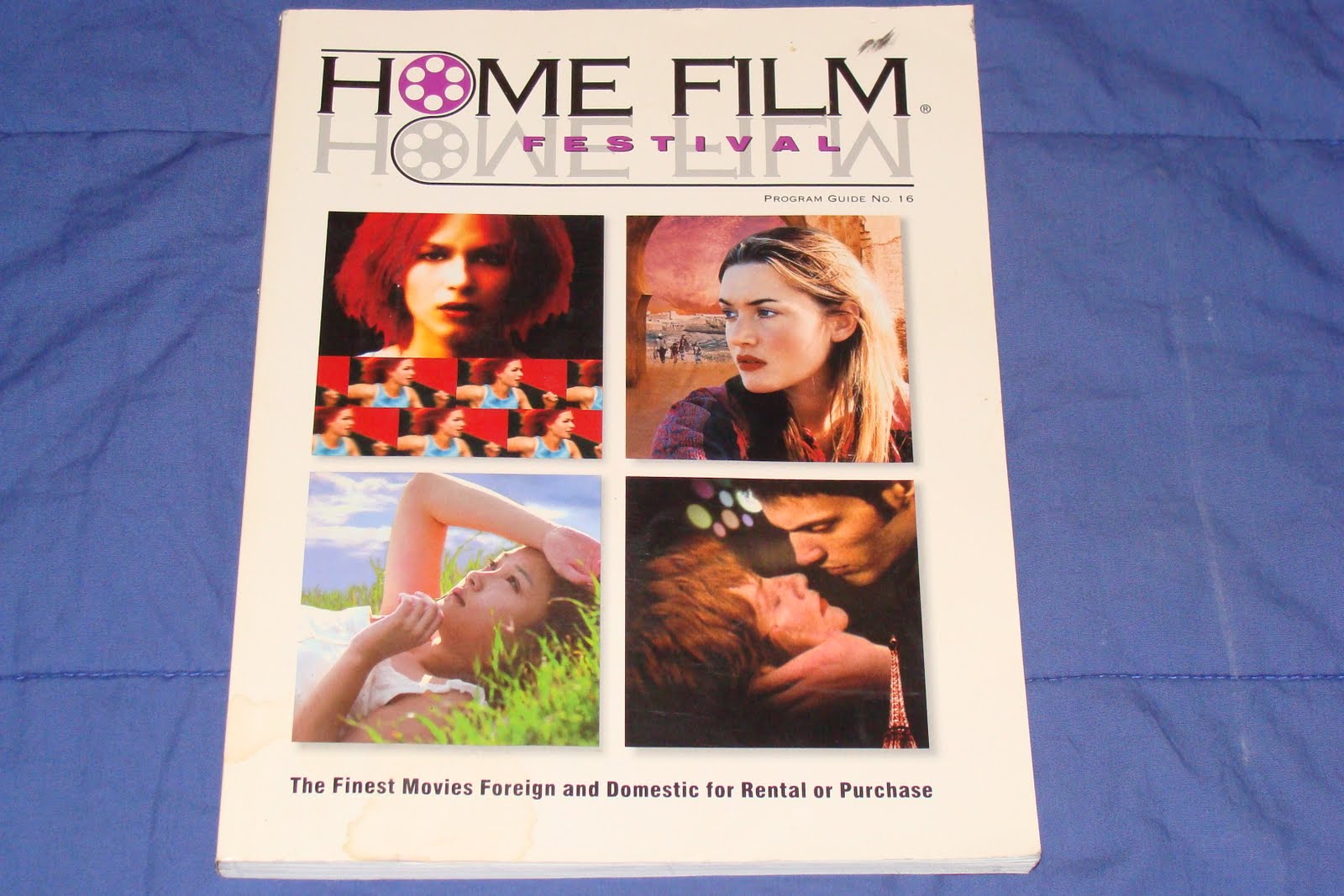
Going through some boxes of books yesterday, I came across this blast from the past. In the mid 90's, I signed up as a member of Home Film Festival and received this program guide. The idea, renting movies through the mail for flat fees and postage paid, was brand spanking new and I jumped at the chance. Granted, we're talking about VHS tapes here, but for someone with a unique passion of finding films one could not find anywhere else, this was terrific. Home Film Festival exposed me to the films of Jean Pierre Melville, Hou Hsiao Hsien, hard to find Godard, and Lars von Trier. I remember only ordering five or six times, with the pricing of 16 bucks for three tapes, and the idea of actually calling and speaking to someone with ID numbers and titles is definitely antiquated in this streaming and rapid Internet environment, but it got the job done. Good times indeed. I'm glad for the current existence of DVD-R's and Netflix, but there's a special place in my heart for combing through this guide and then having to wait 4-5 days for my VHS selections to arrive. Drop a comment if you remember other pre-Netflix methods of home film exposure.

Sunday, May 01, 2011

Produced and Abandoned #10

Ten more movies that deserve a mainstream region 1 DVD release:


1. City of Hope (1991)- Thank God John Sayles is working again and with a new movie coming out later this year, it got me thinking about this early 90's "mosaic" film which charts numerous subplots in a story of urban politics. I've only seen it twice on VHS years ago and wonder how it holds up today. With a majority of Sayles' fine work available on DVD, this one is a head scratcher.
2. United Red Army (2007)- Japanese director Koji Wakamatsu's three hour epic about the violent internal and external clashes of a terrorist group has screened all over the world at festivals and garnered a French DVD release, but that's all. I've read the final hour of this film- as police attack the Red Army compound- is tremendous. Wakamatsu has led a lengthy and varied career so I suppose the delay on "United Red Army" is no real surprise.
3. The Beaver Trilogy (2000)- Ok, first off I have no idea how good or interesting this experimental project actually is, but the thought of Crispin Glover and Sean Penn playacting the very strange existence of one man named Groovin Gary sounds alluring. I've stumbled across it at various bootleg sites, but never pulled the trigger and paid for it. Thoughts?
4. The Jerusalem File (1972)- Director John Flynn (whose made this list with great, under seen films like "The Outfit" and "Rolling Thunder") adapted this short novel into a 1972 film starring Bruce Davison as an idealistic college student caught up in international politics and violence. With Flynn's track record, I think this could be something great.
5. The Black Windmill (1974)- Starring Michael Caine, directed by Don Siegel... spies and international intrigue. What's not to like.. and I see its available to watch on YouTube!
6. Vanya on 42nd Street (1994)- One of the several Louis Malle films not available on DVD, this was a mainstay on IFC back in the day, starring a young Julianne Moore as an actress rehearsing a play in their studio. The complete lack of costumes and artifice was especially riveting and Malle's gentle touch was evident. A great little film.
7. And God Said To Cain (1970)-Supposedly tough little spaghetti revenge western starring Klaus Kinski. All of the reviews I've read for this film- which apparently stem from a now OOP poor transfer DVD- sound intriguing, with the big standoff happening within the first act, allowing the film to break usual narrative constraints.
8. Knock On Any Door (1947)- So little of Nicholas Ray's films are readily available on DVD, and this his debut, is one of them. It does air on TCM later this month, though.
9. The Seduction of Joe Tynan (1978)- Alan Alda as a senator involved with Supreme Court objections and his increasingly strained home life. Also starring Meryl Streep, "The Seduction of Joe Tynan" sounds like a promising and intelligent political drama. Too bad MGM, one of the studios awfully inept at home video releases, has never really put any faith behind this film. Update: looks like the film was just added to Netflix streaming today, May 3rd!
10. Go Now(1995)- One of Michael Winterbottom's first films about the relationship between a soccer player (Robert Carlyle) whose body begins to betray him. Another indie stalwart that made the rounds on IFC back in the late 90's. Winterbottom, one of my favorite directors, makes this film work despite the mawkish storyline and Carlyle is terrific. It deserves a wide release on DVD.

Saturday, April 23, 2011

An Appreciation: Elaine May

There was little room for women in the new brat pack of the 70's. Either marginalized to the independent fringes such as Barbara Loden or encapsulated within international cinema in the likes of Line Wertmuller or Agnes Varda, the machismo-enraged ticket buyers were interested in large, deadly sharks or casting a fresh eye on the mean streets of New York. But there was another director who produced three stunning films in a five year creative burst amongst the boys. Elaine May. Coming to the silver screen by way of Broadway (and with ex-comedy partner/writer Mike Nichols on her roster of good friends), May never quite got the respect she deserves.... in my opinion at least.

Her initial film, "A New Leaf", which she also wrote, was released in 1971 to good reviews but little box office. Watching it today, not only does it crystallize May's unique ability to write witty (and hilarious) dialogue, but it begins her fascination with the simple interaction between two divergent souls... a theme that will be explored in all her films. Starring Walter Mattheau as a bankrupt New York playboy forced to marry the clumsy and nerdy Henrietta (May in a supporting role) for her money, "A New Leaf" avoids the trappings of its sitcom set-up that many films might have fallen into through its innocent, gleeful and almost Chaplin-esque qualities. Look no further than the awkward meeting of playboy Graham and Henrietta. Comparing it to most comedies of the last 40 years, not only is "A New Leaf" a terrific and tone-perfect debut, but still funny as hell.

In 1972, May directed her second film entitled "The Heartbreak Kid"- which I personally consider her very best. Despite the terminally awful remake by the Farrelly Brothers a few years ago, which fails to capture the supreme awkwardness or humanity of the original, May's film remains an accurate-feeling thermometer of the times. Charles Grodin stars as Lenny Cantrow, newly married to Lila (Jeannie Berlin) and on vacation in Miami for their honeymoon when he meets the much younger and attractive Kelly (a stunning Cybil Shepherd). Growing increasingly addicted to Kelly's beauty Lenny begins to make drastic choices. "The Heartbreak Kid" is a comedy... just a very dark and unsettling one. Inharmonious matrimony and the idea of separating from the stable life established by their 1950's parents, early 70's cinema bore this unrest like a badge of honor. From Cassavetes in "Husbands" to Ingmar Bergman's scathing examination of a marriage on the brink in "Scenes From a Marriage", "The Heartbreak Kid" feels right at home with this malaise, albeit with a smirk and whimper rather than existential guilt. The scene in a seafood restaurant when Lenny tries to announce his feelings about his new found young love goes on for what feels like forever, leaving Lila a crying, miserable mess and the fellow onlookers forced to confront this couple's apocalypse with them. It's a moment alternatively sad and side-splitting funny, with Lenny desperately attempting to talk his way out of it (as he's done most of the movie) and Lila, crying, gasping for air as if she's been gut punched. And in all honesty, May's film does create the alternate life of Lenny and beautiful young Kelly as something more healthy and satisfying. But even then, like her ex-partner's generation-setting masterpiece "The Graduate" 3 years earlier, "The Heartbreak Kid" ends on a resoundingly depressing note for a comedy even after Lenny succeeds in his goal. While "The Heartbreak Kid" does surpass the expectations of a great (if uncomfortable) comedy, it also features some indelible image making, such as the first appearance of Cybil Shepherd, with her face blocking out the sun of a relaxing Lenny on the beach, which in and of itself deserves to be regarded as one of the finest entrances in screen history.

In 1976, May wrote and directed "Mikey and Nicky", a modest drama starring Peter Falk and John Cassavetes. Filmed mostly on location in New York, the film remains May's most potent examination of friendship soured by external forces. Cassavetes plays Nicky, a low rent member of a crime organization holed up for some oblique act he committed against the boss. His best friend, Nicky (Peter Falk) is tasked to murder Mikey. The two men spend a nervous night and morning together as the questions of will he or won't he continue to surface. Played in long takes and full of awkward stammering and the usual Cassavtes-like improv set pieces filled with booze and nervous laughter, "Mikey and Nicky" infuses every moment with bustling New York life and congested street noise. It's certainly May's most visually aggressive film, and one where the subject matter seems to lend confidence, such as a tension-filled scene in a diner where we carefully wait for a payphone to ring. The parlay between Falk and Cassavetes grows stronger as the psychological games mount. Fitting comfortably in neither the crime genre or the buddy movie, "Micky and Nicky" is truly an effort that defies categorization.

Then there was "Ishtar". Released in 1987 at a staggering budget for a comedy, amidst rumors of director and star discontent and unanimously negative reviews, it's a film that basically killed May's career behind the camera. Starring Warren Beatty and Dustin Hoffman as lounge singers who embark on a circuit tour in Morocco and end up being mistaken for CIA operatives, the film's out of proportion legend far proceeds its actual merit. All of that to say it's not a terrible film, consistently funny and completely indicative of the 1980's buddy comedies of Akroyd, Chase and Murphy. One of the biggest laughs I can remember having at the film is its typical Elaine May conversation that skewers both politics and the almighty dollar. While being 'recruited' in Morocco by CIA officer Charles Grodin, he lures Hoffman with the line of... "we'll pay you 150 dollars a week"... Hoffman- "really?" Grodin- "sure, I mean you can't really put a price on democracy". Then there's the blind camel scene that plays like a another reference to Chaplin... and Hoffman's impersonation of an Arabic auctioneer in the desert... jokes and scenes that feel like rocket science compared to the gross out humor and juvenile antics of current comedies. "Ishtar" certainly doesn't deserve the banishment it's refined in certain circles today, and its a supreme shame that May has never rebounded from the personal and bureaucratic offenses stirred up by the film. She's much too talented to be sitting in the wings. Now, if we could only get a few of these films available on DVD, maybe the retrospective appreciation could begin.

Tuesday, April 19, 2011

On Hanna

There's no doubt that director Joe Wright loves all that's technically dazzling when it comes to camera movements. The much talked about tracking shot in his 2007 film "Atonement" is self indulgent, yet my heart still races when I realize I'm in the midst of a specially arranged tracking shot that dares to visualize certain narrative points in unique and challenging ways. While there's not quite the length of this shot anywhere in his latest film, "Hanna", Wright does showcase several technical moments of brilliance in a film that otherwise feels remote.


Starring the young Sairose Ronan- who has quickly amassed a few roles that pose her as an energetic new talent on the brink of something great- "Hanna" sets up the premise that she is a fresh-faced killing machine, trained in the wilderness by her ex-CIA father (Eric Bana) and chased relentlessly by government figure head Cate Blanchett. The moment young Hanna is captured and her innate ability to run, survive and shoot weapons becomes imminent, "Hanna" turns into an eye-catching, post-punk fast and furious romp across downright weird locales bracketed against the techno thumpings of The Chemical Brothers. If nothing else, "Hanna" feels like a modern revenge grrl fantasy, filled with innovative cinematography (by the great Alwin Kulcher) and jaw-dropping set pieces.... such as the image of the very evil Cate Blanchett emerging, literally, from a giant wolf's mouth in an abandoned amusement park. Thrown into the mix is Ronan's dough-eyed connection with the outside world and a friendship with a fellow teenager (Jessica Barden) that quietly slows down the middle section of the film into an offbeat coming of age tale. But its not long before director Wright re-emerges with bullets, sadistic German bounty hunters and lots and lots of running.


Ultimately, I'm split on "Hanna". One side of me wants to celebrate the uniqueness of the film through Wright's esoteric style of filmmaking... such as the long handheld shot of Eric Bana through a bus station, down an elevator and into an underground parking garage where a quick fight ensues with a half dozen agents wanting to bring him in. There's yet another scene early in the film that explores some of Hanna's background, where a handheld tracking shot slowly follows Blanchett's fatal walk up to a burning car. While I loved every second of the anticipation of what was to come, I could hear the grumbling in front of me of "hurry up already". Clearly, parts of "Hanna" are not for mass consumption... and that alone should be enough to recommend. But there's never really a solid connection established for Hanna as a person. It's all surface, neon lights and, at times, MTV-video style ediitng... all aspects of modern film that don't quite lend themselves to strong character interaction. "Hanna" is a noble effort, but not quite. For me, that's the most frustrating thing about 2011 so far and the number of "almost greats" and "not quites".

Saturday, April 16, 2011

The Alphabet Meme

An interesting idea.. and an experiment that tests ones recollection for movie titles at the drop of a hat, but fun nonetheless. Started by the terrific Rupert Pupkin Speaks blog, this meme asks that each participant list their favorite (or random) movie titles alphabetically. There are all types of diversions, so be sure to click on the participants and discover some great movies. So, without further adieu, here's my very 70's edition:


A is for All the President's Men because no other film justifies the idea of truth being in the details... and I hold my breath to this day everytime Pakula films someone simply dialing a phone.


B is for Badlands because the sweet innocence between Sissy Spacek and Martin Sheen still impresses today. And you know, its Malick.


C is for Cemetery Without Crosses, one of the best non Sergio Leone revenge westerns of the late 60's and early 70's..

D is for Day of the Jackal, another riveting 70's police procedural that boasts an international cast and flawless storytelling.


E is for The Exorcist because one its a great film, meticulously framed and edited and two, its damn hard to come up with any other "e" titles of the 70's.


F is for Un Flic, aka "Dirty Money", and the great Jean Pierre Melville's final film about a bank robbery that tailors his penchant for doomed criminals and fatalistic hues. And I'm sorry, but no one films guys in trench coats walking around quite like Melville.


G is for Get Carter because the British are just ballsy about their lone-man-on-a-revenge-spree movies. And Michale Caine is Carter!


H is for Husbands because you know at least one Cassavetes film has to make its way onto this list and for that 30 minute diner scene that runs uncomfortably long like only Cassavetes can orchestrate. In his films, dinners are often like slasher films.


I is for Idaho Transfer. Once available on DVD but now sadly OOP, Peter Fonda's hugely under appreciated time travel movie is definitely a relic of the early 70's, with hippie students playing with time and creating some drastic consequences. Look for it.


J is for Junior Bonner because not only is Steve McQueen a majestic bad ass, but this is probably my favorite Peckinpah film.


K is for The Kremlin Letter. This fun, convoluted spy thriller saw venerable director John Huston move into the 70's (for my money, his most creative period) with a bang. Hard to find, but it does air on cable sometimes and well worth the DVR set.


L is for The Last Picture Show. So many great L titles I could have chosen here, but I have to go with my fav in "The Last Picture Show" because, 40 years on, this film still inhabits the Texas landscape like no other and so closely nails the feelings, moods and whims of the state I call home.


M is for The Master Touch, a well plotted, brilliant heist film that tackles that age old theme of the 'old criminal and his one last job'. Kirk Douglas, doing what many aging film actors did in the 70's, stars in this Italian production of that great genre known as Euro-crime and succeeds with dazzling results. Available on a bare-bones DVD so Netflix it now.


N is for The Nickel Ride, another seemingly forgotten, modest mid 70's character study about a wheeling and dealing neighborhood crime boss trying to hold onto his sanity as modern progress and personal upheavel threaten to override his lifestyle. Jason Miller is terrific and the film darts in several directions that are shocking.


O is for The Odessa File, Jon Voight's best film, directed by the workmanlike (and recently deceased) Ronald Neame that dares to place Nazi hunting into the mainstream.


P is for The Passenger, a thriller like no other, helmed by auteur Michealangelo Antonioni and infused with that sublime paranoia rampant in 70's cinema, made all the more quizzical through Antonioni's methodical avant garde gaze.


Q is for Quintet. Robert Altman's most misunderstood effort? Probably, and not near as bad as everyone claims. In fact, the re-emergence of cold, clinical sci-fi films like "Code 46", "Gattaca" and "The Island" probably owe this film a huge debt.


R is for Return From Witch Mountain, which not only remains one of my very favorite films as a kid, but the one that got me hopelessly attracted to Kim Richards and made me pay to go see movies like "Tuff Turf".


S is for Smile because a re-watch lately makes me think Michael Ritchie's panaromic view of mid 70's California against the backdrop of a beauty contest just might be better than "Nashville". Discuss.


T is for Three Days of the Condor. More trend setting paranoia from the 70's.... can't possibly leave this one off the list.


U is for Up In Smoke. On a Saturday night at 2am, watch this and see if you don't laugh until it hurts.


V is for Vanishing Point. Like the title, somewhere along the half way point, this film becomes something else besides a chase movie. Only in the 70's could artists take something as mundane as muscle cars and transform them into a mythical quest across the cosmos.


W is for Wedding In Blood, Claude Chabrol's deeply moving tale of infidelity dwarfs anything else he made in the 70's. Enigmatic at times, the title alone should tell one this is an alienating study, but well worth the effort to track down and see.


Y is for The Yakuza because Mitchum, like Kirk Douglas earlier, travels to Japan and kicks ass in some great Euro-crime. Sydney Pollack behind the camera doesn't hurt either.


Z is for Zombie, one of those illogically edited and filmed Lucio Fulci splatter fests that always brings a smile to my face when I watch it.

Saturday, April 09, 2011

Random Thoughts

First off... new television. I'm not sure how I got turned onto AMC's new show "The Killing". I rarely watch AMC for their butchering of classic movies with commercials. Maybe it was advertised on the last season of "Breaking Bad" I watched on DVD. Regardless, a fantastic show after just two episodes. The choice of basing its harrowing and sad tale of a pretty 17 year old girl's murder in dreary Seattle is somehow fitting and takes the atmosphere to a whole new level. Lead actress Mireille Enos perfectly portrays a female detective drawn back into the murder on her last day before retiring and starting a new life in San Francisco. The faces she makes when her new partner makes the family a promise to find the killer.... the tired way in which she questions a witness... the lackadaisical strut in which she carries herself establish the character as a new spin on old genre tropes. Set the DVR's.

New music. Two old dogs have resurfaced to make some new noise. First, J Mascis of Dinosaur Jr fame just released a blistering solo album that combines melancholy acoustic numbers mixed in with his heavier trademark slurred guitar. Admittedly, Mascis really always was Dinosaur Jr. so any new work from him makes me very happy.


Unlike Dinosaur Jr, its debatable whether Thurston Moore was the singular driving force behind Sonic Youth's wall of sound. His latest solo album entitled "Demolished Thoughts", due to be released in May, knocked me over with the first song introduced last week. I can't wait for this one.


And finally, RIP to the great Sidney Lumet. I'm extremely glad I completed a retrospective of his work a few years ago. He will be missed on the cinematic landscape.

Thursday, April 07, 2011

Current capsules

Source Code

No sophomore slump for director Duncan Jones. His latest film, the Jake Gyllenhaal/Michelle Monaghan starring sci-fi thriller is even better than is debut film “Moon”. Never straying far from the emotional connection of his main characters (which always lends the loopy sci-fi genre a welcome sense of identification), the film works so well as a thriller because I actually wanted this couple on a bomb-laden train to survive. Through a series of recurring events timed to 8 minutes, Gyllenhaal is the root of a government experiment sending him back in time (or memory rather) to uncover the source of a terrorist attack on a tram outside Chicago. Redundant, of course, as he relives the same eight minutes of time over and over but never boring, director Jones emphasizes each segment with an exciting new perspective. Upping the ante is Gyllenhaal’s human nature curiosity to figure out why he’s involved with this experiment in the first place. All of this comes together in a taut… and even sweet… mind bending finale.

Insidious

Dissonant piano chords… a bleached out, flat visual style…. And a title card that literally jumps off the screen with aggression… James Wan’s “Insidious” starts out as a slow burn horror movie and evolves into something pretty disturbing. The moments early on- involving the ominous use of a baby monitor and the horrific sounding voice it picks up- more than make “Insidious” an enjoyable haunted house story for people wanting to jump a bit. And then, when Wan and screenwriter Leigh Whannell begin to explore ideas of astral projection, demon channeling and dream walks into hell in the second half, “Insidious” becomes something altogether terrifying. I give the filmmakers credit for not playing it safe. This is not the usual horror movie and (thankfully) a huge departure for Wan and Wannell with their “Saw” franchise, completely devoid of blood and gore. In the final 30 minutes, “Insidious” travels to some insane places and I found it genuinely unsettling, much like Rob Zombie’s “House of 1000 Corpses”. Both films use the standard genre to spin their own macabre tales replete with odd images and unique editing styles that propel shadowy craziness into new heights. A new midnight cult classic for sure and one of the first great viewing experiences of 2011.

Certified Copy

Abbas Kiarostami’s “Certified Copy” continues on his penchant for meta-cinema of the highest order. Alongside his great 1991 film “Close Up”- which dared to mix up cinema, voyeurism and documentary with head spinning acuity- “Certified Copy” follows a couple, writer James (William Shimell) and antique dealer Elle (Juliette Bincohe) as they (possibly) first meet and then spend the day together playacting a relationship with both themselves and strangers in the sunny Italian countryside. Trying to decipher whether their relationship truly is real or not (which the beginning gives hints to both sides of the coin) seems inconsequential. “Certified Copy” is Kiarostami inverting the meet-cute romance genre into a war of words, body language and imagination. Binoche is simply brilliant here, running the gamut of emotions with ease.

Saturday, April 02, 2011

70's Bonanza: Sitting Target

Douglas Hickox's 1972 crime film, "Sitting Target" begins as a prison break-out film before turning into a revenge thriller of the highest possible order... and all of it is very angry. Starring Oliver Reed as Harry Lomart, a British thug sent to prison, the opening moments see him sitting down for a visitation from his lovely wife (Jill St John), who proceeds to tell him that even though she's pregnant, she'll be divorcing him and marrying another man. Lomart proceeds to punch his way through the glass and unsuccessfully strangle his wife. Thrown in the hole for 30 days, Lomart has plenty of time to think of the devious ways he'll make his wife pay for her unwillingness to wait for him. Alongside partner in crime Birdy (a very young Ian McShane) Lomart makes his break from prison in a taut sequence of wall climbing and barb-wire vaulting into the free world. From there, "Sitting Target" becomes a meticulous pattern of tracking down old cohorts, procuring weapons and carrying out their plan of revenge.

Director Hickox (a personal favorite auteur for Quentin Tarantino) frames "Sitting Target" in visually aggressive ways. In prison, the main characters are represented by stilted angles behind bars. On the outside, one of the main sets is an apartment where Birdy and Harry corner and trap the girlfriend of an old cohort. There are rumblings of past deceptions amongst the band of thieves and Lomart and Birdy menacingly wait for their old partner to return home. In an apartment full of mirrors on the doors and ceiling, "Sitting Target" becomes a paranoid longueur as they flirt with the cornered girlfriend and (eventually) take advantage of her.

But it's not long before the burning desire of Lomart takes control and "Sitting Target" gets down to the nitty-gritty of its central revenge idea. Of course, this is the 70's (and British no less) and "Sitting Target" spins into a nihilistic and especially violent denouement. If nothing else, the film is worth seeing for Oliver Reed's determined performance that will almost turn your stomach for his single minded obsession for payback. Made immediately after Ken Russell's maniacle epic "The Devils", one can't say Reed wasn't pushing the boundaries of stardom.

Sunday, March 20, 2011

Top 5 List: In Space, No One Can Hear You Go Mad

5. The Dark Side of the Moon

Probably the most obscure movie on this list, it's still immensely entertaining in that direct-to-video early 90's way. Written about at length here, "The Dark Side of the Moon" was directed by no one of real fame (DJ Webster) and starred no one of real notoriety. But it does seem to come from a genuine place and it does tweak the idea of madness in space into some interesting theories about the dark side of the moon, the Bermuda Triangle.... and the devil himself. The production values do lack something, but its the film's atmosphere that more than makes up for any economic shortcomings.


4. Planet of the Vampires

Now here's a really interesting film. Ever wonder how one of those Italian giallo films would play in space? Mario Bava attempts just that here with "Planet of the Vampires". Take all the visual trademarks of the wildly popular giallo genre- i.e. garish lighting, extravagantly cheap looking costumes, fog drenched settings and a distinct emphasis on obscuring the killer or killers through POV shots or off screen menace- and one gets the basic set up. But I make "Planet of the Vampires" sound worse than it is. I actually really like this film and it does build up some incredible tension while leapfrogging the idea of "madness in space" for future consumption. A crew of astronauts lose contact with their shipmates and are forced to land on a strange planet where the crew members begin to resort to mind-numbing fits of rage and violence against one another. Bava stretches out the appearance of the 'vampires' to sustain the film's thriller status while developing a unique metaphor for our modern definition of vampire. Bava's film has long been out of print, but i recently emerged on Netflix's streaming service.

3. Sphere

Ok, a bit of a cheat here, I admit. "Sphere" takes place under the ocean instead of outer space, but its emphasis on cramped confinements, lost space ships and side plots involving the 4 specialists (Dustin Hoffman, Sharon Stone, Liev Schrieber and Sam Jackson) facing their worst fears all fit into this list. I'm an unabashed lover of Barry Levinson's somewhat loopy and intellectually stuffy adaptation of Michael Crichton's novel, and the film hasn't diminished in my opinion since seeing it opening night back in 1998. "Sphere" tosses out alot of ideas- time travel, psycholgical warfare, killer jellyfish- and its oblique ending never registered with the mainstream movie-going public and that's a shame. "Sphere" still remains an under appreciated film that examines the treacherous outcome of dealing with extraterrestrial methods, even when the best minds in the world are in charge.

2. Event Horizon

For many movie fans of my generation, "Event Horizon" was THE best madness in space film to come along. Not only is it an effective science fiction tale, but an out and out horror film that managed to combine the best elements of both genres. Starring Laurence Fishburne, Sam Neill, Kathleen Quinlan and Joely Richardson, the crew is assigned to recovering a ship that was lost years earlier and then re-appears. Of course, something evil is brought aboard and each astronaut is forced to confront some of their scariest thoughts. The joy of "Event Horizon" is not in the reductive narrative, but its eerily timed scares and psychological dread. Director Paul W.S. Anderson has gone on to create some really awful muck, but "Event Horizon" has that something that still makes it relevant for this type of list.

1. Solaris (1972) and Solaris (2002)

The definitive films about the possible ill-fated effects of a lonely trek through outer space, I suppose the real master of the genre is Russian novelist Stamislaw Lem who wrote the original novel. A grounbreaking mixture of guilt, science fiction and political repression, the novel is a terrific read which gives us two very different films. Russian auteur Andrei Tarkovsky's version of the novel is ponderous and trance-inducing with its long stretches of space travel (and earthbound travel as well). Stephen Soderbergh's 2002 update runs half the length of Tarkovsky's original but has a serene style all its own. Though visually miles apart, both films retain the central idea of an astronaut growing increasingly mad by the effects of the planet Solaris. These two efforts may seem like easy additions to the madness in space genre, but they're both illuminating pieces of art that continue to expand and open up new ideas everytime I watch them.

Thursday, March 17, 2011

DVD Shout Out: It's Kind of a Funny Story

There are always those films that slip the cracks, and for me, Ryan Fleck and Anna Boden's "It's Kind of A Funny Story" is one of them. Arriving and disappearing from theaters in the blink of an eye last year,I can assuredly say that if I had seen it earlier, it would have surely ranked pretty high on my official list of the best of the year.

Fleck and Boden have amassed an incredible track record of piercing films, from the indie drama "Half Nelson" to the acutely moving minor league baseball saga known as "Sugar". So I suppose it really comes as no surprise that they hit another home run here with this modest, affectionate and sweetly engrossing film starring Keir Gilchrist as a somewhat depressed (but mostly stressed out) student who checks himself into a mental hospital and ends up helping everyone else more than himself. It all sounds horribly cliched, and there are a few moments of Wes Anderson-like whimsy in the first half that threaten to engulf the narrative, but "It's Kind of a Funny Story" also hits such high notes of honesty and cathartic energy between its characters that it comes off as something more.

And then comes this scene:


... and from there on I was hooked. Emma Roberts, the suicidal teenager who forms a relationship with Craig (Gilchrest), doesn't formulate a role full of nervous ticks or emo irrationality. It's a very human performance. And that's the real beauty of the film, which is based on the acclaimed autobiographical novel by Ned Vizzini. Even though the central setting is a mental ward and the jokes could be simple jabs at insanity, each charatcer is developed with warmth, humor and depth. There's the weird, but ultimately charming, way in which a fellow patient named Johnny (Adrian Martinez) whispers "Johnny don't phone kiss" at the end of a telephone call.... or the immense performance by Zach Galifianakis as the man who quickly befriends Craig. While the film never specifically spells out his troubles or the outcome of his problems, Galifianakis portrays Bobby as someone caught in the downward spiral of life with little idea of how to stop-gap the issues. Again, its a very human performance that displays humor, rage and complete understanding.

With a soundtrack by Broken Social Scene and Fleck/Boden's natural instinct for editing and camera movement- i.e. a glorious tracking shot down a hospital hallway as Gilchrest and Roberts try to find their way to the roof or a strong cut to her face as she blows away an eyelash he's just removed from her face- "It's Kind of a Funny Story" should not have gotten lost in the Holiday season rush last year. It's a distinct pleasure.

Monday, March 14, 2011

Revisiting the Faves: The Bed You Sleep In

"The Bed You Sleep In" ranked as one of my favorite films from 2002.

Jon Jost made what was perhaps his most accessible film with "The Bed You Sleep In", a modest drama that weaves two types of narrative filmmaking into a perfect blend of image and emotion. Known for his avant garde works of the 80's and 90's (which, sadly, very few are available on any type of home video distribution), "The Bed You Sleep In" was produced in 1993 but didn't see much of a distribution until 2002 when I caught up with it at the Dallas Video Festival. Part documentary about the slow Pacific Northwestern life of dwellers along the Oregon coast and part searing family drama, "The Bed You Sleep In" stars Tom Blair as Ray, a lumber mill owner besieged by all types of bad luck. A recent government initiative to tax a certain type of wood threatens his livelihood and business. He's affronted by a young wandering preacher (Thomas Morris) who warns of dire future consequences if he doesn't change his ways. Then, in an unnerving shift in tone, Ray comes home one day to find his wife, crying and distraught over the letter written by their daughter who's away at college. It levies particularly harsh blame at the feet of Ray. Crafted like an intimate novel, the remainder of the film plays out like a complicated guessing game of guilt and refusal, working itself out through its characters' slow-speech pattern and trance-like dissolves. It's certainly a Jost film.


As previously mentioned, "The Bed You Sleep In" feels as if its broken into two distinct parts. For the first hour or so, Jost is content to establish mood and place through long, static exterior shots of the unique Northwestern town where the film takes place. From the rusted steel of street barriers to a gentle running stream between a rain-soaked landscape, "The Bed You Sleep In" could be taken as a tourist advertisement for the area's very Zen like exteriors. In the film's most bravura set-piece, Jost examines the minutia of the town's greasy spoon diner through an elegant, four minute tracking shot that pivots and turns 360 degress around every corner of the restaurant, eavesdropping on the customer's conversations and displaying the complex actions attributed to serving the dishes behind the counter. At first, this may seem like cinematic gamesmanship (which Jost is very adept at, by the way), but it serves a purpose as well. "The Bed You Sleep In" takes its time and seems to absorb the very lifestyle of Ray, mapping out his comfort zone so when the bomb drops later, we fall into the tragic circumstances. Basically, its the inaction of a travelogue film turning radically active later.


The consequences, as foreshadowed by the wandering preacher, do come home to roost for Ray, and Jost handles it with the rigor in which he handles most everything in his career... a slow dissolve with Ray's face covering the blue tinted windhsield of his car as he drives. "The Bed You Sleep In" doesn't aim for tragic melodrama, but it very nearly gets there in its own unique way.

"The Bed You Sleep In" is available on DVD.

Friday, March 11, 2011

New Stuff, Finally

The Adjustment Bureau

George Nolfi’s directorial debut, “The Adjustment Bureau”, is an involving and slightly loopy love story that works itself out through the enormous chemistry between Matt Damon and the lovely Emily Blunt. Essentially a tale about the choice between free will and the more darker-themed tones of a matrix-like web of higher authority, the film never misses a beat. Emily Blunt, who I’ve admired for several films now, lights up with the screen with every appearance and its on the interaction between her and Matt Damon that the film wins the viewer over. Basically, this is a sci-fi story with heart. When things get downright other worldly at the end, I was pulling for Blunt and Damon. But the real star here is the Philip K. Dick story that “The Adjustment Bureau” is based upon. Dick continues to provide Hollywood with a wealth of ideas based on his intelligently progressive short stories and “The Adjustment Bureau” (adapted by ex-screenwriter Nofli himself) retains the verve of science fiction while maintaining an emotional core that doesn’t feel out of place in the slate of good modern love stories. A very nice way to start out my early movie-going year.

Hall Pass

Maybe I should have waited to write the above line before succumbing to the slight urge to see the latest Farrelly Brothers movie, “Hall Pass”. I would say their career is long beyond the apex of “There’s Something About Mary”, or does that film simply live in my memory for its groundbreaking use of gross/shock humor in the mid to late 90’s? Either way, they try to regain their comedic maestro crown again with more shock humor, including penis jokes, frontal male nudity and a sneezing scene that could give the hair gel scene a run for its money. The problem… none of it even made me snicker. It all feels like the film is trying way too hard to push the limits, which seems to be the fault of so many comedies today. Owen Wilson, Jason Sudeikis, Jenna Fisher and the incredibly funny Christina Applegate seem wasted as the married couples taking a breather from each other in order to reclaim their golden days of being single. The most touching moments in this film have to do with the realizations that everyone is passed their prime, especially when the guys’ first night out on the town ends up as a gorge-fest on food at the local Applebees… something we can all relate to. Less relatable is the idea that a golden beauty like Nicky Whelan would be attracted to Owen Wilson… or maybe even that Applegate would have married a guy like Sudeikis? I’m analyzing “Hall Pass” more than it deserves. Pretty awful.

Cold Weather

Aaron Katz, whose previous features “Quiet City” and “Dance Party USA’ where introspective additions to the DIY movement of current independent filmmaking, ups the ante a bit with a low-fi thriller of sorts in “Cold Weather”. Cris Lankeneau is Doug, a Portland, Oregon native stuck in a dead end job with an affection for Sherlock Holmes novels. When his ex-girlfriend visits town and promptly disappears, Doug enlists the help of his sister (Trieste Kelly Dunn) and friend Carlo (Raoul Castillo) to investigate the matter. Katz’s interest here resides less in a tidy resolution to the mystery aspects of the film, which makes it a defiantly proper “mumble core” movie in which atmosphere and awkward silence is more of a preoccupation than narrative cohesiveness. “Cold Weather” is a challenging film, none more so than the fact that Katz so eloquently builds up momentum in its thriller aspect only to disappoint with an anti-climactic finale that has one scratching their heads. I’m all for oblique endings (see “No Country For Old Men”), but “Cold Weather” leaves one with very little to savor after its abrupt ending.

Tuesday, March 08, 2011

Children Of War: Edward Yang's "A Brighter Summer Day"

In the annuls of ironic film titles, Edward Yang's 4 hour masterpiece certainly takes the cake. Taking place in the summer of 1959 and the following year, Yang's film is autobiographical in the sense that his family lived through the same turbulent times. Yang's family was displaced from China into Taiwan during the late 40's and the film's slow-evolving burst of violence is based on an actual incident. Everything in between is immersing and, at times, overwhelming. "A Brighter Summer Day" does focus on one central family (and essentially a young boy named Sir) as they face problems both intimately and politically.

Released in 1991 and growing marginally over the next few years where it received critical support slowly when it was shown at various film festivals or Yang retrospectives, "A Brighter Summer Day" has been my number one sought after film for several years now and it doesn't disappoint. It's length is almost necessary... observing a sprawling group of students and street gangs as they fall in love, fight with each other, deal with domestic problems within their families and, perhaps most importantly, swoon with Elvis Presley records and diligently decipher the lyrics. Still, the street gang violence eventually overtakes as the crux of the film, with its many young child stars evolving from innocent bouts of fistfighting and gangster posturing to bats and samurai swords. Yang quietly belies the fact that the children's seething angst mirrors the unhappiness of their parents resentment for leaving their homeland for an uncertain future.


Like the films of Hou Hsiao-Hsien, "A Brighter Summer Day" is an instinctual film. Yang never rushes any shots, resorts to simple camera movement and gentle dollies to enhance the narrative, and allows the lingering strands of his multiple stories to breathe. For example, one of the surface characters is gang leader Honey. He's only mentioned for the first two hours or so, and when he does finally arrive on-screen, his name is never mentioned but the viewer gets an immediate idea of his presence. And while the many gang fights can be disorienting as to their root cause (and Yang doesn't help matters by obscuring most of them at night time or during a driving rainstorm), what's important is the gradual impact they have on Sir (Chen Chang) and his impressionable group of friends. Thrown into the mix are several girlfriends to the gangs that only raise the hormone and jealousy level, eventually causing the roof to blow off in shocking ways.

Yang would make several more films after "A Brighter Summer Day" dealing with some of the same issues of cultural and political displacement. Of course, 2001 would bring him international acclaim with his powerful film "Yi Yi". That would be the last film he would make, passing away from cancer in 2007. I can't imagine a more inspiring way to memorialize a life in "A Brighter Summer Day". It's full of so many gentle moments amid the violence and it lovingly recreates the excitement of discovering rock and roll music like few films. Our first loves may not result in the type of violence that spews out in Sir, but the feeling of uncertaintly and the desire to simply blend in are universal themes and "A Brighter Summer Day" crystallize it.

Friday, March 04, 2011

Produced and Abandoned #9

Ten more titles deserving a commercial DVD release.

1. The Bed Sitting Room (1969)- Richard Lester's post apocalyptic... comedy? Avant garde absurdest drama? I've only heard it described as an extremely loony affair and I just know I have to see it. Update: looks like its available on Netflix Instant Play and a showing is scheduled on TCM later this month.
2. Ministry of Fear (1944)- Fritz Lang's nightmarish film is odd, but highly effective. The first half of this film plays like a 40’s David Lynch movie- including a suburban carnival that takes place at midnight, an eerie entrance for a blind man on a train and a seance sequence that ends in murder. Once the plot (concerning Ray Milland being mistaken for a spy and hunted by a shadow NAZI organization) is defined, “Ministry of Fear” becomes a little more commercial in its second half. Still, fans of Lang deserve to have this available.
3. Puzzle of a Downfall Child (1970)- Jerry Schatzberg's psychological drama about a model (Faye Dunaway) having a nervous breakdown leads the pack of under-represented Schatzberg on DVD, followed by "The Seduction of Joe Tynan", "Street Smart" and "Sweet Revenge".
4. The Stone Tape (1972)- British television show that scared the shit out of me as a kid. I found a copy recently, and while it's not as terrifying as I remembered, its primal exploration of ghost phenomenon recording devices and bare-bones chills (ohh that high pitched scream) manage to create an entertaining viewing experience.
5. The Stolen Children (1992)- Gianni Amelio would make waves a few years later with his well regarded 1995 film "L,America", but "The Stolen Children" ranked in quite a few lists in '92 and took home the Grand Jury Prize at that year's Cannes Film Festival.
6. Mickey One (1965)- It's still a shame that Arthur Penn's ode to the French New Wave isn't readily available. Warren Beatty gives a fairly vapid performance, but part of that's the point. As a nightclub performer mixed up with the mob, Penn's black and white cinematography continually offers something new and the use of disorientation and dream sequences giddily recall Fellini. Sure, "Mickey One" can be found quite easily on cable, but it would still be nice to own the DVD.
7. Kid Blue (1973)- One more of the lost Dennis Hopper films of the 70's by veteran TV director James Frawley, its narrative recalls the story of a young man (Hopper) who arrives in a small Texas town and becomes involved with seduction and crime. I've often read this is yet another under seen revisionist western in the loosest of terms. It also stars Peter Boyle and Warren Oates.
8. Many Wars Ago (1970)- Another Francesco Rosi makes the list. I admire this Italian director so much, yet so little of his work is available. I'm not holding out much hope for this one either, as google searches yield very little besides an obscure San Francisco screening 5 years ago. I suppose I should be glad there's at least one print out there. This film tracks the disastrous results of an Italian army unit's attack during World War I. Also known as "Not Another War".
9. Little Fauss and Big Halsey (1970)- "A story of two motorcycle racers, the inept, unsuspecting Little Faus (Micheal J.Pollard) and the opportunistic, womanizing Halsey Knox (Redford)".... from the imdb.com description. Go to any MIA DVD movie list and this title shows up over and over and over....
10. Dudes (1987)- Antone else besides me remember this movie from the VHS cover? Jon Cryer and someone else dressed as cowboy and indian?