Sunday, December 24, 2006

Christmas Wishes...and 2 reviews

Holiday Wishes go out to my friends and fellow bloggers- Chris and Ojo, Moviezzz, Sam, Dennis, Adam, Evan, Brad and Craig.


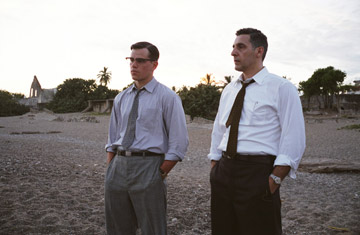
Robert DeNiro's "The Good Shepherd" is a taut, complex, and relentlessly intriguing film that uses its main character to bear mute witness on the formation of America's Central Intelligence Agency. Following a disjointed timeline that shuttles back and forth between the disastrous Bay of Pigs invasion (and the potential fallout of the government's participation) and Edward Wilson's (Matt Damon) involvement of the agency when it was a foreign intelligence group during World War 2, "The Good Shepherd" reigns in classical style and quiet, intense ensemble acting. As the double and triple crosses mount, this is a film that forces the viewer to pay attention to dialogue, inference and to catalog his or her own sense of documented history. Among the faces that crop up amidst the 30 year timeline are Alec Baldwin as an FBI informant who gives Damon his first break, Keir Dullea splendidly embodying a morally (and politically) conflicted Russian agent, Michael Gambon as a poetry teacher, William Hurt, Joe Pesci (in a scene stealing few minutes) and John Turturro as Wilson's partner. The tendency with a film like this- i.e. one that clocks in at just under 3 hours- is to either bore the viewer to tears or fastidiously churn through time and events with little regard for the implications these events initiate. Fortunately, neither happens here. While there's little chemistry between Wilson and his wife (Angelina Jolie), its established fairly early on that theirs is a marriage of convenience for a woman desperate to settle down with one of the Skull and Bones classmates of her brother- certainly not out of love. And Wilson is not a monk, of course. A majority of his guarded sensibilities that form later in the film seem to stem directly from an impotent early romance with a deaf woman (played with affection by Tammy Blanchard). The script, credited to Eric Roth, resembles the political and moral acuity of his previously penned flick, "Munich". Both films present a main character charged with the job of upholding political justice. What each character gets in return is a slowly eroding sense of self. While Eric Bana violently sheds some pent up frustration and emotion towards the end of "Munich", Damon's Edward Wilson is a hapless observer as the agency's methods become more and more violent and each accomplice becomes more and more shaded in ambiguity. We get the sense he's a time bomb waiting to go off. Both character arches are radical in their own way, and director DeNiro never forces any of the script's big moments. Roth and DeNiro also clearly understand the importance of suspense cloaked not in gunfire, but in whispers and furtive glances. "The Good Shepherd" feels right at home in the 70's, not in 2006 when everything is bigger and louder.


Pedro Almodovar's "Volver" is yet another charming but ultimately middling portrait of strong women. Perched somewhere between a sub-par Hitchockian drama and a televison weepie, "Volver" is less affecting than the previous 2 Almodovars ("Bad Education" and "All About My Mother"). Penelope Cruz is good, and the scene where she stops traffic with a song inside a restaurant should probably earn her an Oscar nomination, but I can't help but feel a little jilted in the story's mild mannered approach to five distinct women in Madrid, all desperately trying to escape one life altering event in the past that comes to reap in the present (and present generation). Almodovar has treaded on this territory before, often with much more intimacy and emotion.

Wednesday, December 20, 2006

And the Lists Roll On...

Get yourselves over here quickly. Not only is GreenCine my daily must-stop for everything film related, but now they've got a daily tally of Top 10 film lists from all around the globe. Now's the time for us list-junkies to overdose. Enjoy.

Friday, December 15, 2006

Tops In Pops '06

While I'm still wading through a myriad of film releases, I feel prettty confident that I've listened to a good majority of music out there so far this year. The following are my favorite albums of the year. Now, granted, the scope of this list is pretty narrow and I can only claim these are favorites. I certainly have no room to contemplate a "best of" list in music when I've listened to probably 3% of the music released this year. See Rolling Stone for that exhaustive year end list!. After number 1, you can pretty much interchange any one of the remaining titles. Enjoy.


1. Thom Yorke, "The Eraser"- Dramatically low key and endlessly inspiring, Yorke's feature debut album after a break from fronting Radiohead showcases his emotive voice. I remember hearing rapper Ludacris cite Yorke's vocal prowess recently, stating he was one of the rapper's favorite artists because his voice shows "raw emotion". That's a fairly accurate way to sum up "The Eraser", an album that segues naturally between the electronica rock of Radiohead with more subtle and stripped-down singles that express voice and mood over sound. This album is pure bliss from start to finish.

2. The Appleseed Cast, "Peregrino"- I discovered this band early this year and immediately bought up everything I could find. From Kansas, this rock quartet carry on the somewhat cosmic sounds of Radiohead mixed with pop-tinged influences (I guess "emo" its called?). They don't sound like anyone else out there and the lyrics are often haunting. I urge everyone to check them out here and broaden your horizons.

3. Broken Social Scene, "Broken Social Scene"- This ensemble band from Toronto combine so many dazzling elements, their sound threatens to overwhelm. I've featured their work on a YouTube post on this blog before, scoring a minor hit on the soundtrack to the film "Half Nelson" back in the summer, which is where I first heard them. Their music (intermingling horns, Sonic Youth-frazzled guitars, a crescendo of voices) is unique in modern music, creating large and expansive songs that play like free form jazz pieces. As with everything else these days, the best exposure to their music is here on MySpace.

4. The Mars Volta, "Amputechture"- A bit of a letdown after the sprawling masterpiece that was last year's "Francis the Mute" (which is probably the best album I've heard in the last 5 years), "Amputechture" is still light years ahead of 99% of the other stuff out there. Their sound hasn't changed- The Mars Volta are still 10 minute plus jam freaks who love progressive rock and song titles like 'vicarious atonement' (so basically those who feel they whank off with their guitars too much will still think they whank off with their guitars too much). Don't listen to the words, but get lost in their complex arrangements and stunning use of vocal and sound.

5. Black Tie Dynasty, "Movements"- This Dallas based band covers the 80's scene pretty well. Cashing in on the much heralded success of bands like The Killers and The Strokes- bands that mine a groovy 80's sound with a retro makeover- The Black Tie Dynasty are something more than that. The seem genuine in their lust for the past, plus they put on one helluva show. While their best known hit, "Tender" is probably their weakest, this is a band that I'm sure will continue to expand their sound into somemething special. You can learn more about this band at their site. One glance at their influences tell you all you need to know.

6. Muse, "Black Holes and Revelations"- Epic in every word, from the opening chords to the last. Invoking spaghetti western sounds (that seem to come from the long lost vaults of some Ennio Morricone music sheet), political commentary and brash vocals, Muse's lastest album feels playful and direct.

7. People In Planes, "As Far as the Eye Can See"- Originally from Cardiff, Wales, the vestiges of 70's hard rock seem to remain in distant parts of the world (see the next band as further proof). They scored a minor hit early n the year with a song called "If You Talk Too Much, My Head Will Explode", which has to be the best song title ever. There's nothing flashy about People In Planes. You've got straigh-forward rock that echoes back to the influences of Led Zeppelin and Black Sabbath. And this is the one band that I was less than 100 yards away from seeng, but didn't. They were the first band to play on the second stage, which was way before my friend and I even knew where the hell the second stage was. I heard they rocked, though. Give them a spin at their website.

8. Wolfmother, "Wolfmother"- See above. Pure unadulterated hard rock. Great stuff.

9. The Killers, "Sam's Town"- Noy quite as relevatory as their debut album, but The Killers carry an unmistakable style that causes a nice discussion. Are they 80's rip offs or new wave extraordinaires? Either way, I dig their unprentitious rip offs of 80's hits.

10. Bands I picked up this year that would've made the list if these albums were released this year- so sue me for shameless plugs!:

Fair To Midland, an excellent Dallas band whose album features some of the best (and worst) tracks I've heard from a local band in a very long time.

The Twilight Singers, former Afghan Whigs front man Greg Dulli's band. Listen to their rendition of Bjork's "Hyperballad" and be in awe...


Bands and albums I've overlooked that deserve much more listening- TV On the Radio, The Yeah Yeah Yeahs (I loved their first album), Dylan's Modern Times (to see what all the fluff is about), Surfjan Stevens, The Arctic Monkeys, new Tom Waits (his past album are very hit and miss with me) and Midlake.

Thursday, December 07, 2006

On Recent Comedy

Watching 3 new comedy films almost back to back over the last week gave me a rare adrenaline rush during this time of the year when my movie-going experience is saddled with heavy handed drams (i.e. Oscar and Christmas season)- Broken Lizard’s “Beerfest”, Christopher Guest’s “For Your Consideration” and Larry Charles’ “Borat: Cultural Learnings of America For Make Benefit Glorious Nation of Kazakhstan”. While one is much more subtle than the others, all three hit their intended marks… they made me laugh… and laugh a lot. “Beerfest”, the one that probably received the most contemptuous reviews, is also my favorite of the three. I’ve long been a fan of the Broken Lizard crew (yes, I’m the one guy who loves “Club Dread”) and while “Beerfest” pulls no punches, it still showcases the pubescent (but at times wryly intelligent) physical and verbal comedy that has the magnetic ability to charm several tiers of the movie-going population. Simply put, I think Jay Chandrasekhar, Kevin Heffernan, Paul Soter, Eric Stolhanske and Steve Lemme amuse and entertain the 17 year old as well as the 30 year old. And why wouldn’t a film about naked women and mass beer consumption do well for any age?

Christopher Guest’s “For Your Consideration” continues his delicate observation of ensemble comedy by charting the humorous intricacies that plague a film when the word “oscar” is tossed around lightly. Unlike the frontal assault of “Beerfest”, Guest’s films are all about minor laughs… and neither is wrong. They just go about their agendas in wildly different manners. While there are fewer laughs in “For Your Consideration” than say “Waiting For Guffman”, its still a film that raises more intentional laughs than 90% of the films that exist as ‘comedy’. I still crack up everytime I think of the scene where an aloof publicist (played to perfection by John Michael Higgins) walks up to two people having a conversation and offers the prophetic line of “you know, they say it’s not the apple on the tree that causes problems but the pear lying on the ground.” Its just that type of non-sequiter dialogue, plus the hamming-it-up performance of Fred Williard, that gives a Christopher Guest comedy the oomph needed to outlast its comedic counterparts.

And then there’s the cinematic whirlwind of Sacha Baron Cohen and his “Borat” impersonation. Unfortunately, this is a film that needs to be seen without the hype, and while I appreciate his lambasting of society (specifically his playing on stereotypes to elicit frank commentary from the participants in his scenes), it’s the way in which he ingratiates himself with an almost subliminal manner that elicits the greatest laughs-the fact he’s come to America with just several small possessions as well as “a vial of gypsy tears to protect me from AIDS”. Or the way he buys his hated neighbor an IPod mini because “everyone knows mini for girls!” Plus, just watch the scene when he enters a gun store and asks for something that will help kill Jews. The way he snarls “die Jew” and plays with the gun, while the owner barely bats an eyelid, ratchet up the humor onto so many levels. It’s rare that a comedy can illuminate the diversions of thought, hatred and paranoia with such lucidity. And I’m certainly glad to live in a country where “women can vote, but horses, no!”

Tuesday, December 05, 2006

INLAND EMPIRE official trailer

The true stuff of nightmares. I can't remember the last time I was this excited about a Lynch film.

Wednesday, November 29, 2006

Recently Seen

The Fountain

Darren Aronofsky’s “The Fountain” should’ve moved me a lot more than it did. Instead, by its fragmented hop between 3 seperate centuries featuring the same 2 people, it almost becomes a joke... subtitled the movie where Hugh Jackman cries- a lot. Even though I buy the film’s 3 plotlines (although only 1 of the three are intended to be representative of an actual plot, while the other 2 are figments of the character’s imaginations), there’s still something very cold about the film. A heartbreaking score from composer Clint Mansell aside, “The Fountain” never gels even though it presents Hugh Jackman and the luminous Rachel Weisz in a moving relationship that bears resemblance to the worst type of sitcom predicament. When the film does get around to maintaining some worthwhile images in the final minutes, it’s too little too late. Not only do the scenes from 500 and 2500 take away from the emotional immediacy of the story, but they add an abstract frame of reference that plays up the ‘trippy’ idea of the story and flattens any chance of development between Izzi (Weisz) and her conquistador husband, Tom (Jackman).


Fast Food Nation

Richard Linklater’s “Fast Food Nation” is my choice for his most accomplished film to date (although I haven’t seen “A Scanner Darkly” just yet). Bristling with sharp characterizations and an abundance of ideas, Linklater focuses on a dozen or so people whose lives revolve around the manufacturing, producing and selling of red meat on a daily basis in rural Colorado. It all has a rather jaundiced tone, of course, but what sets “Fast Food Nation” apart from other films that aim to condemn mass consumerism is the attention Linklater and script writer Eric Schlossier give to mundane details- the scene involving a group of border-hopping Hispanic workers given their orientation via an English video that none of them seem to understand… the crass body language and verbal tone of a Human Resources manager giving Sylvia(Catalina Sandino Moreno) news about her husband’s involvement in a plant accident and then tells her the “bad news” of his termination- all the superfluous things that usually get in the way of more self-aggrandizing films that feature an ‘us vs. them’ mentality are given equal measure to the grand dialogue setpieces of Kris Kristofferson and Bruce Willis. In any other film, the ratio of big moments to small ones highly outweigh each other, but in “Fast Food Nation”, Linklater weaves a balancing act that cascades from the ‘very poor’ to the ‘very used’ with compassion and intelligence. He’s still naturally drawn to scenes of hanging out- such as the cameo of Ethan Hawke who infuses the film with ample doses of left wing radicalism and Avril Lavigne as an environmental activist who sparks the passion of fast food check out girl Amber (Ashley Johnson)- which have been his independent calling card since day one, but “Fast Food Nation” also clearly understands the importance of keeping the ideas flowing. And in the final moments, when Sylvia (and us) are finally given glimpses of the killing floor where our fast food originates, I couldn’t imagine a more poignant, fitting emotion to end the carnage on. Like the rest of the film before it, it’s a mundane and intelligent reaction in a landscape littered with corporate logos and mass murder on several levels.

Deja Vu

And what better way to wash off the serious overtones of one film by immensely enjoying the overblown ideas and logic of Tony Scott’s “Déjà vu”. Ok. Internet friends know my adoration for Scott (hell I think I’m the only person in the universe who included “Domino” in his favorite films of 2005) and “Déjà vu” is no exception. It ranks pretty high up there with “True Romance”. With his latest, Scott has toned down the MTV visuals a few notches and allows the story and strong leading performance of Denzel Washington to carry the brunt. Through all the macho posturing and glib statements about terrorism, “Déjà vu” hits some pretty high emotional arches; just watch the chemistry between Washington and Claire (Paula Patton) when he’s watching her past reel before his eyes or the natural interaction of the computer geeks as they work their magic inside the whatever-the-hell-it-is-machine. And that’s what a lot of people miss in the films of Tony Scott. Flashback to last year in "Domino". I'm sure alot of its detractors will find it hard to place any blame of the film's shortcomings on Keira Knightley, who gives a sensitive and sexy performance. The same happens in "Deja Vu". Scott always wants to make more than a Bruckheimer financed action film, and he often carves out sublime little moments between his characters, giving his films an extra dose of personality. Plus, he’s a director who understands the nuances of charismatic lead performances, presenting Denzel with what feels like his most loose and vivid performance in a few years. This is the most fun I've had at the movies in a while, and it features one helluva car chase that has implications for 2 different dimensions!

Bobby

Emilio Estevez’s “Bobby” also suffers from some of the same glib and sketchy characterizations as Aronofsky’s film, and it too features a powerful condensation of images and ideas in the last few minutes, but the parade of high profile mugs on display feels like an insider’s pat on the back rather than a cohesive story. In the remembrance of Robert Altman, I wondered what he would’ve done with this material (or for that matter, maybe he already did with “Nashville”). There’s not a cliché unturned or a plot device left unchecked in "Bobby"- even the use of music (Donovan and Cream for a scene featuring drugs!) is uninspired. It’s clear that Estevez’s intentions are good, but something is lost in translation. It’s all surface. The best examples of truth in “Bobby” radiate from relatively little-seen actors, such as Nick Cannon's turn as an African American campaigner or the performance of Freddy Rodriguez as a kitchen cook who gives up his seats to a Dodger game to play an integral part in history. The beautiful faces that routinely pop up in "Bobby" detract from the more serious affair of creating a realistic and authentic portrayal of a dramatic political event. Estevez is certainly no Altman.

Wednesday, November 22, 2006

The Emergence of the New (Old) Bond


If one were to approach the somewhat limited career of Daniel Craig on rational terms, his ascension into the role of James Bond would've been obvious. Did any one of the 25 million people who showed up over "Casino Royale's" opening weekend even see his performance as a British crime boss in the accomplished "Layer Cake" from 2 years ago??? That performance alone sold me as a fan of Craig's. His steely-eyed determinism, coupled with a fierce sense of intelligence, elevated what should've been a routine Brit crime pic into a marvelously energetic and surprising documentation of the London underworld. Without Craig holding down the fort, I don't know if "Layer Cake" would've been as affecting. And then there was a pair of films from director Roger Michell, "Enduring Love" and "The Mother" both from 2004. Neither presented Craig as the torch bearer to a legacy of great spy films, but instead represented, at opposite ends of the spectrum, his range and precision as an actor. In "Enduring Love", Craig played a mild mannered professor whose life becomes the obsessive focal point of a man whose life he saves from a hot air balloon accident. As the stalker increasingly nears closer to the things Craig holds dear (namely his wife), his character turns into a panicked and desperate every-man, suddenly looking to violence as a resolution. It's an interesting performance because Craig reveals the perversity beneath someone who has to act out in a way that's totally disassociated with his normal means of life. Then, in "The Mother" (perhaps his finest role to date) Craig plays the fixation of yet another person's unrealistic obsession, but this time with much more empathy and restraint. Craig, while renovating the house of his married lover, falls in a sexual relationship with his lover's mother, who is in her 60's. I know... sounds morbid right? But it works, and Craig pulls off the performance of his small career, precariously balancing more mixed emotions as he struggles being the father of an autistic child and the masculine playtoy for two very different women. It's one of those performances that could've easily fallen apart at the seams, but Craig's temperament holds a steady tone.

So, here we are in 2006. We have a blue-eyed and blond haired James Bond and the die hards are crying about it. Get over yourself. "Casino Royale" is a very good film, made even better due to the control of Daniel Craig as an actor. Two things work well for this film (and I really want this entry to be more about the progression of the actor Daniel Craig and James Bond than a review for the film... after so many, that would be boring!): 1- the series is given a starting point... a point where one can mold and embellish a character in any way they wish because we all know that we're one form in youth and certainly something else as we grow older, gain life experience and have the shit routinely kicked out of us. In "Casino Royale", we're given a lean and mean James Bond, not yet jaded by the evil empire of adversaries and certainly still interested in love rather than disposable sex. In Daniel Craig's world, the possibility of true love still exists in the (of course) eye-appealing visage of Eva Green. Unlike every other Bond film, Craig doesn't seduce and destroy for the pleasure or because women throw themselves at him, but he seduces (partially) only to advance the narrative of the chase. 2) for the first time, a Bond hero feels like he's not invincible. Perhaps that was part of the attraction to so many James Bond fans- basically every film up until now was a wish fulfillment fantasy concerning a hero with cheesy gadgets who ran out of exploding buildings carrying the girl on his arm without a wrinkle in his styled hair. Hopefully with the franchise now, those days are over and we're given a more realistic view of Bond's world. And without going deeply into politic-speak, I imagine there are very few films nowadays that won't have some sort of political or social overtone towards post 9-11 tensions and government unrest. "Casino Royale" directly presents the villians as financiers of terrorists. Goodbye cold war ruskies and hello poverty-striken freedom fighters and terrorists! And where did this rejuventaion of style come from? I'd love to say it was due to the one-two punch of Matt Damon's "The Bourne Identity" and "The Bourne Supremacy", two films within a series about a globe-trotting secret agent that challenged the traditional thinking of the spy genre. For the first time in a long while, Damon's Jason Bourne was a protaganist who did get beaten sometimes, suffered a cut lip and bruised ribs and, certainly, was given emotion through disorientation, betrayal and lost love. Additionally, the Bourne series featured two diverse directors (Doug Liman for the first and Paul Greengrass for the second) who gave each frame of the film a kinetic charge. I can't imagine "The Bourne Identity" without that masterful scene in a well light apartment as Liman cut out all excess during a vicious fight between Damon and a knife-wielding assasin, emphasizing the sounds of violence and underscoring the scene with a persistent phone ring. In Greengrass' version, it's all pretty damn good including the you-are-there immediacy of his cinematography, but its especially the car chase scene towards the end of that film where you feel the hits. What these 2 films did (and did well) was unmask the invincibility of the hero while slowly inserting gestures of political malignance, making one of the second film's worst villains a member of our US Government. I really don't know if the success of these 2 films spurned the maturation of the 2006 Bond in "Casino Royale", but the bottom line is that it doesn't matter. We finally have a James Bond to match the harsh realities of our modern times.


So if there's one defining moment that defines my appreciation for Daniel Craig as James Bond it's this- after a relatively brutal fight down the spiraling steps of a casino hallway, Bond sends Vesp (Eva Green) back to her hotel room. Once he arrives in her room later, she's till outfitted in her cocktail dress and sitting on the floor of her shower, crying. Bond slowly crawls in with her and sits next to her. She's upset about just witnessing the death of Bond's assailant by his hands, and she whispers that she can't wash the blood off her own hands. Craig, as Bond, gently puts his arm around her and lightly sucks two of her fingers. It's a moment that's both gentle and telling- gentle because it wouldn't be found anywhere else in the Bond catalog before this and telling because, hopefully, it marks a profound shift in the icy facade of James Bond.

Saturday, November 11, 2006

Broken social scene - shampoo suicide

Ever since seeing the film "Half Nelson" back in the late summer, I've been obsessing over a song in that film called "Shampoo Suicide" by a then unheard-of band called The Broken Social Scene. After I purchased 3 of their albums, I'm still obsessing and have fallen in complete awe of this band's sound. So, with the purpose of a blog being in a share-universe, I pass one song along to you all in the hopes that you like it as much as i do.

Friday, November 10, 2006

DVD classic- I, Vitelloni


Years before Federico Fellini came to cinematic prominence with films like “La Dolce Vita”, “81/2” and even “Nights of Cabiria”, he struck a minor miracle with his third film entitled “I, Vitelloni”. Probably one of the few best films about hanging out and not wanting to grow old ever filmed, it follows the lives of four young Italian friends as they chase women, party, obsess over future desires and kick about lazy jobs in a resort town. This was way before Fellini’s sprawling interest documenting the large social stratus of Rome… and it’s even a little tender when one of the friends, eventually, runs away to the city. It’s even more devastating because we know what this man will become in the amoral wash of “La Dolce Vita”. Fellini’s only intent here is to charm and present these five men as aimless, young and discontent… a feeling we all have at 23. And for its 1 hour and 45 minute running time, “I, Vitelloni” strikes a resonant chord as it observantly details the languidness of small time Italian life, as well as giving any film lover the glimpses of family and friendship that emerges in the later works of Scorsese and others.

Each character is drawn with vivid and humanistic flourishes. Fausto (Franco Fabrizi) is a relentless skirt chaser. When he impregnates Moraldo’s (Franco Interlenghi) sister Sandra, he learns to grow up fast and lands himself a boring job in an antique store that gives him equally flirtatious time with the shop owner’s wife. Leopoldo (Leopoldo Trieste) dreams of becoming a famous playwright, but when his idol comes to town, he receives a life lesson in major disappointment. Alberto (Alberto Sordi) continually worries about his mother and the effect the relationship his sister carries on with a married man will have upon her. In between the interruptions of modern life, Fellini frames his four young protagonists as genuinely likeable and ingratiating subjects. They fill their days walking along the beach, going to parties that last all night and drinking until they can’t stand up. But what’s even more prevalent in Fellini’s general outlook throughout the film are the bittersweet emotions that slowly build beneath the surface. We know someone, for all their posturing and talk of starting adult lives somewhere else, has to get out alive. And when it does happen and one character hops the train for Rome, there’s a simple camera move that’s earth-shattering in its translation of that single moment when we outgrow one part of our life and face ahead to the uncertain future as an adult. At its core, “I, Vitelloni” is about that five seconds of film, and everything up until that point is preparation.


So in regards to films about hanging out, I think there are 4 definitive versions that capture a vulnerable sense of time-standing-still. Only “I, Vitelloni” is an outright masterpiece, but…

2. Mean Streets, Scorsese’s ode to youth and violence that rolls Catholic guilt, taboo romance and violent urges into one rabble rousing tale of youth loose at night.
3. Beautiful Girls, Ted Demme’s highly overlooked 1995 film about the return home of one man to his childhood. It’s a film that reaches poignant heights and never gets old.
4. Diner, Barry Levinson’s portrait of 50’s youth enriches upon each viewing simply because the banter between the film’s actors feels so natural.
5. The Last Picture Show, Peter Bogdanovich’s supreme elegy to small town Texas life that gets it right on so many levels. If you didn’t grow up here, the nostalgia may be lost on you.

Monday, October 30, 2006

15 Horror Films You Should See

I appreciate the response given by fellow bloggers and their 15 favorite horror films. Below you'll find a link to each site, and I'll update it daily.

My 15 stands as these:

1. Night of the Living Dead (1968), dir. George Romero- This was one of the first horror movies I remember watching, and more directly, watching through the slits of my fingers as I held them over my eyes. Even today, Romero’s black and white zombie-fest is light years ahead of the social commentary and the gory bleakness of modern horror films. “Night of the Living Dead” is a perfect example of a filmmaker creating the right movie at the right time with an ample understanding of its context in history.

2. Demons (1985), dir. Lamberto Bava- Carrying on the horror tradition of his father, Mario, this Italian zombie movie (like Romero’s above) constantly exerts a sly gesture of political and cinematic winks, while remaining wholly true to its gore-induced roots. A group of people are trapped inside a movie theater while flesh eating zombies claw away at them. While fellow Italian filmmakers were creating horror films whose splintered narratives made them feel choppy (see any Lucio Fulci film) Bava’s intention was clear- entertain. And in the process, he infused new life into a deflated genre. Extremely bloody and sometimes shocking.

3. The Texas Chainsaw Massacre (1974) dir. Tobe Hooper- Besides the obvious reasons, Hooper’s masterpiece feels unlike any other horror movie- raw, unfiltered, dirty… all of the things that give this movie a “lived in” feel. Hooper never quite regained his chops after this debut, but the existing result is a terrifying and perverse portrait of madness that fits perfectly into any midnight movie extravaganza. This is the kind of film that forces you to take a shower after watching it.

4. Ju-On (2004) Takashi Shimizu- Only 2 years ago and the J-Horror movement was beginning to take shape. Now, Hollywood has drained the life out of the genre, substituting teen cleavage for harsh psychological thrills and abrasive editing in place of subtle, jarring movements in the corner of the frame. And while it’s hard not to partially blame Shimizu for this (seeing as how he re-directed 2 of his Asian films for Hollywood with Sarah Michelle Gellar), this 2004 J-Horror film really pushed these films into the limelight. Tremendously creepy and eerie, Ju-On works best in a dark movie theater with the sound cranked up and no where to hide from the images. While the film’s story- ghosts in a big bad haunted house- lacks some spark, the energy of the film lies in the small scares and the suffocating mood that slowly boils as the film rolls along.

5. Dawn of The Dead (1979) dir. George Romero- Mass consumerism- both human and un-human- is the real shocker here. While Romero’s sequel is certainly just as socially pointed as the first, Dawn of the Dead spares no limb as a group of survivors fight to stay alive inside a shopping mall. This is fun from start to finish, with more humor and interesting observations than 10 horror films combined.

6. Don’t Look Now (1973) dir. Nicholas Roeg- While there are very few outright scares in Roeg’s 1973 psychological thriller, there is that final scene when Donald Sutherland suddenly finds the thing he’s been chasing for the previous 2 hours… and it’s a downright disturbing moment, and some of cinema’s most devastating final images. Before that though, Roeg amps up the psychological tension to an unbearable level, utilizing sound and mirror reflections to chilling lengths. This is one of the true gems of the 1970’s.

7. The Evil Dead 1 and 2 (1983 and ’87) dir. Sam Raimi- So I cheated here a bit and lumped together two films at once, but can you blame me? Both of Raimi’s hyper-energized flicks cull two distinct generations of horror into two wonderfully realized projects. By morphing the zombies of Romero into the low-budget antics of the independent film movement of the early 80’s, Raimi essentially re-defined the genre in moving and incredibly inventive ways. The reaction shots of Bruce Campbell throughout these films is reason enough to find them, but it also satisfies the gore hound in anyone.

8. House of 1,000 Corpses (2003) dir. Rob Zombie- One of the most disturbing horror (and grindhouse) films of the last 10 years, Rob Zombie’s descent into madness recalls all the B-movie excesses he soaked up as a youngster, but nothing could prepare you for the assaulting final 30 minutes of this film, where sanity and good taste go flying out the window. A group of teens are stuck (where else) in the country when they come across a truly sadistic family who make them their own play toys. Like “The Texas Chainsaw Massacre”, director Zombie has opted for seedy, dirty settings that graphically underscore the malignance of the film’s attitude.

9. Pulse (2004) dir. Kiyoshi Kurosawa- If there’s a common theme among a majority of the films on this list, its mood. Kurosawa has mood in spades. While very few of his films are categorically horror, his films often express a deep rooted sense of dread, and none so brilliantly as “Pulse”. What would happen if spirits from another world use the internet to transfer their presence into our world and slowly bring about the demise of our society? “Pulse” never easily identifies itself, but images of dark rooms as a contorted shadow looms towards us or the solemn quiet that builds throughout certain scenes are highly unnerving. This is one that crawls under your skin, collects in your head and rattles around for days.

10. The Thing (1982) dir. John Carpenter- I rented and watched Carpenter’s version on a whim one day. What I found was an utterly disgusting and disturbing series of images and transformations that changed my perception about Carpenter’s directing skills. There are so many surprises and gross-outs in this film, that it doesn’t seem fair to other horror films. Plus, like “Invasion of the Body Snatchers” and Cronenberg’s earlier efforts, Carpenter was able to scare and create a snide comment on things sexual and political.

11. The Haunting (1963) dir. Robert Wise- Atmospheric and undeniably eerie, Wise accepted this project as a worker under contract and turned it into an instant classic by maintaining smart camera angles and accentuating the presence of the gothic house in which the film’s main characters reside. The final moments, and a face in the attic, are impressive.

12. In the Mouth of Madness (1995) dir. John Carpenter- I know at least a couple of Carpenter flicks has to make the list, I just imagine it’s not the one that will make plenty of them. While I have respect for “Halloween”, I saw it too late in life to recognize its greatness beyond being one of the slasher trendsetters for later generations, and “In the Mouth of Madness” rocked me to the core upon first viewing. Sam Neill plays a novelist whose novel begins to turn people insane as well as calling to life the novel’s nightmarish narrative. While the film’s denouement turns a little tepid, there are some imaginative and jarring moments- a boy riding a bike over and over at night time namely- that gives you a few goosebumps.

13. The Shining (1980) dir. Stanley Kubrick- Ahh those lovely low angle tracking shots. Kubrick, like Polanski, was a director who understood the ramifications of camera placement. That and those weird, eerie red headed twin girls. It’s almost a cliché to list “The Shining”, but it’s a film of immense intellect and wonderful pacing that elicits some twisted moments.

14. Nosferatu (1922) dir. FW Murnau- Black and white is just creepier. While Herzog was able to capture some of the unnerving intricacies of “Nosferatu” in color, the poetry and engraved images of Max Schreck crawling around the screen as the original vampire can never be duplicated. Sensual and scary, Murnau had to speak in purely visual ways, and he created a masterpiece that has stood since the early 20’s.

15. Shivers (1974) dir. David Cronenberg- A bunch of parasitic mutations invade the bodies of people in an apartment complex and turn them into horny zombies. Sounds like the stuff of genuine B horror movie, but Cronenberg’s debut is much more than that… and probably the most overt attack on sexually transmitted disease ever placed on film. While a majority of Cronenberg’s films use genre to comment on other things, “Shivers” speaks volumes while maintaining a tongue in cheek attitude.


And joining in on the fun is Weepingsam over at his blog. He conducts a list of oldies but goodies and even manages to throw some theory into the mix.

Adam over at DVD Panache also throws up a list and his number 1 will probably surprise you.

Evan Waters at Club Parnassus scares up a top 15 at his site as well.

Dennis at Sergio and the Infield Fly Rule gives us a link to a list he created last year with the promise of a new one any day now! In the meantime, his blog has been on a Halloween roll anyway, documenting some lost classics and giving us some great old posters to feast our eyes on.

And last but not least for now, Moviezzz at his busy blog has also added a list.

Updated 10-31! Dennis at Sergio Leone and the Infield Fly Rule has included a new list, detailing his 13 underrated and lost horror classics. He then goes further and lists 13 more, then tops off the whole affair with a "guest writer's" favorite 13. Great stuff.
Friday, October 27, 2006

3 Films


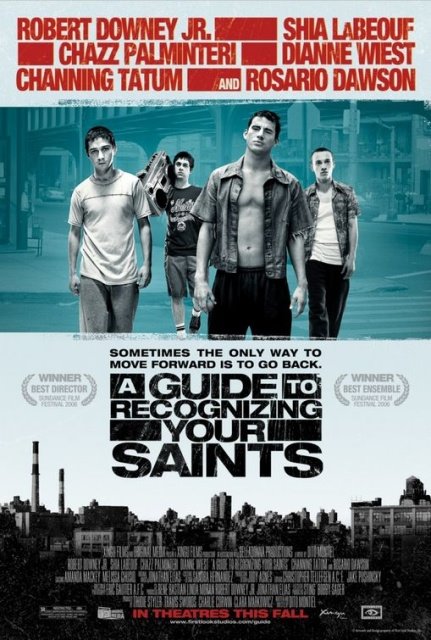
A Guide To Recognizing Your Saints

First time director Dito Montiel’s “A Guide To Recognizing Your Saints” is a harsh autobiographical look back at his youth on the mean streets of Astoria, Queens in the mid 1980’s. From the film’s opening moments, Montiel introduces us to an intimate world of family and friendship that totally blindsided me by its greatness. Opening in 2005, Dito (played in adulthood by Robert Downey Jr in yet another devastatingly perfect incarnation) lives as a writer in Los Angeles who’s just written the film’s title. He receives a phone call from his mother (Dianne Wiest) letting him know that his father, Monty, (Chazz Palminteri) is sick and won’t go to the hospital. This, of course, opens up a floodgate of memories for Dito as he flashes back to his younger, wilder days and hops a plane for home. We quickly meet his close group of childhood friends, Antonio (Channing Tatum) is the volatile Robert DeNiro of the group- and while this comparison seems naïve, Turner embodies a hulking character whose violence and strong headed machismo resonates deeply throughout the film- Nerf (Scott Campbell), Joey (Kyle Benitz) and Mike (Martin Compston) a transplanted Scottish boy who plants the seeds of journey into young Dito (Shia Lebouf). And where would a story like this be without first love, tenderly rendered by Diane(Melonie Diaz) the pretty girl whom Dito sneaks up the fire escape for nightly. The conflict comes from familiar sources too, such as the clash of cultures within the neighborhood that pits these five against a Puerto Rican group whose graffitti vandalism encroaches on their turf. But handled more subtly is the dynamics between Monty and Dito- we often get the sense that Dito and his father are more friends than father and son and Monty seems over-affectionate to Antonio, who himself suffers from an abusive relationship with his own father. There are moments in “A Guide To Recognizing Your Saints” that roll along with such force and emotion, that Montiel feels like a natural born filmmaker, infusing his personal heartache into strong characters breathing within a vivid time and place. Montiel’s handling of edits, sound, and music are also powerful, such as a scene in Dito’s kitchen between his father and group of friends that explodes into stark images and quick cuts to black. Montiel also handles the return home of Downey Jr. with care and vulnerability, searching for small answers that come in revelatory conversations with his mother and grown up Dianne (played by Rosario Dawson). And while such personal material can be hard to translate without lapsing into melancholy, Montiel finds a way to craft a clear eyed version of his life, allowing strong acting and electric filmmaking to take over the balance of the experience. I love finding unheralded gems such as this. The name of Robert Downey Jr. brought me to the theater and I discovered a true talent in Dito Montiel who has crafted one of the finest directing debuts in several years.


The Prestige

With five films under his belt, its been amazing to see director Christopher Nolan grow as a filmmaker (although to be honest, with a film like "Memento" as your second film, I suspect there was very little growth, simply the need for discovery for a talent already in progress). "The Prestige" takes its cue from the fractured narrative of "Memento", pitting two magicians (Hugh Jackman and the consummate Christian Bale) against each other in narcissistic and ultimately violent methods of one-up-manship. Even though we've already experienced one feature this year charting the contrivances of 19th century magicians in Neil Burger's "The Illusionist", Nolan's film is a bit more cynical and looks a helluva lot better. And then you have David Bowie embodying Nikolas Tesla... who could ask for more? "The Prestige" is thoroughly enthralling and continually forces you to pay attention as it skips back and forth in time and place.


Marie Antoinette

Sophia Coppola's "Marie Antoinette" is a nice companion piece to "Lost In Translation"- both films deal with anachronisms, a person impeding on a culture with observer-like status, often caught with a what-the-hell-am-I-doing-here stare. And like "Lost in Translation", Coppola feels right at home in documenting the listlessness of her main characters, freeing the narrative from strict plots and subplots, employing her camera to leisurely capture stunning images of life in a constant motion even when there's no purpose. I didn't want a history lesson, and "Marie Antoinette" certainly isn't that. Kirsten Dunst flits through the film in airy, charming ways. Her Marie is a kid in a candy factory, thrust into royal stature without any sense the implications her spending and nonchalant days in the country will eventually have on her people. And, gladly, those days of violent overthrown= are rendered in just 5 minutes of screentime at the end of the film. We've seen too many historical lessons, and Coppola's film, instead, chooses to create a punk rock version of the French queen, full of gorgeous sets and humble humor (and some startling images timed to 80's hits).

Thursday, October 19, 2006

Calling all lists!

OK, so this is my feeble attempt at kickstarting a blog-a-thon of sorts. I'm inviting all fellow bloggers to post a list of their 15 favorite horror films on their respective blogs. Now I say "favorite" but one can interpret to mean "scariest", "most disturbing", "the films that scarred me for life".. whatever floats your boat. On October 30th, I'll publish mine here and include links of the blogs that decide to participate. You can either e-mail your link to Henryhill51@aol.com or reply here in the comments section by October 29th.

Wednesday, October 18, 2006

Martin Scorsese's version of Sesame Street

Something to tide everyone over since I haven't posted in a few days. I was kinda bummed out, then I watched this and all is right in the world....

Tuesday, October 10, 2006

The Departed

I’m terrible at writing about a filmmaker that I adore quite like Martin Scorsese. It’s so easy to get wrapped up in the hyperbole. And I’m afraid I can’t avoid that pitfall here. His latest, “The Departed” is an electric experience, scurrying back to the violent streets that once made him famous. This is Scorsese at his most playful. Like “Bringing Out the Dead”, “The Departed” throws caution to the wind and belts out a wildy energetic pace that’s matched in strong, calculated performances from all involved. That’s all I can muster to write about this one so far. I watched it twice over the weekend and can’t wait to experience it again. If only every year I could have a Malick film and a Scorsese film top out my favorites of the year.

Exploitation Pick! Blood Sucking Freaks

I’ll lay my intentions bare- I love exploitation and grindhouse flicks. I think one has to take into consideration two aspects when one watches these types of films: 1) they’re usually a product of their environment. What I mean by this is that you cannot expect more than a limited budget, horrendous dubbing, poor acting and a diabolical (if not cheap) sense of humor. These types of films were often produced with little funding, limited equipment and actors on loan or leave from more mainstream projects. In fact, this crudeness derived from minimal means often lends an air of perverse sleaze to the entire project. 2) They hardly ever take themselves seriously. The best future for a grindhouse film was to find an interactive audience in a New York slum theater and play for 2-3 months to the lowest common denominator of the movie-going public. That was the measure of success with this genre. With that in mind, the overwhelming goal of the grindhouse film was not to make explicit any political or social messages (although that was a joyous byproduct of some of the best) but to simply entertain. The reason that Troma films are more entertaining than say, films such as “See No Evil” or “The Darkness” is that they don’t ever take themselves too seriously. The emphasis is on entertaining rather than scaring. So, with that said, I’ve made it my pre-new year resolution to see as many of these flicks as possible. Films like “Blood Sucking Freaks”, “Don’t Go In the House”, “The House on the Edge of the Park”, “Thriller, a Crude Picture”, “The Candy Snatchers”, “Isla films”.. the list is endless. And what better way to initiate this resolution than with Joel Reed’s “Blood Sucking Freaks”. This film epitomizes the above criteria- filmed in 10 days in the basement of Reed’s house with actors on loan from soap operas and various other low budget projects and using every last bit of film (i.e. certain exterior shots giving off that sputter that indicates the cameraman was using ends of film reels). Seamus O Brien plays Sardu, the ringleader of a troupe of rejects that orchestrates off-off-Broadway shows of the macabre using real life victims. His right hand man, Ralphus (played by a black midget with an afro named Luis de Jesus) is sheer delight from start to finish, whether he’s enjoying a decapitated woman’s head giving him oral pleasure or throwing pieces of chicken into the cage of naked women held hostage, de Jesus is a walking comedy, sincerely playing up the weirdness of his character. And I wonder if this is where the inspiration for the character played by Dennis Hopper in “The Texas Chainsaw Massacre 2” springs from? Black midgets with afros aside, “Blood Sucking Freaks” rolls along with little regard for consistency or logic. In one scene, while a police detective talks to a famous football player (played by Niles McMaster) about the disappearance of his girlfriend, why does the football player have his shirt off, combing his hair in front of a mirror? And why doesn’t the detective question this? Because in the world of exploitation, you learn to question nothing. “Blood Sucking freaks”, filmed in New Jersey in 1976, capsizes the mores of decency and explodes across the screen with giddy dementia. Isn’t that what exploitation is all about? Rent it now.

Wednesday, October 04, 2006

Music To the People!

Thanks Brad for sending me this. I know a few people out there who will appreciate the selection. You're one click away from internet radio around the globe. Dutch alternative station? It's there. Brazilian reggea? It's there. God bless the Internet. Highlight this link, save it, use it.
Nascar - Drivers fighting Glass City 2006

Ricky Bobby on the racetrack? Talk about life imitating art. And I chose to post this video with it's German newsreel soundtrack just to add to the absurdity. Listen carefully for the word Kung fu!

Friday, September 29, 2006

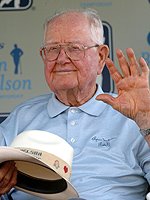
RIP Mr Nelson


News came late on Tuesday evening about the death of professional golf legend Byron Nelson at age 94. The next day, his passing was unjustifiably marginalized by the diva-esque dramatics of another local professional athlete (whose name I won’t even bothering mention, but not because I’m bitter, but because I’m a staunch Tennessee Titans fan). Sad. Lord Byron Nelson will be missed both as a presence in the golf world and for his unwavering support of local Dallas athletics.

The remarkable aspect of Nelson’s career is thoroughly documented in print. the PGA Tour.com website sums up his career in retrospect with the fact that his records set within the golf world in 1945 sum up a truly remarkable season. That year, he won 18 tournaments, capturing 31 of 54 events during the years of 1944 and 1945. He won a total of 52 events in his career, winning Major Championships in 1937 (Masters), 1939 (US Open), 1942 (Masters) and 1940 and 1945 (PGA).

Compare that with the scratching and clawing that Tiger Woods has done this year by winning 5 in a row, and that feat stands as an even greater accomplishment, especially when one takes into consideration the rudimentary construction of equipment and balls in his day.


My own experience with Nelson was a little personal. His PGA tour event, the Byron Nelson Invitational, occurs every spring here in Dallas. About 7 years ago, I attended the tournament and made it my first ever professional golf event. A good friend and I wandered around for a couple of hours and then grew weary of the inconsistent views on various holes. We made our way to the eighteenth fairway and found ourselves a spot on the side of the fairway about 275 yards from the tee box and approximately 150 yards from the expansive eighteenth green. Not only did we have a perfect view of 90% of the golfers as they drove the ball down the fairway (about 10 feet from Tiger when he stuck it in the rough and about 20 feet from Phil Mickelson) but we could peer up the fairway and, with binoculars, see the tent that Lord Nelson and his wife called home for those 4 days, perched ever so preciously off the back of the green in clear view of the days action. Of course, it was customary for the golfer to finish his round, exit the green and immediately pay his regards to Lord Nelson up in his make shift skybox. The respect and emotion of the players as they shook his hand and spoke a few words was palpable. It was a once-in-a-lifetime thing to see. The event was also memorable for me because I was hit in the forearm by a golf ball from player Ben Crane, and had a 3 foot view of the shot as he played his second shot (alas, I was not on TV). He would finish 2nd in the event. Still, even a shot in the body with a golf ball doesn’t out weigh the memorable tradition that comes with being part of an event sponsored by the good will and good graces of such an enormous personality within the world of golf.

Thursday, September 21, 2006

Out There Video


The joys of DVD are wild and varied. Between companies like Blue Underground and Anchor Bay, long lost cult classics are seeing the light of day. Another upstart video production company, Tartan Video continually dazzles the market with releases that alternate between Asian gems (known as Asia Extreme) to American grindhouse experiments. Within the last eight months, Tartan video has released films onto commercial American shelves (i.e. Blockbuster video) that expose visions from internationally recognized auteurs like Chan Wook Park and Takashi Miike. But the real niche of Tartan video is the odd surprise from lesser known gems, such as Kelvon Tong's "The Maid" and Kong Su-Chang's "R-Point". Tartan video also seems to own the distribution rights to a majority of Kim Ki Duk's work. Though I'm not a fan of Duk's usually obscene and intellectually challenged ouevre, the opportunity to hold this negative opinion of this Korean filmmaker is, in itself, largely due in part to the surprising availibility of his work. How can one expect to carry any opinion about something without ever having the opportunity to view it? That's the real advantage given to cinema lovers from Tartan video- love it or hate it, at least they're one of the few distribution companies giving audiences glimpses at the alternative.


As mentioned above, Tartan video doesn't limit itself to Asian oddities. In it's vast catalog also exists a variety of lost classics, either due to rights, content, or the lack of a viable audience outside of New York's Times Square. Probably the most indispensable release from them within the last year was Victor Janos "Last House On Dead End Street". Filmed and released (barely) in 1977, this grindhouse classic came and went. Generally regarded as the film of a madman, the director's name, Janos, never appeared on another film. Some people believed the story and images were based on fact. Some of the film's porn loops, interspersed throughout the film, may have been actual images from this director's own snuff film. The truth was that "Last House On Dead End Street" was financed independently from Roger Watkins, a porn producer who worked up into the 80's. The bottom line is that the film itself- a host of bad acting, stark brutality and poor editing- ingrained all that was nasty and vile about the American grindhouse cinema. It represented the opposite of traditional American film- financed, produced and marketed to the lowliest common denominator of the movie-going public and dumped into theaters in certain red light sections of large cities. Now seen, largely, as the fore runner to the independent movement of the late 80's and early 90's, a majority of these films truly didn't deserve a release. But the ones that survive, such as "Last House On the Left", now employ a home on smaller labels such as Tartan video. Once again, whether you decide to rent and give into the unrelenting nastiness on the screen is your own choice, but it's gratifying that it's there if you wish to.


If anyone senses a theme here, it's that I hold a fairly democratic view on things. More options, for better or worse, can never be a bad thing. When you look over the catalog of companies like Tartan or No Shame, which dedicates its release slate to an even higher degree of esoteric films than Tartan, one can't help but feel alive over the possibility of viewing choices outside the mainstream. Whether grindhouse or Italian crime films are your bag, baby, the option is there. Unlike niche markets or art house cinemas that dot the landscape in ever-growing minorities, at least 80% of my movie watching now occurs on DVD. This is not due to a lack of good 'new movies' as so many of the public loves to decry. I live within 10 miles of 2 art house theaters, but the choice of trudging out in traffic, paying eight dollars and having someone knee me in the back or spill popcorn on me pales in comparison to the small pleasures of lining up titles in my Netflix queue and discovering a new talent like Jun Hwung Jan's sci-fi head splitter "Save the Green Planet" or savoring the ugliness of the Paul Morrisey/Warhol "Blood For Dracula" and "Flesh For Frankenstein". That just sounds much better. Right? And all of the mentioned titles are available from Tartan. Check them out.

Sunday, September 17, 2006

4

The Black Dahlia

There's a frustrating dichotomy to the cinema of Brian De Palma. His films, often visually arresting, sometimes fall short due to his overheated passion for cinematic mythologies. The glorious failures of his career succumb to an outdated sense of cinema that don't play well in modern multiplexes. The best of his career, “Carlito’s Way”, “The Untouchables”, “Blow Out” and “Obsession”, survive due to a number of anomalies- respectively the sheer presence of Al Pacino, the noble set piece of a train station and a Canadian bridge, the precise tension of the thriller narrative juxtaposed with bravura editing, and ripe sexuality blown to excessive proportions. Whether De Palma is channeling Hitchcock or not, he’s a modern filmmaker deeply in love with a style and a voice that long ago left the aisle. And that’s probably why his latest, “The Black Dahlia” feels like a mis-fire. Everyone is playing it straight, as if this really were 1947. Scarlet Johansson fairs a lot worse than the male leads (holding a cigarette ever so daintily, and saddled with some of the film’s worst dialogue) and De Palma is never able to hold a steady tone throughout. The final fifteen minutes veers wildly into ‘camp’ territory, feeling much closer to the acidic finale of “Sunset Boulevard” than the 120 minute thriller that has come before it. De Palma wants to create a 2006 film reincarnated from the black and white noir world of the 40’s, and the film itself suffers from his wild impulse to copy the past. There are several inventive ideas here though- namely the 360 degree crane shot up over a building, lingering on a body in a grassy field, a woman walking by and discovering the body and back around the alley onto a car in which the film’s two leads, Josh Hartnett and Aaron Eckhart, sit. De Palma hasn’t lost his flair for the technical, but some heart and emotional investment in the characters becomes stale. And, I couldn’t forgive myself if I didn’t mention the work of Mia Kirshner here as Elizabeth Short. Her role is no more than 10 minutes of screen time, composed in grainy black and white images from a screen test she supposedly shot before becoming Los Angeles’ great unsolved mystery, but her performance brims with sexuality and warmth. If you don’t know who she is, I beg you to check out her early Canadian films, Exotica and Love and Human Remains. But be warned, I saw her first. I certainly intend to dedicate some space to her in an upcoming article. Perhaps "The Black Dahlia", much like De Palma's recent "Femme Fatale", will grow on me with time. There's a madness at work here- the way the actual murder becomes a subtext for perverse (unspoken) love triangles and deep-seated insecurities between Hartnett, Johannson and Eckhart.... the way sexual impulses, both homosexual and heterosexual, seethes throughout every frame... the introduction of a Hollywood family that grows weirder with each passing minute....confronted with this upon a first viewing can be a harsh experience when one halfway expects a policier thriller mixed with that keen De Palma flair for long tracking shots and hidden glimmers of suspense. Instead, things get very screwy and, maybe, that's what De Palma wanted. Knowing that, next time maybe I can sit back and enjoy the retro ride for what it is.


Dead Man's Shoes

I've only seen one other film from director Shane Meadows, and I'd be lying if I didn't admit that his latest, "Dead Man's Shoes" has kindled an interest in seeking out his other 3 works. Starring Paddy Considine, he plays a soldier who returns home from the army and systematically begins to track down 6 men from the neighborhood who absused his mentally challenged brother. That's all to the plot. Director Meadows infuses nothing with great style, eliciting a dominating performance from Considine. Just watch the hatred brewing beneath the surface when one of the men he's hunting comes up to him on the street and they have a casual conversation. Considine exhibits great presence throughout the entire film and even though the ending feels like a letdown after the mood of the first 80 minutes, "Dead Man's Shoes" is a terrific little movie. It also boasts an outstanding and atmospheric soundtrack from bands such as Aphex Twin, Smog and The Earlies.


Half Nelson

Garnered with strong reviews since playing at Sundance back in January, Ryan Fleck's "Half Nelson" is one of those 'independent' type movies that usually gets praised for its incendiary topic (drug abuse) while maintaining a visual scheme full of handheld photography and artsy editing. Well, "Half Nelson" has all of that but the film succeeds exceptionally well in part due to the performances of Ryan Gosling as a teacher struggling with addiction and the 13 year old student who finds out about his heart of darkness. The key to the film's acceptance for me, though, lies in the untypically impressive performance of 13 year old Shareeka Epps, a young actress who doesn't do too much, yet creates an aura of realism about her presence throughout the film. Gosling plays a teacher in a Brooklyn high school and moonlights as a crack addict, trading meaningful relationships for a bar stool on a nightly basis. He also coaches the girl's basketball team and one night after practice, Drey (Epps) finds him smoking crack in the locker room. What follows could be easily dismissed as uncertain or ill-fated melodramatics, but Gosling and Epps make it work. There's a moment towards the end of the film where teacher and student meet in a very disturbing point in both their lives, and the scene works due to the honesty displayed from both actors. In fact, this is a film that understands the importance of building naturalism slowly- the way Gosling interacts with his students, the way a visit to a family dinner signals so much about the past and where we come from, and the disregard that we fling ourselves into when an old flame returns engaged to someone else- these are all great moments in one of the year's very best films.


Hollywoodland

The second vintage murder mystery taking place beneath the luminous Hollywood sign in 2 weeks, Allen Coulter's directorial debut surrounds itself with classy acting and elegant cinematography, but it's ultimately lifeless. Adrien Brody plays Louis Cima, a private detective attemtping to determine whether the death of Superman George Reeves (Ben Affleck, fresh off his "huh?" win as best actor at the Venice Film Festival for this performance) in 1959 really was suicide. Though the film rolls out several plausible examples, it eventually ducks all these possibilities and resigns itself to play it safe where Hollywood legend is concerned and emphasize the hopelessness of its two male characters- one already lost and the other (maybe) saved.

Sunday, September 10, 2006

Short Cuts

Idiocracy

Mike Judge’s “Idiocracy” is not subtle satire or black comedy- it’s a fairly exaggerated yarn that intends to lambaste everything from corporate sponsorship to the rapid mutation of redneck families. And, while the film comes off as inept some times in look and tone, Judge strikes some pretty decent jokes along the way (such as a vending machine that shoots out food and says “here comes your giant ass fries” and then “for twenty bucks extra, do you want a giant ass taco?”) Luke Wilson plays Joe, an average military man who’s chosen for a special experiment due to his above average “averageness” and lack of family who’ll miss him. Maya Rudolph is a hooker who gets paid for her services. They think the army is planning on hibernating them for a year to test out the feasibility of preserving life. Things don’t go so well. The experiment is abruptly shut down and they’re left frozen for 500 years and when they awake, the world has dumbed-down dramatically and Joe and Maya become the smartest people on earth. The President is an ex porn star and WWE wrestling figure while society has degenerated into leaving huge piles of garbage around, and creating media that supply man’s basic needs- food and sex (such as a Masturbation channel and the idea that water is only found in toilets and the drink of choice is a Gatorade-like drink because “it has electrolytes!”) Like I mentioned earlier, Judge hits some striking moments with his humor throughout the film, but the presence of Dax Shepherd as Joe’s accomplice along the way brings things down dramatically and Maya Rudolph seems to be reaching in a lot of her performance. In “Office Space”, the acting was spot-on, creating vivid characters that arched the story along in unsuspecting and generous ways. In “Idiocracy”, Judge relies on the outrageous themes to overshadow the human element, and it wears out its welcome pretty fast. This isn’t a disaster, just a disappointment.


The Wicker Man

Another disappointment… oh hell who am I kidding- we all knew this one was bad. Neil Labute’s “The Wicker Man” enticed me by the fact it could present some unsettling moments and somehow enrich the bland 1973 film of the same title, but this was even worse than I imagined. I’ll say this once. I do not get Nicolas Cage. I can’t think of a single performance since his off kilter turn in “Peggy Sue Got Married” and his marginal stint in “Bringing Out the Dead” that I’ve liked. He seems false, unsure of himself in every performance. I scratched my head over enormous praise lauded him in films like “Adaptation” and “The Weather Man”, and wanted to close my ears every time he spoke in “World Trade Center”. Here he plays a California highway patrol police office lured to the Pacific Northwest by an ex-fiance who claims to be missing her daughter in a hippie-like commune. Sure…. I’d fly out there right away too. People start dying, Cage starts to go a little nutty and he yells at a woman via gunpoint to “step away from the bike!” And not a motorcycle, but a bicycle. Things get even worse when he puts on a bear costume and begins to run around the country side looking for this little girl. It’s awful I tell you. “The Wicker Man” is the type of film that movie-goers dread- it has little intelligence and even less care for giving the audience anything striking or original.

The Illusionist

Probably the best film of this little bunch has to be Neil Burger’s “The Illusionist”, boasting an all star cast of Edward Norton as the “magician” Eisenheim and Paul Giamatti as the chief inspector determined to uncover the supposedly naturalistic devices of Eisenheim’s tricks. Filmed with great care and beauty by Dick Pope and scored by one of my favorite composers, Philip Glass, “The Illusionist” builds terrific suspense out of a complex little story. Even though it eventually telegraphs its conclusion, the journey is highly enjoyable and Edward Norton and Giamatti display great chemistry