Sunday, July 23, 2023

Franchise Fatigue

For two nights in a row, I exited a movie theater supremely disappointed in the latest incarnations of two franchises whose history has given me a memorable (and in one case classic) lineage. "Insidious: The Red Door" and "Indiana Jones and the Dial of Destiny" pretty much broke my heart. From where both of these franchises started to the dregs of where they are now, I began to wonder if the fault lies with my old-man-screaming-at-clouds disillusion with the Hollywood project. With "Indiana Jones and the Dial of Destiny", I could feel my heart shrinking into my chest within the first 20 minutes of an elongated action sequence that sees Jones (Harrison Ford, right digitized and de-aged) spring about Nazi castles, trains, and motorcycles as if he's trying out for the latest Marvel film. Add to the fact that director James Mangold's fifth iteration of the Indiana Jones franchise looks so murky and tactless, and it quickly became a recipe for immense dissatisfaction. Granted, I slowly warmed to the film as it went along, but with each larger set piece and a finale that dares to actually visualize the metaphysical nuances that made "Indiana Jones and The Last Crusade" so enthralling as young teen, it's an entry in a vaulted series of films that I will most assuredly never re-visit.

The hatred of Patrick Wilson's "Insidious 3: The Red Door" came more incrementally. For the first 30 minutes, the fourth installment of the James Wan/Leigh Whannell horror series establishes the anemia of its father-son relationship between Wilson and college-bound son Dalton (Ty Simpkins) as both struggle with the slow release of the pent up horrors of their past (through hypnosis) that eventually sees them both re-enter "the further" for more terrifying shenanigans. There are some creepy corner-screen movements that set the stage for something grand, however, the scares are ultimately neutered by the very bland performances and unremarkable scares. As the film progresses, it becomes clear that "Insidious: The Red Door" is content to create fan fiction (complete with shoehorned cameos by Lin Shaye, Angus Sampson and Leigh Wannell) and serve as greatest hits for a franchise that began with a shrieking sense of old school horror and a demented, go-for-broke mentality. None of that exists in the latest film.

Looking at both films and the wonderful filmic parents that spawned them, what went wrong? Granted, this is just my rhetorical question as I'm sure both films have their admirers.... although most of the accolades I've seen for "Indiana Jones and the Dial of Destiny" range from "well, it's better than Crystal Skull" and "fun!". Ever since its premier at the Cannes Film Festival in May, Mangold's latest Indiana incarnation has mostly been met with subdued murmur. In my heart of hearts, I wanted to love both films. And since I was lukewarm on "Insidious 3" and could see the film getting further and further away from the genuine terror evoked by the first two "Insidious" efforts, I suppose my greatest frustration lies with "Indiana Jones and the Dial of Destiny".... which also has strayed into a netherworld of CGI confusion and murkiness so far removed from the practical excitement of the first three Indiana Jones films that its tired set pieces play like a video game without physics or sensibility. Each action scene- its opening, a ride on a horse through the New York subway, a cart chase in Morocco- rely on so much wham-bam CGI green screen effects that they remove all heart and emotion from a series that once proudly succeeded on mixing true heroic characterizations with bracing, exuberant, practical adventures. I know this type of film is still hopeful in Hollywood, but both "Indiana Jones and the Dial of Destiny" and "Insidious: The Red Door" make the case that we're getting further away from replicating (or even marginally extending) the simple joys of what made these franchises so enjoyable long ago. 

Tuesday, July 04, 2023

Flares and Squibs: Ringo Lam's "Undeclared War"

Ringo Lam's "Undeclared War" had me from its stunningly violent open in which a baptism ambush leads into hand grenades and helicopters. From there, it staggers into pretty much every late 80's/early 90's action film aesthetic- from the gaudy lens flares that visually accentuate Hong Kong 'actioners' of the time to the cop buddy narrative that sees two opposing worldviews combine to stop a global terrorist. Add to the mixture loads of cop swagger and "Undeclared War" is a pop masterpiece from a director known more for inspiring the skeletal outline of Quentin Tarantino's "Reservoir Dogs" than for his own works. After seeing Lam's "Sky On Fire" at the 2018 Dallas International Film Festival and then lapping up the brutality of his Jean Claude Van Damme collaboration (one of his many) "In Hell" last year, I've had the enjoyment of discovering one engaging action film after another. As usual, going beyond pop culture lip sync to observe the original purveyors holds so much more value.

And the value in "Undeclared War" hits the viewer in the face immediately. After the aforementioned violent opening, the stage is set for a visiting CIA Agent Gary (Peter Liapis) to team up with a local special agent in Hong Kong, Bong (Danny Lee), after his ambassador brother is assassinated by a terrorist named Hannibal (Vernon Wells). Played to cool perfection by Wells, Hannibal seems like a baddie ejected from the "Mission Impossible" universe.... prone to quickly dispatching those who fail him and eluding everyone through a variety of disguises. He's also a pretty good hand-to-hand combat fighter as well.

But beyond the mechanics of a plot that sees Gary and Inspector Bong putting aside their personal differences (Gary from the "Lethal Weapon" school of policing and Bong from the respect-bureaucracy phase of detective work), what stands out from "Undeclared War" is the clean and precise action set pieces. From a funeral home to a large hotel conference finale, Lam maintains a focused, organized logistics of violence. We understand where everyone is. The gun shots feel real. The delineation of good guys and bad guys is pronounced. Unlike so many Hong Kong action films, Lam doesn't lose sense of the placement of bodies and the elongation of suspense. Just watch how he handles a bomb in the finale. Or the cool confidence of police guys doing their work. Like the films of Johnnie To or especially Michael Mann, Lam infuses "Undeclared War" with a keen awareness of both public and private space in an action universe. I love discovering works like this and look forward to more Lam.


Monday, June 19, 2023

The Current Cinema 23/3

 Sanctuary

The twisted beauty of Zachary Wigon's "Sanctuary" is that it's a film of two people, sitting in a room and talking. Well, it eventually devolves into a maddening, cerebral examination of the push-and-pull between the said two people (Christopher Abbott and Margaret Qualley), and it doesn't help matters that the relationship is based on the paid expectation of a dominatrix session. "Sanctuary" is even more jarring because anyone expecting a cheap, lurid thrill based on the word "dominatrix" will be sorely lost as the film (literally) tosses the script early on and becomes a trenchant power play where words, ideas, and threats quickly replace the commodity of sexual gratification. Abbott and Qualley (typically) excel in their high-wire roles.... he as Hal, the recently uber-rich heir to a hotel fortune and she, the paid escort who takes his wishes to end their relationship in very menacing stride. Written by Micah Bloomberg, "Sanctuary" thrills from beginning to end with its allusion that domination-as-therapy has its thorny limits. And in the heavily committed performances by Abbott and Qualley, the film could also be seen as domination-as-therapy filmmaking itself.


Past Lives


Celine Song's debut is a film that owes its heartfelt lineage to the films of Julio Medem, Richard Linklater, and Wong Kar Wai..... all filmmakers that certainly believe in true love, but not in the traditional way, but in how love manifests itself across the unreachable barriers put up by the universe's cosmic sense of humor. In "Past Lives", Na Young (Greta Lee) and Hae Sung (Teo Yoo) meet as kids and then spend the next 24 years hopelessly trying to rekindle what they once shared on the steps of a building, each going their own direction. Song and her actors etch so much fragility, honesty, and emotion into the vagaries of their relationship that, when the two meet again in New York for the first time as adults, their reactions are so organic and heartfelt, I felt guilty (like an interloper) for watching the film. But once that feeling passes and "Past Lives" continues to weave its magical spell of yearning (plus facing the uncomfortable but blazingly honest performance of Nora's now husband played to perfection by John Magaro) I ultimately felt grateful for the beauty of a film willing to allow us to share in all the uncomfortable silences that build up over (possibly) thousands of years between people. I can't stop thinking about this one.

Monday, May 22, 2023

The Current Cinema 23.2

Joyland


There's a scene in the middle of Saim Sadiq's ironically titled "Joyland" that sees Haider (Ali Junejo) save the lighting impaired show of trans dancer Biba (Alina Khan) by urging everyone to shine their cell phone lights towards the stage. It's a bustling moment of joy that interrupts the generational struggle of the film's many characters and establishes a quiet humanity that most films never realize. It's easy to say from that point on, the film is all tragically downhill- full of subdued emotions and some of the year's most striking cinematography- but "Joyland" is too smart to be just an international downer. The characters are too dimensional.... the emotions are too well earned.... and Sadiq understands that great truth comes from great sadness. Outside of the central relationship between Haider and Biba, "Joyland" tracks the rest of Haider's extended family as they convene in one large house together. The cultural observations typical in most Iranian films are observed but mangled. Both wife Mumtaz (Rasti Farooq) and his sister-in-law (Sarwat Gilani) are dynamic. The various sideways and byways given to the rest of the family are highly involving as well as they try to simply live in a modernized world. But "Joyland" ultimately rests on the destructive relationship of Haider and Biba as they navigate capricious times together. It all comes together in a damning finale that washes over the viewer (literally) and exemplifies the messiness of life;s choices even if we try not to hurt others.


The Covenant

Or "Guy Ritchie's The Covenant" to distinguish it from another film of the same name, this rah-rah war effort starts out pretty disdainfully..... full of macho swagger and the same military might that infuses most films about America's involvement in Afghanistan after September 11th. But once the film shifts gears in the second half and concerns itself with Jake Gyllenhall trying to save the translator (Dar Salim) who saved his life, "The Covenant" emits a few interesting ideas about the price (and scornful debt) of war. It's also the first film in a while to present war violence in a clear-eyed and unflinching light. Ritchie and company certainly have fun watching all those bodies spray about, but there's a ruthlessness that's undeniable. While it's a film that clearly wants to earn its stripes with middle 'merica, I forgive some of its awful gung-ho earnestness in the way it presents pretty much everyone with guilt-soaked hands.


The Eight Mountains

Europeans seem to do heartfelt, decades-spanning tales of friendship better than most. In Felix Van Groeningen and Charlotte Vandermeersch's "The Eight Mountains", that sentiment is again exemplified. Telling the story of two men (Luca Marinelli and Alessandro Borghi) who waver in and out of each other's lives for 40 years, "The Eight Mountains" dispenses with narrative gently and wisely. Even though some elements of the story seem a bit forced in that art-house way (especially the building of a mountainside house), the film never condescends in the way its characters ebb and flow across time. All the performances are spectacular and the cinematography is equally breathtaking, whether its exploring the snow capped vistas of a mountain range or the barely lit interiors of brick-enforced homes. But through it all, the "The Eight Mountains" captivates because of the carefully modulated central relationship between Pietro and Bruno and how-despite their best efforts- they slowly slide into becoming their fathers. "The Eight Mountains" doesn't blame anyone, but gracefully explores how life gives us immense perspective of both the exterior and interior.


Saturday, April 15, 2023

Cinema Obscure: Dominik Graf's "Bitter Innocence"

Dominik Graf's "Bitter Innocence" twists about halfway through from a corporate thriller to a sweet love story borne out of the casual indifference and sexual violence men perpetrate on women. That the love forms between a twenty-something woman (Laura Tonke) and the young teen daughter (Mareike Lindenmeyer) trying to unravel the mystery her parents have immersed themselves in should come as no shock to those who've watched just a few of Graf's films. They are mostly love stories buried within a larger framework of genre. Last year's masterwork called "Fabian: Going to the Dogs" is one of the most lush romance films in years, buttressed against the backdrop of an encroaching Nazi evil. Situated firmly in the times it was made (1999), "Bitter Innocence" follows the same pattern as love is widdled out of the complicated yuppie mindset that those in the corporate world can get away with anything if their check book is large enough.

But before we get to the central relationship of Vanessa and Eva, Graf's film wanders through the thriller realm when aggressive boss Larssen (Michael Mendle) threatens to destabilize the vague pharmaceutical company Andreas (Elmar Weppar) has been conducting research within for the past few years. Andreas' fears about the wolf Larssen are confirmed when he discovers him raping Vanessa behind closed doors. Working as a waitress for a catering company providing services at a company party, Andreas doesn't report (or even lift a finger to help) the vulnerable Vanessa, instead using the the act to steal a file that may secure his employment..... which is a prickly move since Vanessa sees him dodge out without coming to any sort of chivalry rescue.

From there, Larssen, Andreas, his wife Monika (Andrea L'Arronge), Vanessa and young daughter Eva become embroiled in a cat-and-mouse game of who-knows-what and whose-blackmailing-who. It's about two-thirds of the way through that "Bitter Innocence" grows a moral compass in the scrappy personality of young Eva as she tries to set things right..... and falls in love with the sophisticated perfume salesman-Vanessa during the process.


With the visual style of a glistening television movie (Graf has careened through an array of features, both for the big and small screens) and a sense of rhythm like that of a soap opera, the film's themes of ravishing passions and high intrigue feel right at home with that lowbrow entertainment. But Graf's swirling ambition about the youth of the world being the most morally grounded figures in a world set on financial gain and personal advancement (and I didn't even mention the affairs!) fits right at home in the subversive tactics of a filmmaker who continually buries so much in his works. I look forward to carrying through with his expansive body of work. 

Sunday, April 09, 2023

The Current Cinema 23.1

Marlowe


Walking the fine (but successful) line between noir pastiche and its own brutal re-imagining of young Hollywood corruption, the negative talk about Neil Jordan's "Marlowe" should be ignored at all costs. Embodying Raymond Chandler's P.I. for the umpteenth time in cinema, this time Liam Neeson gets to flex his laconic detective muscles in a terrific looking 1939 Los Angeles noir that glides its way through the underbelly of a town hellbent on movie magic and criminal debauchery. What begins as a missing person case by the elusive and wealthy Diane Kruger who elicits Marlowe's help, naturally, boils over into a cauldron of corruption. The swipes at virtually every neo-noir since "Chinatown" (including a nice in joke of having Danny Huston portray a sinewy club owner) not withstanding, Jordan and writer William Monahan craft an intricate, engaging, and satisfying cocktail of a film. And it features a terrific line from Neeson spurning the advances of the beautiful Kruger. I can't help but imagine it's an act of denial and an ethos that would've saved 50 years worth of previous private investigators from sliding deeper into their own poor choices.


Emily

In this second month of the new movie-going year, I doubt there will be a better scene than one portrayed in Frances O' Conner's fictionalized story about the life of Emily Bronte. In a very nineteenth century act of youthful time wasting, a group of people sit around a candlelit room and play "guess who" with a Shakespearean mask. Leave it to young provocateur Emily Bronte (Emma Mackey) to turn their innocent dalliance into a nightmarish seance where she pretends to embody her dead mother. As an example of the heightened manipulation the younger Bronte sister will continually bring to her family, it's an astonishing moment. As a precursor to the belief that no one can ever really understand her genius in mind and spirit, it's a revelation. In "Emily", filmmaker Frances O' Conner (in this her debut feature!) has molded a heartbreaking tale of the young writer as she tries to find her voice. She falls in love with a young minister (Oliver Jackson-Cohen), dabbles in narcotics with her brother (Fionn Whitehead), and desperately tries to step outside the shadow of her older sisters. Composed with an assured sense of mise-en-scene and a soundtrack that melts the wind swept images, "Emily" should be a breakout effort for all involved. 


A Good Person

I wont deride anyone calling this film overwrought and maudlin. It is. But it worked for me, and naturally, Florence Pugh and Morgan Freeman are very, very good even if Zach Braff tries to derail any real emotions with a Shins song every few minutes.


The Innocent

A bit of Jacques Audiard with a dash of Hitchcock, and even some David Mamet thrown in for good measure, and one gets Louis Garrel's fun take on the Parisian heist drama. With some good humor and wild energy playing at the margins as well, "The Innocent" hustles through so many genres, it seems Garrel thinks he may not get a chance to do this again. He will. Full of cinematography that screams out the dreamy, frosty fog at France's dawn and garish (but not obtrusive) colors (oh that flower shop!), "The Innocent" also stars Garrel at the heart of a complicated family drama when his mother (Anouk Grinberg) marries an ex-con (Roschdy Zem) who says his past is behind him.... until the curious son decides to butt into his affairs. Also along for the ride is his best friend Clemence (Noemie Merlant). How the story unfolds is hugely entertaining, at its best when we're not sure where reality meets criminal fiction and the con ensues. I'm not sure if the relationships all earn their lush finales, but "The Innocent" is fun as it goes and proves Garrel will be a staple in front and behind the camera for a long time to come.


Saturday, March 11, 2023

After Hours: Robert Siodmak's "Phantom Lady"

Even though I admire the toughness of Robert Siodmak's perennial film noirs, "The Killers" (1946) and "Criss Cross" (1948), nothing quite prepared me for the formal, stylish greatness of "Phantom Lady". Released in 1944 and starring Ella Raines as a secretary who descends into the New York netherworld of coked-up jazz musicians and psychotic killers in the hopes of saving her boss (Alan Curtis) from a murder rap, the film is relentlessly surprising in both narrative and mise-en-scene. There are two or three camera movements that rank with the visual inventiveness of Hitchcock's best (just watch as we finally discover "the hat") and a mood imported from the inky grains of German expressionism. Everything is mixed flawlessly within a somewhat cute American studio system work. Between this film and others, Siodmak has created a large (but still somewhat undervalued) body of work. And outside of his noirs, finding them is the trick.

But, what we do have (courtesy of the Criterion channel) is invaluable. For the first half of "Phantom Lady", the film doesn't even hint at the heroics of female secretary Kansas (Rains). She's barely present, except to establish her mundane duties of filing receipts and returning phone calls within the office of her architect boss Scott (Curtis). Instead, we have a traditional set-up where a lonely man picks up an equally morose woman (Fay Helm) in a bar and persuades her to go to a theater with him. Breadcrumbs of possible alibis are stacked, but then he returns home to find his wife has been murdered and the police already waiting for him. His emotions are confused, but heightened.... and in one of the many stellar provocations in the film, Siodmak chooses to expend narrative off-screen. As Scott's wife is hauled out of their apartment, the camera holds on him as he screams out "look what they're doing to her hair!". It's a moment that says far more than shows. There's no need to show a body. The image of a lifeless woman's hair being dragged along the floor is pungent....horrifying..... and soaks an image of careless disregard in an otherwise gutting personal moment. The off-screen theatrics will be employed brilliantly throughout "Phantom Lady".

Enter Rains as the Nancy Drew-like secretary who fully believes that her boss is innocent and sets out into the city to find witnesses to Scott's bar tab, theater event, and (most importantly) the woman that no one claims to remember. There's a wonderfully energetic Elisha Cook Jr who takes Rains behind the grimy veil of after hours musicians. There's the sheepish bartender who may be concealing more than he knows. And, most importantly, there's Franchot Tone as Scott's best friend who returns from overseas to help Kansas clear his name. Together in his modernistic New York high rise apartment, Tone embodies a role that's both slimy, perverse, and haunting all the same. But more important than any extra-Freudian overtones,"The Phantom Lady" shifts gears completely and becomes Rains' film in spirit and body as her quest will take her close to extreme violence.

Playing with genre as if it's shuffling cards, Siodmak never loses control of the film. When it stops down for a couple of minutes to vibrate and gyrate with a coked-up drummer, it works. When it devolves into a thriller and the door knob to escape is just out of reach, it works. And it certainly works as a film noir where the city hisses steam at all hours and the police are hard nosed but virtuous. Even despite its seemingly happy ending, "The Phantom Lady" hints that the savior complex of Kansas may have doomed her to a place of subservience that's well beneath her true worth.


Saturday, February 18, 2023

Moments of 2022

Inspired by the now defunct Film Comment "Moments Out of Time" series and the great Roger Ebert's year end recap, this Moments of the Year list (now in its 24th edition) represents indelible moments of my film-going year. It can be a line of dialogue, a glance, a camera movement or a mood, but they're all wondrous examples of a filmmaker and audience connecting emotionally.


The long shot holding on the face of a jockey (Clifton Collins Jr) as he starts and finishes a race. The range of emotions curbed by splotches of dirt being kicked up into his face don’t lessen his array of feelings.  “Jockey”

A young girl munching precociously on chips in the backseat of a car and then her small arm protruding into the frame with a juice box for her mother to drink while she drives  “Petite Maman”

The diner scene between Jessica Chastain and “The Good Nurse” (Eddie Redmayne) as she tries to gently coax a confession from him. The unease slowly builds

"I don’t even know what you make at the factory!”    “You’ll know what we make at the factory, when you work at the factory!”     The comic line reading of the year by Toby Huss in “Weird: The Al Yankovic Story”

The dance title sequence.  “After Yang”

Pretty much any line reading of  Andrew Scott in “Catherine Called Birdy”

From a comfortable bedside reading to a tortured wounded soldier screaming. Just one of the many sublime (and heartbreaking) transitions in Terence Davies’ exploration of self identity in “Benediction”

A woman (pleading?) saying that the woman (Dolly de Leon) inching up behind her with a rock can work equally in their new household.   “Triangle of Sadness” 

“Everything Everywhere All At Once” and the Wong Kar Wai inspired wet, moonlit alley conversation between Evelyn (Michelle Yeoh) and Waymond (Ke Huy Quan). Both are dressed to the nines, but the spare emotion expressed between them is heartbreaking

“Montana Story” and the performance of Eugene Brave Rock as a Native American car seller. It's a complex moment in the film. Can we trust him? 

Colin Farrell and his imitation of Werner Herzog. “After Yang”

“She Said” and the numerous shots of tense bodies carefully poised around a speakerphone intercom

The first meeting between Jakob (Tom Schilling) and Cornelia (Saskia Rosendahl) in “Fabian: Going to the Dogs” as she emerges as a shadowy figure bathed in blue light behind, and the quick succession of future images that will mark their torrid love affair. Perhaps the most romantic moment all year

A man hitting on two women at the bar as Modjo plays and his line of “I have a lot of money. A lot of money….” and they perk up to him.     “Triangle of Sadness”

The waves taking a baby’s body with it.  “Bardo, False Chronicles of a Handful of Truths”

An empty bed. "Sr."

The needle drop of ethereal music as a young girl floats on a boat. "Petite Maman"

Strobe lights on a dance floor. A father and daughter oscillating in time. A long walk down an airport hallway and then out a door. The gutting final few minutes of Charlotte Wells' brilliant debut "Aftersun"


Friday, February 03, 2023

On "The Mind Benders"

Generally regarded as one of the first true paranoid thrillers, John Frankenheimer's "The Manchurian Candidate" dealt with the brainwashing of a Korean War POW (Laurence Harvey whose steely eyed presence seemed like the perfect tonic for an empty vessel) and his subsequent mission as a presidential assassin. It holds up even better today.

Released just a year later in 1963, Basil Dearden's "The Mind Benders" certainly hasn't gotten the same acclaim as Frankenheimer's effort, but it's no less terrifying. I'd even argue it's a much more insidious example of the ability of one human to crack open and infect the brain of another human. In Dearden's stratosphere, the purpose isn't world domination, but simply the nature of suggestion in wielding power over another.... which plays havoc and begins the dissolution of a happy marriage.

As he did a few years prior in Dearden's taboo breaking "Victim" (1961), Dirk Bogarde is the man placed in a precarious situation fighting for his very soul. Portraying Dr. Longman, Bogarde is a scientist involved in an experiment whose opening title card suggests the entire story is ripped from the annuls of American research documents involving isolation tanks and perception reduction. And if this doesn't sound so far out today where such tactics dot the fringe landscape of psychology, things don't start so well for one doctor involved in the experiment who rightly tosses himself off a moving train in the film's opening minutes.

Hoping to find out if this strange death is a matter of political subterfuge or just someone unable to deal with his own mind, Major Hall (John Clements) asserts himself in the experiment and convinces a research aide (Michael Bryant) to help him push the boundaries of isolation. Enter Henry Longman (Bogarde), another doctor on the experiment who volunteers to stay submerged for the longest amount of time possible.... a stoic step for science and the perfect excuse for Major Hall to play with his own limits of twisted psychology.

After a terrific paranoid-filled first half, "The Mind Benders" turns chamber-piece driven in the second half. The slight suggestions whispered about his wife (a wonderful Mary Ure) moments after a hectic decompression from 7 hours in the tank turns the film into an acidic story about the slow dissolution of self and relationships. Bogarde doesn't always drip with empathy in many screen roles, but here, he really allows the snide distrust to leak off the screen..... even as his wife is 8 months pregnant and struggling just to understand the seismic shift in her once loving husband. 

This abrupt shift from tangential science fiction elements feels odd at first, but once "The Mind Benders" settles on Longman and his wife's shifting power dynamic, the film's kitchen sink realism (a style dominating much of British cinema during this time) feels all the more powerful in showing how disruptive progressive science can be. He's not slated to kill a presidential candidate, but the final riverside boat party seems just as violent for the way he openly courts another woman (Wendy Craig) and flagrantly challenges the tenets of marriage. Longman's brainwashing may not be the equal of murder, but "The Mind Benders" makes a strong case that its something far more damaging.

Perhaps best known for the aforementioned "Victim" and the first film in his own production company, "The League of Gentlemen" (1960), Dearden isn't an extremely well known filmmaker, mostly noticed for his social justice films of the 50's and early 60's. While "The Mind Benders" doesn't seem to have a great cause, it's no less thrilling for how it utilizes genre to twist and burn into an expert examination on psychology. Based on the handful of films I've seen, Dearden deseres to be mentioned in the same breath as other contemporary artists of his time.


Monday, January 23, 2023

Your Lying Eyes: Jacques Audiard's "A Self Made Hero"

As a doom laden masterpiece where a whisper can be deadly or the nod of a head betrays friendship, Jean Pierre Melville's  "Army of Shadows" is one of my favorite films. Applying the same fatalistic sense that imbues his crime thrillers, it's a film that paints the Resistance during French Occupation of World War II as a carousel of death slightly postponed in order for its men and women to grasp at heroics. It's sad, infuriating, calculated, and full of Melville's memorialized relics from his past.

All of this to say that Jacques Audiard's "A Self Made Hero" would make for an interesting double bill with Melville's film. A bitter character study about a man who worms his way into the upper echelon of French military immediately after the liberation, "A Self Made Hero" is just as calculated in the dynamics of how a lowly no one (a brilliant Matthieu Kassovitz) becomes an interloper through sheer determination. It's a film that seems to question just how good such a person could have been if they'd applied their talents to something worthwhile.

We first meet Kassovitz early in life during the war, unsure of what to do and working menial jobs with little direction. He claims to be a writer of romance novels, which attracts Yvette (Sandrine Kiberlain) and they end up marrying. It's only after finding out his in-laws were once tangentially involved with the French Resistance (as well as his own mother's political leanings) that he makes a rash decision and walks away from his provincial life. The only thing left of him is his bike on a railway platform.

Through sheer determination (memorizing the stories in numerous newspapers each day), he transforms into the fictional Albert Dehoussie. And like the cold mechanisms that chart the success and betrayals of the Resistance in "Army of Shadows", Audiard's film utilizes the same blueprint for Albert's cowardice. We're at once embarrassed for the way in which he liberally inserts himself in the circles of post-war government, and somehow charmed by his remarkable shape-shifting intelligence. As a cipher for modern politics (thinking of the whole George Santos parallels), "A Self Made Hero" was made 25 years ago, but its exploration of hollow representation feels more apt than ever. He gets free room and board by playing on the militarism of his ex-soldier landlord. He gleans all he can from the smooth operations of a self proclaimed spy (Albert Dupontel) who gives him, perhaps, the best advice of his career. To survive in 6 different cities, tell 6 different lies. Eventually, Albert becomes a top official routing out collaborators during the war.... a point not lost on Audiard and writer Alain de Henry as "A Self Made Hero" is essentially a film about the layers of deception that necessitate survival in a post war environment.

Adding a bit of comical complexity to the film, Audiard also inserts numerous fake current day interviews which comment on the Dehoussie affair, even going so far as to have the iconic Jean Louis Trigtignant playing the aged Albert with a wink and charm that only he could provide. It's fascinating to see theses fictional testimonies inserted as the men comment on Albert's exploits by showing the camera a prominent newspaper image, then deconstructing the deceit that Albert used to place himself there. It's a sharp deconstruction of his rise to power.... a mordant commentary on truth.... and a brilliant black comedy. And that's another essence to "A Self Made Hero". While being a repulsive main character, it's imminently funny. The fact that Albert ends up where he does with two women (one he scorned and another whose innocent love forced him to ultimately reconcile himself) is an embarrassing wealth of riches for such a mythological man. The fact that the film goes even further and shows Albert come out the other side with a reputation seemingly impertinent to the halls of politics is about as funny a comment on his life as anyone could fabricate.

Saturday, December 31, 2022

The Best Non 2022 Films I Saw in 2022

10. "In Hell" (2003) - I've only seen a few Ringo Lam films.... something I'm hoping to change in the new year. With one of his many Jean Claude Van Damme collaborations, "In Hell" is a good start to the auteur's canon. A prison drama that not only trots out all the brutal genre tropes  but manages to weave in some poetic asides about the nature of confinement and how the system brutalizes man's humanity, "In Hell" is essentially a fight club behind bars. When everyman Kyle (Van Damme) finds himself behind bars in a Russian prison, he goes through a series of personal revelations that range from absolution of self in "the hole" to a martyr that kick starts a revolt among the inmates. The film also finds time to play up some hokey mysticism and a voice over from Lawrence Taylor (yes, that one) that adds a touch of philosophical depth to the mayhem. I had so much fun with this one. 


9. "The Makioka Sisters" (1983) - Kon Ichikawa's "The Makioka Sisters" trades on alot of the same sentiments that made Ozu such a beloved figure in international cinema. It's a film that concerns itself primarily with the task of finding suitable husbands for two of the 4 titular sisters... something that drove so many of Ozu's efforts about the nuclear family and its important formation. And while Ozu deserves his place in the echelon, Ichikawa has worked a bit more in the margins and toggled through all types of genre. And while no one is going to accuse him of stepping on Ozu's toes in subject matter, in my opinion, "The Makioka Sisters" is better than anything ever produced by him. Released in 1983, "The Makioka Sisters" (only 1 of his 93 films spanning from the late 30's until 2006) also uses color brilliantly. From a face bathed in red light inside a photography production room to the sickly green hue of a corner bar, it's a film that sees a purpose in each designation. Of course, there's the obligatory cherry blossoms as well. In a scene that bookends the opening and closing images, time has passed and life has been altered. But luckily, there's no great sadness. No one has died and the world is still spinning, although Yukiko and Taeko are at vastly different paths in their lives. And even though some melancholy has settled, "The Makioka Sisters" proves that even minor shifts can have tremendous impact.


8. The Leopard Man
(1943) - I'm not sure what I expected from the Val Lewton factory produced "The Leopard Man". I mean, all of their output swerves in interesting, digressive ways but this film is something different (and magnificent). After the aforementioned leopard wildly escapes towards the beginning and claws the hand of a waiter on its torrid exit, I thought maybe we'd get an infected man terror tale. Then the wild animal corners and hunts a young girl in a scene that ranks as one of the most heartbreaking demises in cinema. Then more and more people turn up dead and it appears there's a serial killer on the loose. What's so good about Jacques Tourneur's film is the simple exploration of fear and how it instinctively seems to metastasize during certain periods. Much like war-torn Berlin and serial killer Paul Ogorzow's litter of corpses that went under speculated simply because it took place during the Nazi regime of disappearances, history often reveals that evil is born and enabled by a political shroud of terror. In "The Leopard Man:, the town experiencing the fear of a loose beast soon turns on itself and gives in to its primal urges, turning even the most lucid figures into Jekyll and Hyde-like depositors of destruction. "The Leopard Man" is pure trauma horror summarized decades before the onslaught of lazy, hackneyed approaches to the same treatment that currently scatter the horror film landscape. 

7. Uppercase Print
(2020) -  "The perpetrator may live close by. Or they may live far away".

Taken from transcripts of the Romanian Securitate as they investigated the sudden appearance of chalk graffiti around the city in mid 1981, Radu Jude's "Uppercase Print" is an intellectual examination of both a time and place where liberty needed to be called upon as a dying idea. Interspersing governmental films, weird musical interludes, and VHS images of the country (complete with bad VCR tracking issues!) amid a theatrical reading of the now released investigation notes of the graffiti that eventually ruined the life of a young student, "Uppercase Print" begins as a dryly humorous effort before shifting into an especially acrid portrait of oppressive nationalism. The above quotation is from the crack investigative reports of the secret police and Jude's film initially seems like a comedy of communistic generality. It's clear the government's procedure is casting the widest net possible and mopping up anything they deem "anti-them". Needless to say, things turn very dark, formally assured and completely heartbreaking by the end. I haven't seen a few of Jude's other pointed mixed-media documentaries about his home country, but after this one, I look forward to diving into them.
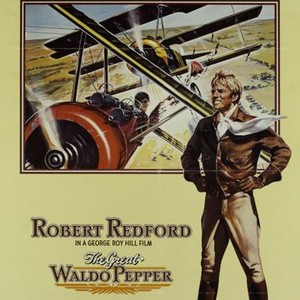

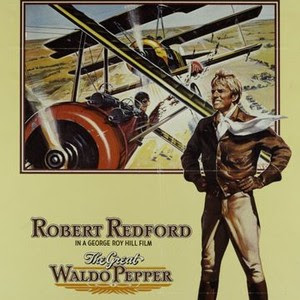
6. The Great Waldo Pepper (1975) - George Roy Hill's film about barnstormers in 20's middle America is an especially wise film beyond its 'scope aerial vistas and Robert Redford infused charm. It's also a film of two halves. The first deals with the chaotic gamesmanship between pilot Redford and fellow flyer Bo Svenson as they try and one-up each other in conducting aerial flight tricks for enraptured audiences. And even though they often end up bruised and battered, it doesn't stop their obsession with circus-like and envelope-pushing stunts. But the second half- after both men have been officially grounded due to some pretty horrific accidents to those close to them- "The Great Waldo Pepper" settles into a reflective conversation about men past their prime, re-living war glory, and their sublimated place in the early days of Hollywood stunt filmmaking. And when an ex-German war hero comes into the mix (played with subtle grace by Bo Brundin), Redford's Waldo Pepper morphs into a man reclaiming his past glories and daredevil fatalism in a finale that's both thrilling and melancholy for how it portrays these men who wish more to be martyrs in the sky rather than living as ordinary schlubs down below.
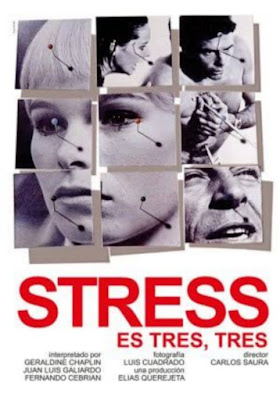
5. Stress Is Three (1968) -  In a scene towards the end of Carlos Saura’s psychological chess match “Stress Is Three”, a man Antonio (Juan Luis Galiardo) is grounded, literally and figuratively, when he tries to drive away in his car on the beach and ends up only spinning its wheels in the sand. This comes after the frustration (and imagination?) of him seeing his wife (the luminous and blonde wigged Geraldine Chaplin) making out with their best friend Fernando (Fernado Cebrian) behind a jetee of rocks on the beach...... an act poor Antonio has internalized the entire film. It’s his breaking point, but in typical 1960’s ennui fashion, it's a violation of the human contract between husband and wife that may have only happened in his mind. If nothing else, Saura's film is about the disconsolate attitudes of the privileged and how they tear each other apart when left to their own devices. Taking place over the course of just a couple of days, the trio embark on a road trip together. There’s no denying the flirtation between Teresa and Fernando from the very beginning. It’s enough that at one point, Antonio sneaks off the road ahead of them and spies on them through his binoculars. And because this paranoid act occurs towards the beginning of the film, it's a nervously implied sequence that sets the ominous tone that something is happening.

4. The Enemy Below (1957) - A naval war film that excels because it humanizes both sides of the altercation. When we first meet the German submarine commander, played by Curd Jurgens, he's commiserating about the effects of war on humanity. Far from being a Fuhrer acolyte (his disdain is subtly reflected later when the man's name is mentioned by another soldier), "The Enemy Below" shares screen time between his desperate attempts to save his hunted German U boat and out maneuver the American hunter above, led by captain Robert Mitchum. Eschewing the usual patriot fervor that accompanies most of the big studio war films of the 50's, Dick Powell's muscular effort is all the better for how it equals both sides of the conflict as simply men who want to see all their subordinates return home in one piece. Directed with muscular flare by Dick Powell, the depth charge explosion scenes are worth the price of admission alone. War movies done right.
 

3. Alive In France
(2017) - Two things are made incredibly clear in "Alive In France", Abel Ferrara's documentary about his overseas promotional tour with his band while attending a retrospective of his films; first, he scratches together music with just as much abandon as he does film making. From the way he pieces together various drummers in each city to how he vigorously commands the light show at each club, Ferrara is an alpha auteur in every sense. Secondly, the documentary fits perfectly with his late career work of quieter, more reflexive pieces of cinema that act as love letters to both the creative process and the people he's chosen to align himself with. As he answers one patron in a Q&A session, the New York of his older films doesn't exist anymore, so why should he continue making films about gangsters? Well, "Alive In France" is still a Ferrara film, beating with the hard-scrabbled heart of his previous films but tinged with a sense of nostalgia and passion for his latest role in life. It makes him immensely happy (despite the pressures of performance) and it's a film that makes us incredibly happy as well. The documentary also continues the filmmaker's varied late career of submerging himself in a cerebral fictional film while seeming to release his pent up fictional ruminations with a loose and freewheeling work of non fiction.
 
2. Dusty and Sweets McGee (1971)


Honed into the type of leisurely, anemic snapshot-of-time that would come to define the careers of Sofia Coppola and scores of others in the post 90's indie new wave boom, Floyd Mutrux's "Dusty and Sweets McGee" outlives its thin pseudo documentary beginning to morph into a sobering, half-dreamt memory of sunny California and the dark storms of addiction that roll just beneath its pleasant surface. That this film is relatively unseen today (thank you Turner Classic Movies for its late night broadcast this month!) only adds to the film's lilting presence somewhere between tone poem beauty and after school special didactic. Beginning with introductions to its main slate of characters (supposedly real addicts playing themselves), Mutrux lets the good times roll, synching images of their late night car drives around the valley and frolicking in bedrooms to a host of popular tunes as if timed to a hay-wired jukebox unable to settle on 1 song for long. Even though it feels like "American Graffiti" (1973) and Mutrux himself would later direct "American Hot Wax" (1978), the film soon settles into the darker reaches of its time and place as various young men and women go about their drug-addled days of dream-big heists and opium-dazed dalliances. Released briefly in 1971, "Dusty and Sweets McGee" never quite made the mark it hoped. Although Mutrux is perhaps one of the more underrated writers and filmmakers of the 70's, the film is one of those discoveries that needs to be made. It may seem tame in comparison to the German miserablism of Uli Edel years later, but as a touch point in independent American lyricism, its message hits loud and clear.

 
1. The Garden (2005) - As usual, Wiseman makes a strong statement about class, society, and human theater without saying any real words of his own, choosing instead to cultivate images and juxtapose them in luminous ways. Filmed in the mid 90's and chronicling the various high profile events and mundane conventions Madison Square Garden plays host to, "The Garden" is infinitely more enlightening when it pivots away from the spectacle and observes the proletariat (cooks, security, ticket takers and floor crews) that really drives the engine of the landmark. Why is it more interesting to watch how cotton candy is made then the Bulls and Knicks playing a game? Why is the message of a self described cat masseur more intriguing than the anti-union discussion of Garden management staff? Because that's exactly what makes all Wiseman films so essential. He takes a single location or event and mines the tree rings for all its worth. And, if nothing else, the film confirms my belief that we humans are the most filthy thing on the planet by the mountain of trash and food that's swept into the aisles by the janitorial staff after an event. As our greatest living documentarian, Wiseman's deep vault efforts continue to fascinate and enlighten even when the subject matter seems like no amount of energy or new information can be gleaned from its antique halls.

Tuesday, December 20, 2022

Top 5 List: Great Performances of 2022

 Jeremy Pope, "The Inspection"

As a gay man entering basic training for the most dire of reasons, Jeremy Pope's performance in Elegant Bratton's autobiographical "The Inspection" is one of the most beautiful things on screen this year. Vulnerable to his emotions, his performance isn't one that causes him to hide his true nature from his fellow recruits. In fact, they all find out pretty quickly, and the rest of the film is his how he deals with the swirl of prejudice. Compounded by the fact his mother (Gabrielle Union) has essentially disowned him for his sexual orientation, Pope's magnificent, layered embodiment of a man just trying to survive (literally) in the most unforgiving of places makes us care all the more.


Ashton Kutcher, "Vengeance"


B.J Novak's social media film noir came and went in theaters pretty fast, which is a shame because it gets more interesting as it goes along and features some genuine depth (and comedy) about our relationship with each other through the thin guise of "cultures". But the minute Kutcher shows up as a laconic, slow drawl Texas record producer who may have something to do with the central murder-mystery, "Vengeance" received a sever injection of brilliance. Whether it's the way he spouts metaphysical nonsense with the cadence of a Southern psychopath or the way he commands attention with his lanky body, his role as Quentin Sellers is the stuff of genuine supporting actor charm.


Bella Ramsey, "Catherine Called Birdy" 


Making her name as the braver-than-most-men in season 6 of "Game of Thrones", Bella Ramsey dons another side of her personality in Lena Dunham's whip smart medieval comedy "Catherine Called Birdy". This time she plays..... well her goofy 14 year old self. Anachronistic, playful, and comedically intelligent, Ramsey inhabits Birdy with all the charm and giggling grace of a young woman who's not only braver than most here as well, but smarter. She has a bright future ahead of her.


Hayley Lu Richardson, "After Yang" and "Montana Story"


The year of Hayley Lu Richardson continues. Or maybe the last 5 years? Her performance as an emotionally stunted daughter returning home to settle her dying father's affairs in "Montana Story" and the lovelorn young woman in her second brilliant effort with filmmaker Kogonada in "After Yang", both show her range as someone battling against her inner demons while remaining a steadfast, independent figure in vastly different realms of narrative. Both films rank as two of my favorite films of the year mostly because of her honest presence.


Key Hu Quan, "Everything Everywhere All At Once"


(image from A24) 

In "Everything Everywhere All At Once", Quan is asked to play many roles as he and his family spin out of control in a whirlpool of multiverses. But through each one (especially the one that directly sinks him and Michelle Yeoh in the recesses of a Wong Kar Wai film), his uncanny ability to portray the goodness and humanity is a revelation. Oscars don't mean much to my view, but I so desperately want Quan recognized later next year for this role.


Tuesday, November 15, 2022

The Current Cinema 22.4

 Triangle of Sadness


All of Ruben Ostlund's films are provocative and hermetic social anxiety dramas that feel more like sociological experiments than films. Up until now, none of them have really vibed with me. The closest that made me pay attention to his distinctive ethos of class and approximation was "Play"... a film that pushes the clash of cultures between young teenagers to the brink of intellectual exhaustion. Now, with his latest subtly sadistic "Triangle of Sadness", I sort of see what Ostlund is up to. Whether it's the exuberant comeuppance through extreme scatological humor or the precise shifts in power and subordination, this is a scathing eat-the-rich comedy that sees a beautiful but tenuous couple (Harris Dickinson and Charlbi Dean) get caught up in more than their scabrous arguments about who's paying for dinner. Divided into three sections and running at two and a half hours, "Triangle of Sadness" doesn't ask one to care about anyone, from a communist yacht captain (Woody Harrelson) to the survivors who find themselves stranded after a disastrous event. Filmed with formal elegance (just admire that quiet, slow pan back from the point of view of a boat drifting towards a multi million dollar yacht that elicited gasps in my screening) and populated by needle drops that serve as ironic counterpoints to the empty vessels of wealth and pomp, "Triangle of Sadness" does skewer the upper class, but then proceeds to take a fine slicing of all the classes in between before this masterpiece of a film cuts out.


Bardo, a False Chronicle of a Handful of Truths

Admiration for Inarritu's head trip epic comes far more easily than enjoyment. Immensely uneven and (at times) borderline didactic and dull, "Bardo, False Chronicles of  a Handful of Truths" ventures down an enigmatic path. Just like its main character, a respected journalist-turned-filmmaker Silverio (Daniel Cacho) who seems to be slipping in and out of reality at will, the film itself alternates between soulful family drama and pretentious fever dream in whiplash fashion. I was immensely more moved by the family interaction between Silverio and his wife (a wonderful Griselda Siciliano) and children (Ximena Lamadrid and Iker Solano). If Inarritu had wanted to completely follow their path, I think "Bardo" would have been a masterpiece of familial heartbreak and common healing. One sequence with the family in Baja, California is without a doubt one of the most moving and insightful sequences in any film this year. Likewise a husband-wife playful chase around their apartment and a banquet dance sequence that radiates careless ebullience. Unfortunately, "Bardo" has heavier things on its mind (or outside its mind) and every time the film switches back to the netherworld wanderings of Silverio and a passion to metatextualize everything from the scrupulous practices of the media to Mexican history, the film is diluted of its intrinsic power built up by the drama of its nuclear family. There's a magnificent film in here somewhere, and sometimes less is certainly more.

Monday, October 31, 2022

Hacktober '22 Continued


Apparently part of a trilogy (which Mubi is slowly dropping each week until Halloween), Michio Yamamota's "The Vampire Doll" is pure early 70's Hammer knock off horror, complete with surreal images tinged with an air of genuflective Japanese culture. It's thrills are few and far between, but when they happen, they suggest a nightmarish rapture of the living dead.Taking place mostly in a lavish old mansion where a family holds a dark secret about the death of a young bride and the family that goes searching for her. I look forward to "Lake of Dracula" that streams this week.


I'm not sure what I expected from Val Lewton's factory produced "The Leopard Man". After the aforementioned leopard wildly escapes towards the beginning and claws the hand of a waiter on its torrid exit, I thought maybe we'd get an infected man terror tale. Then the wild animal corners and hunts a young girl in a scene that ranks as one of the most heartbreaking demises in cinema. Then more and more people turn up dead and it appears there's a serial killer on the loose. What's so good about Jacques Tourneur's film is the simple exploration of fear. Much like war-torn Berlin and serial killer Paul Ogorzow, history often reveals that evil is born and enabled by a shroud of terror. The town experiencing the fear of a loose beast soon turns on itself and gives in to its primal urges, turning even the most lucid figures into Jekyll and Hyde like depositors of destruction. "The Leopard Man" is pure trauma horror decades before the onslaught of lazy, hackneyed approaches to the same treatment scatter the current horror film landscape. 


Despite it's clumsy title, Yamamoto's "Lake of Dracula" is just as atmospheric as "The Vampire Doll", equally as in love with fairly simple creature design, and certainly vibes with its 70's era chills. Just one more in his trilogy to go.


Tuesday, October 18, 2022

Hacktober '22


It's been a couple of years since I've dove headfirst into an array of horror movies, and it feels good. Welcome back Halloween and some sense of normalcy around its wicked traditions and theatrical experiences.


Corsets. Heaving breasts. Bare asses. Poison tipped arrows. Exquisitely framed, gauzy images. Walerian Borowczyk's "The Strange Case of Dr. Jekyll and Miss Osbourne" has all of this and more as it takes Robert Louis Stevenson's perennial classic for a perverse spin. As the dual doctor/murderer, Udo Kier is perfect as a man raging terror on his household of guests. As the film progresses and the bloodshed (and sexual humiliation) escalates, Borowczyk's images become terribley beautiful, from the darkness that surrounds a body hanging upside down to the immaculate light and shadow that frames Marina Pierro lying in the doorway of a bedroom. Such images shouldn't be so wonderful in a Euro slasher, but then again, Borowczyk's film is ideally situated in the midst of an artist traveling from animation to porno sleaze in the 80's. "The Strange Case of Dr. Jekyll and Miss Osbourne" is a juicy entry.


From the Val Lewton produced factory of 40's horror films, the only thing more terrifying then a group of people being trapped on a crypt island while the plague sweeps through their ranks is the tyrannical fervor shown by military man Bela Lugosi and housekeeper Helene Thiming as the sickness hits the fan. So goes Mark Robson's eerie "Isle of the Dead" which mangles together melodrama, zombie horror and nationalist trauma into a tidy, entertaining package. And the final ten minutes is a brilliant collection of light, shadow and atmosphere that surely inspired the muted starkness of Kiyoshi Kurosawa's mid career thrillers.
 
 
Made right before entering the halls of horror infamy with his "Nightmare on Elm Street" series, Wes Craven's "Invitation to Hell" is definitely neutered by its television movie status. Still, what remains is a quasi bonkers tale of corporate inhumanity (literally) and suburban terror as new hire Robert Ulrich realizes he's moved to the desert to work for the devil (Susan Lucci). Far less scary than slightly nerve fraying, "Invitation to Hell" features some paper mache like sets of hell and a tone that's all over the place. I hoped for better, but it is what it is.


Friday, October 14, 2022

The Current Cinema 22.3

 Moonage Daydream


Brett Morgen's portrait of the iconclastic David Bowie refuses to play by the standard documentary rules. Using pieces of Bowie's actual voice from archival recordings as if the singer had been preparing for this type of life reverie since inception, "Moonage Daydream" is all the more potent because of its idiosyncratic nature. I doubt it would've been quite as satisfying if it simply dotted back and forth on a perfect through line of Bowie's ascension to the top of the rock and roll mountain. And even though it doesn't immediately serve as a linear experience, Morgen does some incredibly dexterous editing to subtly evoke a timeline in Bowie's life from his glam rock explosion to heart rendering late life ballads. Like an abstract painting, "Moonage Daydream" bowled me over in sound, image, and juxtaposition, cycling through his hits (and even some lesser known efforts) to create a film that's more attuned to Bowie's outlook on the vibrancy of life than any straightforward exposition crafted about him ever could. 


Amsterdam


Neither deserving of the unmitigated marketing disaster of its opening weekend grosses, nor an esoteric auteurist diamond in the rough, David O. Russell's very busy and overlong thriller-comedy ensemble is simply..... okay. And while I've adored some of the more problematic Russell films of the past few years (namely "Joy"), "Amsterdam" tries way too hard to fit into his formula of quirk and more intelligent comedy. Built around a trio of performances that range from the interesting (Robbie and especially Bale) to the mundane (Washington and pretty much every other star who pops up), "Amsterdam's" rat-a-tat narrative about embedded fascism and corporate skulduggery in early 30's America features an energy that oscillates between high energy and low exposition. It's fits and starts probably equate something to the nervous, unfocused determination of its Nancy Drew like trio, but as the film runs through its tangled web of subterfuge, it slowly runs of out steam. Ideally, this 30's set noir-lite would be right up my alley, and "Amsterdam" does have its enthralling moments.....I kind of wish we could have just luxuriated with the trio in Amsterdam and their Hemingway-esque lifestyle of artistic liberation and pajama wearing bohemie. After that, a real plot kicks in and I cared less and less about what was going on rather than the vibes of its hazy first half. The power of Amsterdam, indeed.


Don't Worry Darling


Another film pretty well sunk due to pre-release mishandling (this time firmly within the ranks of its own film staff rather than the studio), Olivia Wilde's "Don't Worry Darling" also strikes me as a very muted effort. Well made but ultimately derivative of a host of other science fiction rug pullers whose central conceit lays fault at the paranoia of a matrix dominated existence, it's neither terrible nor exceptional. As the young, flawless couple at the center of a 1950's suburbia that isnt-exactly-what-it-seems, Florence Pugh and Harry Styles conduct themselves well and filmmaker Wilde equips herself with a stable of craftsman who make everything pop. The ultimate downside to "Don't Worry Darling" is the constant expectation to figure out what's going on. This type of film can be exciting if it sneaks up on the viewer, but in the case of this film, it's all figure-out and no let-it-wash-over-you vibes, which feels frustrating at times.

Sunday, October 02, 2022

Cinema Obscura: Carlos Saura's "Stress Is Three"

In a scene towards the end of Carlos Saura’s psychological chess match “Stress Is Three”, a man Antonio (Juan Luis Galiardo) is grounded, literally and figuratively, when he tries to drive away in his car on the beach and ends up only spinning its wheels in the sand. This comes after the frustration (and imagination?) of him seeing his wife (the luminous and blonde wigged Geraldine Chaplin) making out with their best friend Fernando (Fernado Cebrian) behind a jetee of rocks on the beach...... an act poor Antonio has internalized the entire film. It’s his breaking point, but in typical 1960’s ennui fashion, it's a violation of the human contract between husband and wife that may have only happened in his mind. If nothing else, Saura's film is about the disconsolate attitudes of the privileged and how they tear each other apart when left to their own devices.

Taking place over the course of just a couple of days, the trio embark on a road trip together. There’s no denying the flirtation between Teresa and Fernando from the very beginning. It’s enough that at one point, Antonio sneaks off the road ahead of them and spies on them through his binoculars. And because this paranoid act occurs towards the beginning of the film, it's a nervously implied sequence that sets the ominous tone that something is happening.


Eventually arriving at Antonio's farm home (and in typical ominous fashion, none of the family is there to meet them) the division between reality and fantasy gently rises in Antonio's head. But for all this talk about challenged masculine identity, "Stress Is Three" really belongs to Geraldine Chaplin. Starring in a handful of Saura's early films from 1967 until the mid 70's, her presence is as inseparable as that of Anna Karina was to the initial masterpieces of Jean Luc Godard. Here, it's easy to understand why Antonio would be selfishly jealous of his beautiful wife.


All of this frustration and ennui culminates in a trip to the beach where the stark black and white cinematography mutes all the beauty of the day and Antonio's spying seems to prove his buried suspicions. But then, Saura pulls a fantastic cinematic trick out of his bag, effectively rewiring the entire film and setting the template for a style of incisive satire and black psychological comedies that will dot his oeuvre for the next three decades. It's all there in just his second film, and "Stress Is Three"- gaining wider attention as a selection on the Criterion Channel- hopefully will bring more understanding to a filmmaker largely forgotten in 60's and 70's world cinema.


Sunday, September 04, 2022

On "Three Thousand Years of Longing"

Entering a film by George Miller, one can anticipate quite the fevered and frenzied ride. But he can also hint at the simpler truths in life, such as the magic of a pig to make us understand the power of humanity. His latest film, "Three Thousand Years of Longing" is fevered and frenzied, but it also hints at some beguilingly beautiful sentiments about connection, patience and (blink and you'll miss it) the idea of reincarnation. The dichotomy of his filmmaking career is well versed in this one picture.

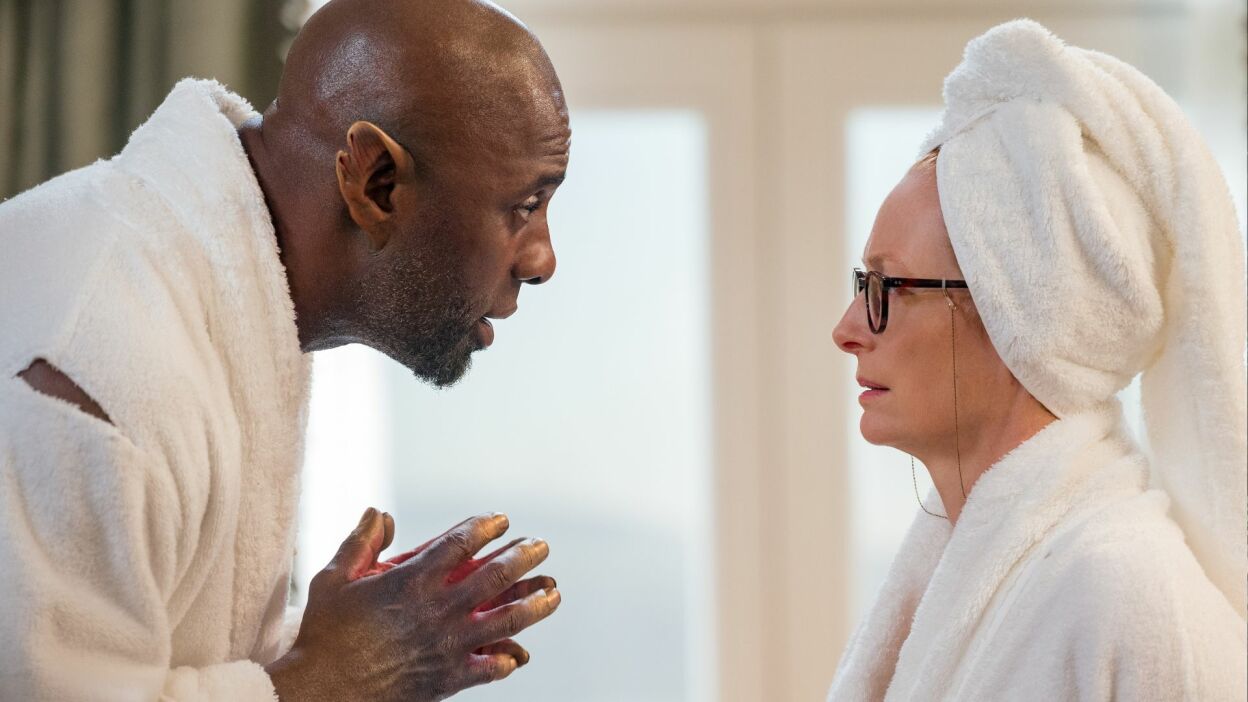
Playing like a cosmic meditation about (literal) star crossed lovers finding themselves once again after many years of isolation, the film begins when academic lecturer Alithea (Tilda Swinton) travels to Istanbul for a mythology conference and finds herself smack dab in the middle of her own fantastical adventure. That comes in the form of a genie (Idris Elba) she accidentally releases in her hotel room after buying a bottle in a stack of trinkets from a local shop. Naturally, Alithea's preponderance for storytelling and myth lends the perfect ear for the genie to expertly tell three stories of lost love and ancient history while awaiting for his new steward to make her 3 wishes. But as his stories progress, not only do his tales exemplify the bottomless nature of such a wish, but they reveal the ways in which love can only entrap those pure of heart.

Swerving from his love for the Queen of Sheba to the more modern doomsday account of a kept woman who believed knowledge would be her salvation, Alithea grows to connect with the genie, and it's here that the film abandons its story-within-a-story structure and follows the couple as they try to carve out their own relationship in modern day Europe.

Magically alive and heartfelt, "Three Thousand Years of Longing" had me from the very start. As a fan of films like those of Julio Medem where the natural world is never very far removed from the fantastic when it comes to his varied couples, Miller's film (adapted from a short story by A.S. Byatt) swoons with overstuffed emotions matched brilliantly by his haunted-house visuals and CGI flourishes. Basically, there are enough ideas here for a dozen films, and at times "Three Thousand Years of Longing" feels like its about to boomerang into space before being yanked back into focus by the central relationship of Swinton and Elba. Their conversations in hotel room bathrobes and a demure English flat are the stuff of real human connection. And it matters because these two people have been running towards and away from each other for centuries, kept apart by wars, jealousies, madness, and sheer bad luck. At its core, "Three Thousand Years of Longing" is a commentary on enduring love. Just why does that one figure from Sheebe'a court appear out of thin air to traumatize Alithea? What does a restless leg have to do with the story? Miller has imprinted the film with a deep appreciation of star-crossed lovers who finally find each other again. In his sly way, he's made the most romantic film in years.


Saturday, July 16, 2022

The Current Cinema 22.2

 Elvis


In Michael Mann's splendid portrait of Muhammad Ali, the first twenty or so minutes are some of the boldest, most invigorating images of his long career. They bolt back and forth in time, jumbling a lifetime of training, moods, faces, hands, and sound into a swell. While I hesitate to compare Mann to filmmaker Baz Luhrman, the latter does something similar with his impressionistic look at another iconic 20th century figure in "Elvis", dropping the usual A to B schematic in favor of a music video aesthetic. From the musical cues that inspired him as a young boy to his nervy first stage appearance, Luhrman compresses time into a barrage of images that aren't overbearing, but pace the rest of the film with his glossy style. To my surprise, it works well because the last thing we needed was a serious deep dive into the artist, and instead Luhrman infuses his tale (approved by the family of course) with all the hip swinging, eye batting ludicrousness that launched Elvis into the cultural stratosphere in the first place. Austin Butler, as Elvis, ably embodies the superstar with not much beyond his looks and affectation but "Elvis" maintains a good time and succeeds in wrapping the singer's life and untimely death in a polished bit of wild glitz and glamour that's just as fitting as his gaudy lifestyle towards the end.


Saturday Fiction

My appreciation for intricately plotted World War II spy thrillers from Euro masters isn't a secret. Last year's criminally neglected "Wife of a Spy" by master Kiyoshi Kuroswa deserved better. And this year, the criminally underrated masterpiece is Lou Ye's "Saturday Fiction". Shown at a scattering of film festivals in 2019 and then unceremoniously released in a few theaters earlier this year, Le is a filmmaker I've long admired- check out "Purple Butterfly" (2003) or "Summer Palace" (2006)- and "Saturday Fiction" is yet another bold stroke in the career of this Sixth Generation Chinese filmmaker. Filmed in Le's typical nervous, handheld style (but this time in beautiful black and white), the film tells the bifurcated tale of a movie star Jean (Gong Li) returning to occupied Shanghai in December of 1941 to act in a stage play by Mark Chao. Is the play a memory of their past together? Le constantly shifts perspective from the play to real life, causing a meta-curious comment on the film's events. But outside of her acting duties, Jean also seems to be acting as a spy. Opposing forces are all around. Who is exactly spying on who? "Saturday Fiction" resides in this cloistered atmosphere where political paranoia and personal attractions are never too far removed. In one brilliant scene that illuminates how invisible this line is, a member of the acting troupe gets drunk and accidentally falls against the door of their hotel suite, which opens slowly into the room of a group of Japanese soldiers. The tensions that rise are spectacular and Le charges "Saturday Fiction" with a beautiful blend of action thriller aesthetic and moody art-house plot mechanics. Part Jean Pierre Melville and part Wong Kar Wai, Le has crafted a terrific effort that (knowing the importance of its December 1941 setting) ticks down and reveals the ominous wreckage of secrets told and kept.