I recently re-read "The American Cinema" by Andrew Sarris, partly in moist eyed remembrance of my most influential and favorite American film critic, but mostly due to the fact it'd been over ten years since I last read it. Having seen a large body of many of the directors mentioned certainly helps in appreciating Sarris and his razor-sharp analogies, and it struck me: what changes would Sarris make today, in 2013, if any? Does he still write off Aldrich, Lumet and others quite so easily now that time has given their canon lenghty and discussive analysis? And, more importantly, what would my pantheon look like? So, here, in quick succession with only a few minutes (and looks back over my best of lists for the past 30 years or so) is how I'd rank things (foreign directors accepted). If one is so inclined, comments and your own rankings on your own blogs is encouraged!
I. Pantheon Directors
Martin Scorsese
Jean Luc Godard
Jean Pierre Melville
John Cassavetes
Michael Mann
Olivier Assayas
John Frankenheimer
Coen Brothers
Wim Wenders
Francesco Rosi
Edward Yang
Tony Scott
Sam Fuller
Abel Ferrera
II. The Second Tier
Michael Winterbottom
Sidney Lumet
Johnny To
Robert Altman
Roman Polanski
Francis Ford Coppola
Frank Perry
Brian DePalma
John Carpenter
Emir Kusturica
Terence Malick (despite my love wavering the last 2 films)
Takeshi Kitano
III. Highly Regarded, but too soon to tell
Paul Thomas Anderson
Wes Anderson
Julio Medem
James Gray
Christopher Nolan
You Le
Fatih Akin
Andrew Dominik
David Fincher
Jacques Audiard
Darren Aronofsky
Rian Johnson
Wong Kar Wai
Showing posts with label Andrew Sarris. Show all posts
Showing posts with label Andrew Sarris. Show all posts
Saturday, June 08, 2013

Wednesday, June 20, 2012
RIP Andrew Sarris
Very sad news with the passing of the great Andrew Sarris. When I first came online in 1994 or so, he was the first critic I archived and went to every week. His critical film books were revelatory to me and his style of writing (which I still mimic to this day and can still recollect how he always addressed the actors and directors as "Mr. and Mrs") instilled a deep intelligence of film as an art.
Andrew Sarris obit.
Collection of his top ten films by year since 1958... a must read and one that has been driving me for years to see all the films if possible.
My own assessment of Sarris from a years ago in lieu of a blogathon.
Andrew Sarris obit.
Collection of his top ten films by year since 1958... a must read and one that has been driving me for years to see all the films if possible.
My own assessment of Sarris from a years ago in lieu of a blogathon.
Tuesday, April 15, 2008
Discovering The American Cinema
 This post is a contribution to the blogathon at Film At 11 blog, dedicated to the anniversary of the publication of Andrew Sarris' seminal film book, The American Cinema.
When my interest in film seriously bloomed, it belonged to the days of going to the library and riffling through the racks, checking out books and discovering new passions at every turn of the page. Writings such as Stanley Kaufman's "World On Film", or selected essays by Pauline Kael, or J. Hoberman's seminal "Vulgar Modernism", or the National Society of Film Critic's series "Film 67/68" and "Film 68/69"- all of these books drew me closer (and sometimes farther away when I couldn't find a particular movie I desperately wanted to see based on the writings) to understanding the filmmaker behind the films. Here I was, a teenager in the early 90's digging back into the past when I should've been enjoying the latest "Terminator 2" or "Jurassic Park". I did like those, but my fervor existed solely in the past as I discovered Godard and the French New Wave, Ingmar Bergman, Federico Fellini, John Casavettes and counter-culture classics like "Easy Rider". If we don't know where we came from, how can we enjoy the present? And then I stumbled across Andrew Sarris and his book "The American Cinema". Here, finally, was a book that enveloped the same passion I was feeling by watching all these grand cinematic statements from the past. Also, the almost maniacal manner of categorizing and listing that Sarris utilized appealed directly to my own insatiable appetite for list-making. What "The American Cinema" did for me was provide knowledge that it WAS important to see "Persona" or "Breathless" or "The 400 Blows", but it was even more important to place these masterworks within a larger frame. It wasn't enough to see just those films, but then to watch ALL Truffaut, ALL Godard and certainly all Casavettes to decipher the fingerprint of the director over each film. "The American Cinema" opened up the possibility to me that there was someone greater behind the camera and his thoughts opened up a whole new discussion about "bodies of work"- an ideal that seems inherent in modern cinema. I quickly learned that the visual or emotional miracle of a film wasn't found in one principle work, but they manifested themselves, equally, over and over again through the course of several years. It didn't matter whether I was viewing a watershed film event of a director's career or a one-off B movie made before that director became famous. If you looked hard enough, the miracles were everywhere. Sarris understood that process of miracles and "The American Cinema" was his documentation of those miracles. And without that documentation, I don't know if I would love film quite as much as I do today. It gave me permission to choose favorites as well as introducing me to the term "auteur". And is there, really, a more foundational approach to cinema than that?
After discovering "The American Cinema" and once the internet consumed our every waking moment, Andrew Sarris was the first critic I read online weekly (with Ebert a very close second). The spirit of auteurism has never strayed far from Sarris' cinematic outlook. While my tastes in film weren't always compatible with his point of view (his preference for more Merchant Ivory fare, for example), I received immense joy from the graciousness of his reviews. I don't think any other film critic has the air of respect shown by Sarris in his writings, continually referring to each actor, director, writer or producer as Mr. and Mrs. throughout his pieces. And while he can certainly lash out vindictivly towards a film he deems of lesser value or social importance, his eye and ear are still close to the pulse of pop culture.. despite his age. He often found value in flashy efforts such as "Running Scared" (yes, that Paul Walker vehicle with a nasty ice rink showdown), "Run Lola Run"... or reveled in the profane, nihilistic portrayal of Billy Bob Thornton in "Bad Santa", his number 2 fav film of 2003- all of this while maintaining equal admiration for "Pride and Prejudice" and the entire career of Eric Rohmer.
Yet even though Sarris penned the ultimate statement on directors, there was always room for re-assessment as he reflected on older films, saw new films by old masters and recognized the brilliance of fresh faces. While some directors were sentenced to irrational pigeon-holing within his book as "Strained Seriousness" or "Lightly Likeable" and couldn't be erased in 1968, Sarris had no problem in adjusting and admitting a mistake in later print reviews. At the very least, "The American Cinema" should be regarded as a revisionist text in the finest sense, ripe for re-discovery today by any film lover struggling to understand the transient space between past filmmaking and modern artistry. And, for a writer who wallowed in categorization, Andrew Sarris certainly defies categorization today.
To see Andrew Sarris' "Best Of" lists from 1958 to the present, check here.
Wednesday, June 28, 2006
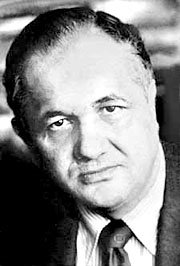
The picture is not a trick. I doubt many people will know who this is. I just stumbled across this tonight. Film lovers can now geek out. The man is Andrew Sarris, respected film critic for the New York Observer and author of the invaluable book called "The American Cinema" which put forth, for American audiences in the late 60's, the radical French theory of director as "auteur". I've long respected this writer's opinions and outlook, and now we have the above collection of his Top Ten lists for the last 30 or so years. If anyone has seen more than 50% of the films on his lists, you truly are cool.
Subscribe to:
Posts (Atom)