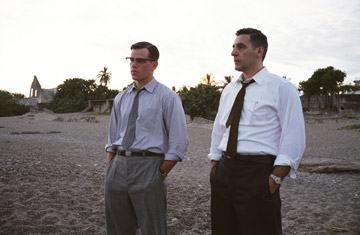
Friday, March 09, 2007

Thoughts On Zodiac

Is there anything more thrilling than the police procedural movie? I'm sure that, based on opening weekend totals and word of mouth, there are plenty of people saying, "um yes, there is when we're expecting another kick-ass David Fincher movie along the lines of Seven!"

Well "Zodiac" is certainly not another "Seven" as much as the film's producers would LOVE to sell it as (especially since that 1995 film has been the only Fincher film to gross over $100 million). But "Zodiac" is something more altogether- its smart, well paced, well acted and certainly well researched. It also falls right into the genre of film that I love- one I affectionately call the 'journalistic procedural' genre- the grand daddy of them all being 1976's "All the President's Men". And while in recent times the emphasis has shifted from a journalistic stance to illuminate the same type of dogged determinism inherent in police work, the main point is still the same- show the audience all the frustrations, the dead ends, the paperwork and especially the elation when all that hard work pays off. "Zodiac" does that masterfully.


Using the zodiac killings that took place during the Bay area in the late 60's, Fincher's film focuses on the cops (a wonderful Mark Ruffalo, who did this type of thing so intelligently also in Michael Mann's "Collateral" and a rejuvenated Anthony Edwards) and the reporters (Robery Downey Jr, need I say more! and Jake Gylenhaall) who spend their careers and their sanity searching for the one clue that may break the case wide open. Characters float in and out of the twenty year time span as the case grows and wanes, time is reflected patiently in clothes and style and, perhaps, the biggest injustice that the film exposes is the lack of law enforcement cooperation that existed between four separate California counties during the killings. The damnation of "Zodiac" lies not on one person, but the bureaucratic breakdown of our judicial system.

Filling the screen with the hunt of the prey based solely on intelligence and research has been done to great lengths in the past, and "Zodiac" deserves to join that list. As previously mentioned with Alan J. Pakula's film, there is also Bertrand Tavernier's "L.627" from 1992- a film whose entire 2 hour and 30 minute running time concerns itself with mundane daily details of a French police unit as they fight the war against drugs and prostitution. As exciting as it sounds, Tavernier elicits great sympathy out of his main character, and I feel for him when he has to sit and type out a long report (often filled in real time as he interrogates his handcuffed criminal) and especially during the film's muted final moment as he drives away in the back of police van, looking out onto the street he's trying to make safe. Also from France this year (why are the French so good at nailing the vagaries of professional life?) was Xavier Beauvois' "La Petit Lieutenant". While this film saddled the police procedural around a somewhat strong framework of plot, it still conveyed the maddening doldrums of city police work. Here at home, the most stunning and recent example lies in David Simon's first season of his HBO drama "The Wire". Just watch that show over its first 13 episodes and I dare anyone not to be intrigued and wholly caught up in its portrayal of a police task force slowly ripping its way into the organized drug trade of inner city Baltimore. That shows breadth and scope, alternating between the street level drug dealers and carrying itself up to the corridors of City Hall, fascinated me more than any movie in the last few years.

Now back to this little movie called "Zodiac". Clocking in at almost 3 hours (and using about 5% of its screen time dedicated to the killings themselves), it can be frustrating at times and lends itself to information overload- I'm still trying to piece together how one section about a murder in Riverside and a piece of wood found with writings on it fits with the rest of the film. But the greatness of Fincher's film lies in its resolve to not be another "Seven". "Zodiac" is a refreshing attempt to reconstruct a process of thinking through a crime rather than exploiting the crime itself. The ultimate example of this is during an interrogation scene with a character who the film (based on Graysmith's book) pretty much vilifies as the true killer- the tension and observation during that scene strikes more points than any action sequence could ever amass. It's all about body language and intuition between the cops and their subject. You can feel their wits literally doing battle on the screen. And that's a battle I'd watch any day.

So, I'm curious to other procedural films that have sparked everyone's interest. List away in the comments section!

Wednesday, February 28, 2007

Reviews

The Astronaut Farmer

For all their idiosyncracies, the Polish Brothers are compelling image makers. With stories pitched somewhere between small town Americana and the netherworld, their films (so far) are never boring or labored. While the stories themselves may seem far-fetched- i.e. twin brothers attached at the hip looking for love in a dank hotel in "Twin Falls Idaho" or a Montana town on the brink of extinction due to an impending dam project in "Northfork"- they make for beautiful pictures. "The Astronaut Farmer" is no different, and sadly, that's its greatest weakness. While all of the Polish Brother films examine dying dreams of ordinary small town people, the characters in "The Astronaut Farmer" are far more commercially structured and less interesting than, say, the six excavation experts who ride into "Northfork" and discover this is a town that's too small for its own roots and commonly stands in as a stomping ground for various angels (yes, you read that right!) Decked out in black suits and raincoats, the experts feel more like angels of death than human beings. There's a sense of that governmental distrust in "The Astronaut Farmer" as well, in the visage of Jon Gries and Mark Polish, two FBI men sent to Story, Texas to keep tabs on Charles Farmer (Thornton) because he's threatening to launch a rocket from his barn. When we first see the FBI men, their shadows are cascaded against a yellow sky, and the Polish Brothers are again lamenting the fact that anyone who dares to oppose their dream maker is obviously evil incarnate. But the metaphorical images surrounding these two soon subsides, and actors Gries and Polish become the most entertaining aspect of the film. Like the character Gries inhabited in "Jackpot" and the entire cast of "Northfork", simply waiting and passing time becomes his only objective. The remainder of "The Astronaut Farmer" deals with the tensions and questions as to whether Farmer (a man with a degree in aero space engineering and a dark past to boot) will overcome the naysayers, feed off the unending hope of his picture perfect family (lucky bastard, married to Virgina Madsen) and truly venture into space. Let's just say the idea and uncertainty of the Polish Brother's first hour doesn't compare to the final one. After all, its a film full of nice images, but when the story begins to turn literal, it loses some of its Americana mysticism and turns into a 'gee-shucks' feel good story. Less is certainly more.

The Lives of Others

The newest addition to the slate of Oscar Foreign film winners is Florian Henckel von Donnersmark’s “The Lives of Others”. Sort of a German companion piece to Francis Ford Coppola’s 1974 masterpiece “The Conversation”, both films feature an obsessive surveillance expert whose life is drastically altered after identifying with the very people he’s supposed to be gathering intelligence on. There’s even a scene towards the climax of “The Lives of Others” in which a man tears apart his residence and discovers the tiny ears that had been listening to his life play out for many years. And while “The Lives of Others” is certainly more upbeat about its denouement than the paranoid air hanging over Coppola’s closing moments, von Donnersmark’s film is still a finely crafted and well intentioned piece of filmmaking that sustains emotion and intelligence for all of it’s two hour plus running time. In the guise of a political thriller, director Donnersmark has created a small epic that deals with the emotional fissures that must exist within an oppressive regime- both on the civilian side and the governmental. While a few of the East German superiors are shown as militant shadows broadly dishing out evil, there are even more figures who are drawn in naturalistic and humanistic ways. Georg’s progression from good boy socialist to small-time dissenter is handled with care and all of the film’s secondary characters breathe life into their roles as members of the artistic community. And the film’s main cipher, Weisel, is given some great little moments as his humanity begins to shine outward from behind the mounds of electronic equipment placed around him. And through all of this, it’s a pretty damn good suspense film as well, especially in the way “The Lives of Others” gives us glimpses into interrogation techniques and the art of spying. It’s clear that Donnersmark is making a political statement, but he makes it so convincingly in such a well crafted form, that his film doesn’t feel like a statement. It’s good entertainment with a clear message- and wholly deserving of its recent Oscar.

Breach

Don't go into "Breach" expecting fireworks and international intrigue. Instead, director Billy Ray fashions a talky and quiet character drama that takes place within non-descript offices and features low-key but effecting performances from Ryan Phillipe as the FBI officer sent inside the agency to 'unmole' agent Robert Hanssen (Chris Cooper). Based on recent events that took place in 2001, director Ray has become the poster boy for designing films that emphasize the procedural actions behind the uncovering of dishonest actions and scandals. His 2001 film called "Shattered Glass", explored similar themes in much the same matter-of-fact manner, detailing the unmasking of a New Republic writer (played by Hayden Christiansen) who falsified many of his stories. While the stakes are much higher in "Breach", it's clear that Ray is much more interested in the bureaucratic rather than the explosive. And there's nothing wrong with that. "Breach" would make a great double-feature with "The Good Shepherd", another recent spy thriller that eschews action for intelligence. Both of these films feel right at home with the 70's thrillers of Alan J. Pakula or Sidney Lumet, and that alone should be worth the price of admission. Don't go into "Breach" expecting fireworks and international intrigue. Instead, director Billy Ray fashions a talky and quiet character drama that takes place within non-descript offices and features low-key but effecting performances from Ryan Phillipe as the FBI officer sent inside the agency to 'unmole' agent Robert Hanssen (Chris Cooper). Based on recent events that took place in 2001, director Ray has become the poster boy for designing films that emphasize the procedural actions behind the uncovering of dishonest actions and scandals. His 2001 film called "Shattered Glass", explored similar themes in much the same matter-of-fact manner, detailing the unmasking of a New Republic writer (played by Hayden Christiansen) who falsified many of his stories. While the stakes are much higher in "Breach", it's clear that Ray is much more interested in the bureaucratic rather than the explosive. And there's nothing wrong with that. "Breach" would make a great double-feature with "The Good Shepherd", another recent spy thriller that eschews action for intelligence. Both of these films feel right at home with the 70's thrillers of Alan J. Pakula or Sidney Lumet, and that alone should be worth the price of admission.


These reviews are excerpts from writings that can be read in full here at TalkingMoviezzz.com

Wednesday, February 21, 2007

I'm Just Gonna Go Find a Cash Machine

Two films, 16 years apart that are basically a dark mirror image of each other. That’s how I see the relationship between “Cutter’s Way” filmed in 1981 and “The Big Lebowski” in 1997. It doesn’t hurt that both star Jeff Bridges as a beach bum, slowly implicated in an ever evolving murder mystery due to the assumptions of a delusional best friend. They both use a young girl (dead and maybe dead) as a morose starting point for their infantile (and at times imbecilic) quest for the truth. They both represent a class war between the ‘haves’ and the ‘have nots’. If you’ve seen both films, the similarities are too great to ignore. And both films punctuate, in their own ways dramatic and comedic, the leanest characteristics of film noir.

Released in 1981, Ivan Passer’s “Cutter’s Way” caught the tail end of the 70’s noirs- phenomenal films that carried such a dark undercurrent and featured a great sense of nihilism that they virtually ‘out-noired’ the original black and white films. Films such as “Chinatown”, “Night Moves”, “Charley Varrick”, “Hustle”, and even to some extent “The Long Goodbye”, all featured an air-tight script with stories gleaned from the 40’s, but fully realized in that 1970’s feel that highlighted psychological mood and atmosphere over twists and turns (though these films had those too). These films, perhaps influenced by the growing pessimism generated by Watergate, Vietnam or inflation, were darker, meaner and all 4 feature dynamic endings that rank pretty high on the ‘bummer factor’. The detective doesn’t always solve the case, and they often end up worse and more disillusioned than when they were dragged into their moral quagmires of death and deception in the first place. I won’t give away any of the cruel twists of fate, but I dare anyone to find an iota of happiness when the curtain closes over J.J Gittes, Gould’s Marlowe, Harry Moseby or Varrick. And I won’t even mention the fate of Phil Gaines, as those fans of Robert Aldrich’s “Hustle” are well aware. Bottom line, 70’s noirs believed in nothing (to paraphrase quite the humorous nihilist in “Lebowski”) and they rubbed our collective noses in it.


“Cutter’s Way” missed the 70’s deadline by just over a year but its mood, lingering attention to a formalized plot, and especially shocking ending lends itself naturally to the best noirs of the 70’s. I can certainly forgive its ill-timed release. Starring Jeff Bridges as Richard Bone, his character sells yachts in an exclusive California town. He spends his time between his boat and crashing at his friend’s house, a disfigured and crippled Vietnam vet named Cutter, played to delirious perfection by John Heard (yes, that father from “Home Alone”). In the mix is Maureen (Lisa Eichorn), Cutter’s estranged wife who’s become secondary to his booze and violent impulses. After Bone’s car dies one night in an alley, another vehicle pulls up behind him and dumps a young girl’s body in a trashcan. Oblivious to the crime that’s just occurred behind him, Cutter leaves his car behind, getting only a glimpse of the man as he speeds off in his expensive car. The next morning, when detectives come calling on Bone because of his stalled car just yards from the dead body, he becomes a witness in a brutal homicide. It’s not long before Bone “thinks” the perpetrator is J. Cord, oil tycoon who happens to own half of the sea-side town where everyone resides. The only discerning factors driving Bone to this decision is the fact that Cord is wearing a polo hat and dark sunglasses like the darkened figure in the alley. Forget the fact that 1/3 of the film takes place within the secluded polo field and nice restaurants that dart this sunny California town. Obsessed with solving the murder and befriending the dead girl’s sister, Cutter relentlessly feeds Bone with suppositions and formulates a plan to blackmail Cord. The logic is simple- if he pays, he’s guilty and they return the money and hand him over to the police. The murdering, rich son-of-a-bitch has to pay! Of course, nothing goes as plans, and Cutter’s dementia as he desperately tries to pin the murder on Cord envelops his life, pushing his wife away even further and releasing both Bone and himself into a collision course that results in even more loss of life. The character played by Jeff Bridges, shown to be quite the ladies man, wants nothing more than to lounge on his boat, bed beautiful women and live off the scraps of his rich friends. It’s the persistent cracking psyche of Cutter that drives the story down its dark trail as he pushes everyone towards a climax that’s inevitable… and all the while holding onto the “truth” through a few ‘possible’ ideas by Bone. Sounds eerily familiar right?


Flash forward to 1997 when Jeff Bridges embodies the Dude, a California slacker who wants nothing more than to smoke pot, bowl and bed beautiful women in “The Big Lebowski”. Due to an unforeseeable set of events caused by a simple case of mixed identities, The Dude soon becomes embroiled in the plot to find a missing young girl. When he mentions his misfortune to his Vietnam vet best friend, Walter (played by Jeff Goodman) and infers his perception of the truth, Walter pushes the film forward through his own delusional presuppositions. Need I go any further?

It’s been a long time since I listened to the commentary by the Coen Brothers or watched them interviewed about “The Big Lebowski”, but I can’t imagine them not mentioning that this film is a blatant homage or re-imagining of “Cutter’s Way”. While “The Big Lebowski” certainly aims for laughter (and gets it in spades), it’s still a remarkably assured film noir, intricately plotted, and filled to the brim with deception, goofy femme fatales and blackmail.

“The Big Lebowski” feels like a film released at just the right time, both in the Coen Brothers own progression of filmmaking as well as the timing of a comedic film noir. Coming on the heels of a rather dour and serious attempt with “Fargo”, the Coen Brothers didn’t feel the need to produce another, instead tackling the genre this time with giddy delight and comedic abandon. And, if one thinks back to the year of 1997, film noir as a whole was getting washed away in glossy and surface ‘neo-noirs’, sparked by the critical and financial success of a fresh faced talent named Quentin Tarantino. For every “Red Rock West”, “The Last Seduction” or “The Underneath”, there were 3 “Things To Do In Denver When You’re Dead” or “Truth or Consequences N.M”, films more pre-occupied with copying the success mold of Tarantino rather than showcasing interesting and honest variations on the noir genre. “The Big Lebowski”, above all else, revealed a keen sense of awareness about the lack of creativity and electricity built into the current stable of modern noirs, and it decidedly punched holes in everything dramatic. No film up until this point really had the balls to accommodate a straight up noir structure with such a ferocious sense of humor (and if anyone can think of one, please let me know!)


So, we have two films, same actor, same plot, 16 years apart, mirror images of one another. Coincidence? I don’t know, but whether it’s a coincidence or not, I’m genuinely glad to have both films around. And about the post title, my apologies, its late and I couldn't think of a catchy one so I just used my favorite line from the film.

Thursday, February 15, 2007

Recently Seen

The following reviews and others can be read here.

Breaking and Entering

Written and directed by Anthony Minghella, "Breaking and Entering" is a film full of the aforementioned acts, both physically, mentally and sexually. In what amounts to his most intimate script since 1991 and "Truly, Madly, Deeply", Minghella has gathered an all star cast to play out a morally complicated but somewhat hollow chess game that details the experiences of an affluent architect who decides to follow his cheating desires and go slumming for the love of a Bosnian mother. Sounds possible right?

Jude Law plays Will, a successful man who's the brains behind a multi-billion dollar project to revamp and revitalize the ghetto area known as King's Cross in London. After a series of break-ins at his warehouse, Will takes it upon himself to sit outside and wait for the bandits to strike again. They do, in the form of Miro (Rafi Gavron) a 15 year old Bosnian refugee working for his uncle who masterminds the burglaries. Will follows Miro after an aborted break-in attempt and begins to insinuate himself into the life of his mother, Amira, played with a hint of overacting by Juliet Binoche. Slowly, Will seduces Amira, presumabley because his beautiful Swedish wife (portrayed sensitively by Robin Wright Penn) and her autistic daughter, Bea (Poppy Rogers) are way too much to handle, right? Soon, the moral complicities begin to pile up. Amira finds out that Will suspects her son of the break-ins, so she has herself photographed with him one day after he falls asleep in her bed in a desperate attempt to protect her family from the impending accusations if and when Will has ulterior motives.

The script for "Breaking and Entering", while it raises some interesting scenarios and wants desperately to be a very serious adult drama, never reaches anything beyond a dry specimen of acting, writing and directing. There's no emotion or force behind the characters. They simply plod through the narrative points obediently without ever infusing life into their situations. The liveliest moments come from Ray Winstone as a been-there-done-that police inspector and Vera Farmiga as a prostitute who sits in the car with Will outside the warehouse each night. These secondary characters, lining the edges of Minghella's ethnically complex melting pot of Kings Cross, momentarily break out from the hermetic universe of "Breaking and Entering's" other insufferable men and women and carve out indelible moments. Otherwise, you have Law uttering lines such as "I love your laughs. I want to collect all those laughs and put them in a box....a box that only I have the key to." Pretentious moments such as this make it hard to take anything else in "Breaking and Entering" seriously. The film does look phenomenal though, thanks to the cinematography of Benoit Delhomme and while Minghella is always an interesting filmmaker (I loved, loved, loved "The English Patient") he aims for something grand and self-important with "Breaking and Entering" but comes up short.


Hannibal Rising

Acting as a sort of prequel to the 1991 film "The Silence of the Lambs", its amazing just how far they've come from the original myth and suspense built around Anthony Hopkins and his monster cannibal/murderer Hannibal Lecter. I always assumed the franchise was effectively put down after the last gasp of "Hannibal", diluting the franchise down to a parody of itself- none so much than the now infamous 'dinner table' scene in which Ray Liotta is fed his own brain as he groggily surveys the scene and murmurs questions. If you've seen that movie, you surely know what I'm referring to. Now arrives "Hannibal Rising", Peter Webber's extension of the Lecter franchise that charts the traumatic childhood of young Hannibal through the German occupation of Lithuania and his subsequent growth into the embodiment of evil. Yes, this is the film that places justification of Hannibal's cannibalism within the atrocities of World War II.

Stepping into the lead role of Hannibal is new-comer Gaspard Ulliel in a one-note performance that requires the Tom Cruise-like effect... i.e. progressing through every emotion with two facial features- a smug sneer and an faux intense gaze that should (but doesn't) instill fear and dread behind a handsome face. Opening in Lithuania during the German blitzkrieg of 1944, Hannibal sees his family killed during a squirmish between German and Russian forces after being ejected from the family castle. Left to protect his sister, Misha (Helena Lia Tachovska), their solace is soon broken when a group of gypsies stumbles upon the children while taking cover in an abandoned lodge. Hannibal is again forced to witness the damage humans propogate against each other when the men decide to resort to cannibalism, and the brunt of their hunger falls on his sister. Hannibal eventually escapes and survives the war, landing in the calm graces of his dead uncle's widow in Paris, played with sensuality by Gong Li (and what else would anyone expect from this legendary screen goddess?) Now safe, Hannibal's past haunts him nightly in his dreams, turning him inside out with anger and resentment. "Hannibal Rising" soon digresses into a slasher film wherein Hannibal tracks down the Nazi war criminals who killed his sister, while a Paris police inspector (HBO "The Wire's" Dominic West, forced to carry an awful French accent) determinedly shadows Hannibal.

As the above plot synopsis describes, there's very little room for subtlety in "Hannibal Rising". I'm not sure exactly what I expected from a film such as this, but there's something perverse in the way Thomas Harris' script justifies a life of murder by placing it within the context of war crimes. "Hannibal Rising" wants to have it both ways- eliciting sympathy for Hannibal while clearly reveling in the bloody killings throughout the film. Unfortunately, neither outlook balances the film very well and lead Ulliel lacks the cold, calculated menace of Anthony Hopkins. And through all of its uneveness, Harris and director Webber even find room for Hannibal to learn the ways of the samurai, using a sword to enact several of his first killings. I guess we're not too far off the parody of "Hannibal" after all.

Wednesday, February 14, 2007

Lovesick-Blog-a-Thon: The Most Romantic Film You've Never Seen


Take a show of hands: how many people out there have seen a film by Spanish director Julio Medem? I doubt there are very many hands in the air right now. I say this not to sound elitist, but to exemplify just how many great undiscovered cinematic treasures there are out there right now, and why the existence of blogs (and blogathons) is important; because they give ordinary people ample amount of space to wring out thousands of words about movies past and present at such a frequency that it borders on sensory overload. Julio Medem hasn't made a film since 2002's "Sex and Lucia", so therefore the print media has no reason to highlight this extraordinary director or his work. And that's where blogs come in- to put a pulse on whatever type of film breathes life into a movie watcher or his/her compulsions. More specifically, blogathons, a cyber event that links a host of ideas and thoughts within a given context, do something else that's unique to the blog universe- they help form a community of like minded individuals whose one passion is the consumption of film watching and writing. That's something I don't take lightly.

So back to this Julio Medem fella. In 1999, Medem directed a film entitled "Lovers of the Arctic Circle" (and it certainly sounds romantic doesn't it?) I wandered into it not knowing anything about the filmmaker, any of the actors, or even the storyline. I initially went to see another movie, but that show had been cancelled due to the reel breaking. Even though this was before the oil prices that strangle us car owners today, I couldn't let this trip go to waste, so "Lovers of the Arctic Circle" it was. Upon exiting the film, I was enraptured and stunned by the film's emotional connection. It had touched a nerve deep inside, announcing the presence of a great filmmaker.

As to the film itself, its plot concerns Otto (Fele Martinez) and Anna (Najwa Nimri) as star-crossed lovers who meet as children, fall in love as teenagers, and desperately attempt to reconnect as adults. Like all of Medem's films, "Lovers of the Arctic Circle" plays heavily with chance and fate and it features a fractured narrative that utilizes visual cues as time progresses (cows in "Vacas", a motorcycle in "The Red Squirrel" amd Anna's deep brown eyes in "Lovers"). The relationship that exists between Anna and Otto is not a precocious one, but earns its depth through the playful interaction between Medem's lead actors. By placing them as half brother and sister when Otto's mother marries Anna's father, Medem flirts with something taboo or perverted, yet he plays everything as just the opposite- sweet and endearing. And when the film reaches its bittersweet denouement, it certainly earns its romantic stripes. Medem has built up an incredible well of empathy around his palindromed characters, and the ending is a near-perfect example of heartbreak rendered as magical release. I do have a heart, so I wouldn't dare betray the genuine surprise and sadness that ends Medem's "Lovers of the Arctic Circle". Part of the reason I fell in love with this film is the way it blindsided me, and having a film do that is one of the great pleasures and the reason we watch over and over, hoping for something transcendental. "Lovers of the Arctic Circle" is definitely that.

This entry is a part of the Lovesick blogathon hosted at 100 Films blog. Go there and enjoy some great writing.

What's In the Netflix Queue #2

Excluding recently mailed, here's the next 10 titles in my Netflix queue:

1. Suzhou River- I'm working on writing a piece of director You Le. Seen this one before and loved it.
2. My Left Eye Sees Ghosts
3. Running on Karma- Number 2 and 3.... yes still working my way through the films of Johhny To. When this guy breaks out in mainstream success this year after audiences get a chance to see "Election", "Election 2" and "Exiled", remember where you read about him first!
4. Damnation- Bela Tarr flick... his previous ones have put me to sleep, but I still want to give him a chance.
5. Le Samourai- Melville... read my recent post on this fabulous director.
6. Blackmail is My Life- Here starts my investigation into the film ouevre of Kenji Fukasaku. I've only seen "Battle Royale" a few years back and was blown away by its attitude and energy. I'm thinking I'll like what I see from this guy, and it helps to have about 20 or so titles available on DVD.
7. Yakuza Papers disc 1
8. Yakuza Papers disc 2
9. Yakuza Papers disc 3- More Fukasaku, this is a TV series produced in the early 70's.
10. The Wire season 2 disc 1- From Fukasaku in the early 70's to today, TV still seems to be a highly energetic arena of creativity. Season 1 was awesome and intelligent, and while I've read season 2 strays from the Baltimore drug trade storyline, this show's still regarded as a detailed and poignant look at a myriad of issues.

Tuesday, February 13, 2007

MIA DVD

In reading through the list of great DVD releases that hit the shelves today, it made me think critically about all the great films still not available on DVD. I posted a comment about this over at Sergio Leone and the Infield Fly Rule blog and Dennis was kind enough to open up a forum on this very topic. So get over and start the discussion and list your top choice for film not available on DVD.

Monday, February 12, 2007

Revisiting a Classic- Bob Le Flambeur

Is film noir passe? Have we, via modern times, recycled and re-invented the genre so much that a majority of its energy has been parodied, zapped out and left for dead? Well the cure for this type of dirge is to go back and enjoy the black and white melodies emanating from the films of Jean Pierre Melville, and especially the relaxed 1955 character study called "Bob Le Flambeur". Starring Robert Duchesne as the title character, Bob is a degenerate gambler who sleeps until eight every night and then stumbles through the neon lights of Paris, drinking and gambling his way to oblivion. He's a genial enough fellow, creating a makeshift family along the way in his friendship with two youngsters, Paolo (Daniel Cauchy) a small time hood and the beautiful (yet frisky) Anne (Isabel Corey). He invites Anne to share his apartment, but not for sex, but due to the fact he feels sorry for her having to walk the glittery streets in the morning hoping that an American GI or a Frenchman with money will open a door for her. She's just an inch away from prostitution, and Bob sees the tremendous damage a life like that might do to the young Anne. Through an acquaintance, Bob discovers that a local casino usually holds close to 800 million francs the night before the Grand Prix. Armed with that information (and the fact that Bob has done time in the past for robbery) Bob slowly sets a plan in motion to recruit and rob the casino. As in alot of Melville's films, good and evil are closely intertwined as Bob is friends with a local detective (Guy Decomble) and, naturally, in this world of pimps, thieves and jealousy, not everyone can keep a tight lip about Bob's foray into crime. Melville slowly boils the plot to a deceptively simple climax. Like the best of the burgeoning French New Wave cinema (which many regard this film as the first), Melville infuses more life and thought into the longeurs leading up to the crime rather than the crime itself. When most films would stage a set-piece around the casino hold-up, "Bob Le Flambeur" magnifies the small moments- the act of learning to crack a safe, the precise way in which Bob gets dressed before the robbery and looks around his apartment, and certainly the hypnotic spell that one gains when confronted with a hot winning streak. Like the best of Melville, the glory is in the details.

I first watched "Bob Le Flambeur" about five years ago when I was catching up with the films of Melville (few there are on DVD and VHS). It's unusual that 2006 was, perhaps, Melville's breakthrough year in filmmaking after being dead for over 30 years (he died in 1973 of a heart attack). Last year saw the release of his previously unseen 1969 film entitled Army of Shadows. The film went onto claim top spots in many critics' lists and renew an interest in Melville. It renewed my interest as well, forcing me to place the few Melville films I've seen onto my Netflix queue. My favorites, a close tie between "The Red Circle" and "Un Flic" (unusual because both are color efforts) are there but "Bob Le Flambeur" is something altogether different. It's a film that feels both familiar and alien at the same time. The similiarities are striking upon second viewing, however, that Melville was always working close to something basic, such as the way Detective Ledru and Bob are friends. All of Melville's films pare the film noir genre down to its simple essence. His characters are men of few words, calmly going through the rhythmns of crime with a precise attention to detail. In one scene, Bob takes all of his recruits out to a field where chalk lines are drawn on the ground mimicking the lay out of the casino. He forcefully but scientifically walks each man through his assignment, then calls it quits and hops back into the car without a word further. One gets the sense that Bob (like all of Melville's men) are floating towards an inescapable destiny that owe less to man's choices and more to the roulette wheel of chance. And that is what makes a great film noir- the idea that this is a world that defies calculation and planning, and runs by an entirely different set of rules that act like a black hole and, eventually, will suck the life and energy out of any man who chooses to step into the noir universe. Melville understood that, and Bob is the definitive noir character. If Bob could've been something else... a dentist or a construction worker... he would've been that nice guy next door. But, this is film noir, so he's a high rolling gambler who walks towards the void. The alien part comes with the way Melville's Paris feels like something out of a science fiction novel, framed at just the right moment when night is fading and daylight begins to unmask the neon ugliness. I can't think of another black and white film that uses light and darkness in quite the same way.

There's been one attempt to remake "Bob Le Flambeur", notably by director Neil Jordan in "The Good Thief" from 2003. Lacking in worn-out feel and featuring a disenchanted lead played by Nick Nolte, if anything, "The Good Thief" was to glossy to be a true noir. In a much less structured attempt, there are also some similiarities of "Bob Le Flambeur" to Paul Thomas Anderson's "Hard Eight" in 1997. The great Philip Baker Hall embodies the same type of wordless, gentle creature of the night who sulks across the Las Vegas dens and casinos with pure cool. He too befriends a puppy-dog like loser named John (John C. Reilly) and a down-on-her-luck beauty (Gwyneth Paltrow) who create a small family out of very little expectations with each other. Whereas Melville's world outlook was bleaker than Anderson's, giving the Paolo/John dependent a more sinister denouement in "Bob Le Flambeur" at the scene of the hotel robbery, "Hard Eight" is probably the closest any modern film noir has come to establishing that feel of all night activity taking a toll on the human body and mind. Both films portray the world outside of the dark gambling rooms as frustrating and encroaching. And both films present main characters who come from a life of crime and are simply waiting for that lifestyle to collect its dues. And its almost sad when those dues catch up to Bob the Gambler.

"Bob Le Flambeur" is the type of film that's easy to saddle with the monikor of film noir, and even easier to admire as a cynical and brilliantly simple representation of characters drawn to a certain type of lifestyle. I don't think film noir is dead. I just think it was done with more intelligence and passion when Jean Pierre Melville was creating masterpiece after masterpiece. 1955 and "Bob Le Flambeur" is as good as any place to start.

Wednesday, February 07, 2007

Viewing Blues

The only thing worse than being sick with the flu is having to sit in a crowded doctor's office for four hours on Monday night while the flatscreen TV on the wall plays, in succession, the final 30 minutes of Bruce Willis in "The Kid" followed by "Radio" and topping it off with "Daddy Day Care".... while you have the flu. At least the TV was a plasma and the attractive woman sitting next to me had a nice sense of humor and agreed with me between sniffles on how unbearable the whole night has been for both of us in this doctor's office. And when in the hell did 'web check-ins' gain precedence over us fine folk who actually walk into the clinic first? But I digress. The only positive aspect of my four day sickness has been the opportunity to drown myself in television. I guess if one has to get sick, there's no better time than February when Turner Classic Movies is running its 31 days of Oscar salute. It's given me the chance to revisit some classic films ("The Last Picture Show", "Treasure of the Sierra Madre", "Stagecoach") and step into some new experiences ("Lovers and Other Strangers", Alan J. Pakula's "Comes a Stranger").

My Netflix queue has also gotten a charge, giving me the opportunity to knock off a couple of selections with little delay. While the choices themselves weren't that great- Marco Bellochio's "My Mother's Smile", another impenetrable film by this Italian director who continually produces pretentious and suffocatingly dense efforts that one needs a roadmap of Italian history and politics to clearly follow, and Anne Fontaine's "Nathalie" which is one of those French films that thinks by placing iconic actors like Fanny Ardant and Gerard Depardieu into a sexually compromising narrative automatically makes for good viewing- its always nice to chip away at the Netflix queue.

And everyone, please, get their flu shots soon. Take it from me, you don't want this.

Wednesday, January 31, 2007

Vows

Passing through alot of fellow blogs and sites lately, it's apparent that we're all making some sort of new year's resolution within the wide universe of blog-ism. Some, like Moriarity at Aint It Cool News, plans on bringing back his much appreciated DVD blog. Others, such as TLRHB plan on posting more about specific directors (and check out his latest post on John Dahl, one of a handful of underappreciated genre directors working today). Still there's Adam over at DVD Panache who plans on re-vitalizing a trick from a newspaper in his hometown that conducted weekly 'spotlights' on people, re-focusing that effort on more contemporary means by choosing a different blog to link each Friday. He's neatly transformed that into yet another exciting example of the 'linking possibilities' opened up by ordinary people who use the blogger universe to type out thousand word essays on whatever topic charges their minds. It's empowering to see (even in the short year I've been hammering away at this site) the number of friendships and acquaintances struck across the globe due to the limitless structure designed by the blog. No longer is media criticism (or any other criticism for that matter) created and consumed by the print conglomerates. Some of the most inventive, insightful and entertaining writings I've read in the last 15 years have surfaced from unpaid writers on a simple computer screen (and that even includes the message board and newsgroup formats, which is currently drawing its last breath as I type this). So, I fully intend to throw my hat in the ring, pull no punches, and continue to fully embrace the blog format in all its glories and I hope everyone else does the same.

With that comes great responsibility, grasshopper. I intend to post more frequently this year, and I've got several things in the mix that will hopefully help me achieve that modest goal. First, as far as movies go, I've been invited to participate in a website found here that should motivate me to more opening weekends this year than ever before and supply me with ample fodder for capsule reviews. The site, which officially launches tomorrow, February 1st, contains a wonderful roster of writers, and if we have any say on things, should eventually rival Film Freak Central (which I won't link to, obviously, because they're now the enemy). Secondly, I plan on doing more of the same type of director appreciations found at TLRHB. Only one last year on this site, dedicated to Michael Haneke, is certainly not enough. Next, I plan on attending the newly renovated American Film Festival held every spring here in Dallas that always brings a nice flavor of selections to the city. Rumors are already flying that this fest will host David Gordon Green's latest! And finally, I think the trick to posting more is finding a niche that forces you to post more. For example, The Listening Ear conducts a Friday 'random music list' from his Ipod. Jim at Talking Moviezzz also raises the music bar by adding a weekly You Tube clip that highlights a forgotten 80's video. So, what's my niche? I figured I'd post a weekly (or hell, bi-weekly, I'm not that voracious of a viewer) list of movies in my Netflix queue. Not only does a list do the body good, but certain titles may well inspire someone to spark up a discussion on it. Or someone may ask why in the hell I'd want to watch that. But regardless, it's a few more posts a month, it gives everyone some insight into my viewing tastes (which I assure you are varied!) and just may continue a small portion of the healthy debate already blazing across this splendid creation known as blogs.

So, without further ado: the current ten titles in my Netflix queue (excluding recently mailed)
1. Nathalie (Anne Fontaine)- French film that got some accolades.
2. The Guard From Underground- early nineties Kiyoshi Kurosawa that I've never heard of before- I'm a Kurosawa junkie so couldn't pass this one up.
3.Into the Perilous Night- Johnny To film, still trying to watch all that are available from this fantastic director.
4. Bob Le Flambeur- all the talk about "Army of Shadows" gave me the jones to revisit all of Melville's films, so few there are on DVD.
5. Back Door To Hell- Last film that I need to watch from Monte Hellman. I loved "Two Lane Blacktop" and "Cockfigter", could barely make it through "China 9/Liberty 37", so his 70's output is very inconsistent. We'll see.
6. Tora, Tora, Tora- Ever since late last year, I've been eating up war films by the dozen. I've never seen this film, so hit me now.
7. Cutter's Way-I remember Richard Jameson in Film Comment raving about this one and came across it on Netflix while just skimming through one day (to hell with those recommendations that NEVER seem to recommend anything half-way cool).
8. Wu Yen- Johnny To
9. Love On a Diet- Yes, even more Johnny To. Hell he made 4 films a year, ok.
10. Uno Bianca- Drew at Aint It Cool News called this one the "Heat" of the Italian 90's pics. That's mighty praise.

Let me know what your thoughts are on this. Happy belated new year everyone!

Monday, January 29, 2007

Fairy Tales Gone Horribly Wrong

Playing catch up is never fun, but when faced with the slew of usual January dumping ground affairs (“Blood and Chocolate, anyone?), it’s actually kinda fun to be faced with the idea of going to see the mentioned films below.


Pan’s Labyrinth

Guillermo Del Toro’s “Pan’s Labyrinth” is a wonderfully handsome and inventive yarn that, if there were any justice in the world, would win its nominated Oscar of original screenplay simply for the way the film’s two central plot strands mirror each in other depth and emotion. There are two grand ideas at work here- first, in order to settle his vivacious need for the ‘fantastic’, Del Toro has created an adult fairy tale that frightens with its dark and moody attention and impressively designed creatures (that thing with the eyes in the hands is the stuff of true nightmares). If this alone had been the entire premise of the film, it would’ve succeeded magnificently. But secondly, Del Toro brings us out of the fairy tale world into the harsh realities of past-day Spain in which villains are more clearly embodied as the military and, specifically, Captain Vidal (Sergi Lopez), a man so consumed with hatred and spite for the rebels he’s chasing that his actions bring about more cringe-worthy moments than the underworld creatures. As Ofelia (a natural and charismatic young actress named Ivana Baquero) revolves back in forth between the real world and the (maybe) unreal one, Del Toro’s screenplay subtly begins drawing parallels between them. Ofelia in the adult world is represented by Mercedes (Maribel Verdu), the housekeeper who is also sublimating herself between two alternate and equally dangerous worlds, working in the mill for the military while supplying her rebel brother with food and supplies. Simply put, “Pan’s Labyrinth” is that rare type of film that expressively uses a children’s medium (fantasy) to highlight commentary and sneak in mature outcries against the political and social regime of the day. I think the enduring reason that C.S Lewis’ “Chronicles of Narnia” series has held up for so long in popular culture is this very reason- it works as a pure children’s fantasy while slowly revealing hidden snippets on religion and politics that become apparent in adulthood. “Pan’s Labyrinth” is certainly not for children, but it hosts a feast of ideas and images for adults and deserves to be seen, felt and heard for a long time.


The Queen

For whatever reason, I never ventured out to see Stephen Frears’ “The Queen” when it was in limited release here in Dallas throughout December. Well, the above is a small white lie. Fact is, this is the type of stodgy British film that never appeals to me so I never had that strong of an urge. With the impending Oscar noms under the film’s belt, I figured it was time to give this feature a chance; that and the fact that director Frears’ versatility is sharp as a filmmaker (he’s recently bounced from “The Hi-Lo Country” to “High Fidelity” to “Dirty Pretty Things”!) While “The Queen” is better than I expected, it also never breaks out of its stuffy confines into anything transcendental. And, in keeping with the title of this post, its a fairly reliable story about a fairy tale gone horribly wrong (royal family faced with the dilemma of losing their beautiful ex-princess to the tragic beasts of vanity). The most interesting aspect of the film (besides the marvelous performance of Michael Sheen as Tony Blair) is the visual struggle that Frears toys with throughout. “The Queen”, at the heart of the story, is the idea of old vs. new and traditional vs. modern. Frears couples that wavering feeling by quietly alternating between traditional pans and cuts when he’s within the confines of the royal family with more handheld and close-up shots when dealing with the fastidious rituals of the labor party headquarters. It was a technique I noticed about halfway through during a scene in which Sheen as Blair calls the Queen (Helen Mirren) on the telephone. That opened up a whole new interest in the film. “The Queen” is one of those polite films that deals with British royalty in a passive aggressive manner, documenting the days after Princess Diana’s death and the royal family’s unwilling interest to speak out or even fly a flag at half-mast. Instead, they spend their days hunting and vainly attempting to keep everything “a private affair”. Archived footage of the social unrest that developed during that week after the tragedy are interspersed with a fictional script by Peter Morgan that also wants to shine a spotlight on the conflicting personalities between the family and the new political labor party. A majority of “The Queen” plays out like a mini-thriller, suggesting that Prince Charles’ alliance lies more with the press and people than the stuffy obligations of the royal family. Likewise, Morgan’s script breathes life into the inner circle of Blair in the early days, including his speechwriter and wife as they attempt to align themselves strategically for the future. “The Queen” is a fine film for its modest purposes and stands to be the next film that declares a best actress amongst its crew.

These reviews and others can be read here

Friday, January 19, 2007

So Much Great TV, So Little Time

My TV watching continues to grow exponentially. I’ve recently been turned onto 2 new shows that have gotten their fair share of critical acclaim, but for whatever reason, never found room on my television set.


The Wire- now in its fourth season, “The Wire” is a dense and telling look inside the procedural bureaucracy of a Baltimore police department as they struggle to topple the drug trade in a sprawling apartment complex. Juggling 20 or so characters from all levels of the power structure, it’s probably one of the most informative series in years about the details of the business (both judicial and criminal). It’s also very smart, relying on the viewer to fill in small details as the series grows. Like the best episodic series, “The Wire” is equal to an epic novel, laying out the structure for a grand chessboard of movers and shakers over long periods of time. HBO continues to leverage their thirst for intelligent adult programming, and this is certainly one of the best.


Battlestar Galactica- When I traveled home for the holidays, my brother persuaded me to borrow his season 1 box set of the Sci-Fi channel’s series “Battlestar Galactica”. He told me it’s nothing like the original, only building on that show’s basic narrative structure in inventive and entertaining ways. I watched the 3 hour mini-series pilot and was hooked. And I’ve quickly come to learn what makes for rapturous viewing- take hotties from different nationalities and put them in space. You’ve got the pretty Asian pilot, the blonde tom-boy ace fighter pilot, the attractive girl next door mechanic, and a 6 foot tall luscious blond who gets to portray the evil killing machine in a slinky red dress. But seriously, this is a fantastic show that blends great CGI with enthralling characters. You can read a virtual week by week analysis at The House Next Door on both shows, and kudos to that blog (and my brother) for opening up new doors of requisite viewing. I’ll go play catch up now.


And you thought I was kidding about the pretty women?

Saturday, January 13, 2007

Notes on a Scandal

Richard Eyer’s “Notes on a Scandal”, based on a sharp and biting script from Patrick Marber, is a nicely affecting drama about the wild disintegration of a family due to one mother’s indiscreet (and controversial) affair. Playing her sensuality to the hilt, Cate Blanchett stars as Sheba, the latest faculty addition at a British school. Everyone (and I mean everyone) is attracted to her, none more so than the aged and lonely Barbara, played with restrained contempt by Judi Dench. When Sheba is caught having a sexual relationship with one of the school’s 15 year old male students, Barbara uses the scandal to manipulate Sheba into her own devices. Sounds very Douglas Sirkian doesn’t it? There are moments when the acting and tone of “Notes on a Scandal” threaten to overthrow the logical maneuvers of the sordid story, but there’s something touching and real about the motives behind each and every character step. Blanchett, looking as gorgeous and sexy as ever, easily embodies the confused, reckless persona of the bourgeous wife who’s helplessly trapped in between a marriage of convenience (to a husband played with ferocious charm by Bill Nighy) and the constrictive responsibilities of bringing up two children, one teenage female as confused about love as her mother and the other a 12 year old boy with down syndrome. It’s no wonder she continually subverts her normal life for a touch of the sordid. Dench, saddled with the juicy role of manipulator and closet lesbian, walks through the entire film with a hollow and malicious tone that is chilling and pitch-perfect, and given the film’s best dialogue in clipped voice-overs. Marber’s script, though it veers wildly into several different categories of camp towards the climax, strikes several small coups of storytelling, such as the time bomb unleashed when Barbara’s cat dies or the way the film’s explosive confrontation happens just after Blanchett has dolled herself up in fish net stockings and black mascara, trying to re-establish an emotional link to her punk rock past. And that alone is the basic idea behind “Notes on a Scandal”- how rebellious actions tend to recreate themselves over and over in our lives when complacency sets in. “Notes on a Scandal” documents that complacency, as well as the twisted obsessions that haphazardly form between two people, with damning accuracy.

I first remember seeing Cate Blanchett on the big screen in 1998 after her Oscar winning peformance in "Elizabeth", a film whose character required Blanchett's seething sensuality to shine through layers of thick make-up and extravagant costumes. Next came the moribund Mike Nichols comedy about stressed out air traffic controllers (yea, we all wanted to see that!)called "Pushing Tin" where Cate held her own against the sex pot hurricane that was just beginning to form around Angelina Jolie. Then came the one-two punch of "The Gift" and "Bandits", two films that required Blanchett to embody diametrically opposed characters- the first being a Southern pyschic caught up in murder and intrigue in Sam Raimi's gothic horror story, and the second as a muse towards two low-level criminals in Barry Levinson's humurous "Bandits". From there, Blanchett retreated a little into more personal works, bringint to life on the screen two strong, politically motivated women in "Charlotte Gray" and "Veronica Guerin", the latter an immensely moving performance. She then became the fanboy's dream (hey, nothing wrong with that.. I"m the one writing 1000 words about her) harboring a recurring part in Peter jackson's "Lord of the Rings" trilogy as the ethereal Galadriel. But, her strongest performance (aside from her latest role in "Notes on a Scandal") lies in last year's gritty "Little Fish". As Tracy, a video store clerk desperately trying to keep her head above water from a past full of drug addiction and petty violence, Blanchett boldly carried the film's generic themes into a whole other realm of naturalistic glances and body language. As in "Notes on a Scandal", she proves that beauty can be a little fucked-up, a little intelligent and very scary sometimes. If there was any justice, she'd win an Oscar this year for her performances so far. And if not, in the words of fellow blogger Dennis Cozzalio, her's is a face I love.

This review (minus the ode to Blanchett) can also be read here.

Sunday, January 07, 2007

Favorites of 2006

20. Déjà vu- The annual appearance of a Tony Scott film! Scott always wants to make more than a Bruckheimer financed action film, and he often carves out sublime little moments between his characters, giving his films an extra dose of personality. Plus, he’s a director who understands the nuances of charismatic lead performances, presenting Denzel with what feels like his most loose and vivid performance in a few years. This is the most fun I've had at the movies in a while, and it features one helluva car chase that has implications for 2 different dimensions.

19. Slither- James Gunn’s “Slither” is a gore-filled modern day horror film that clearly understands its roots in the “b” movies of the 50’s and 60’s when communism was represented as an unknown evil from outer space that would quietly and efficiently cocoon inside normal people’s bodies and devastate small towns. I could be describing “Invasion of the Body Snatchers” or “Slither”, so not much has changed in the wake of terrorism! Whether it’s the delirious plot or the immensely entertaining performances of Elizabeth Banks, Michael Rooker, Nathan Fillion or Gregg Henry, “Slither”, like “Casino Royale” mirrors the most inventive and entertaining slices of its genre without pretension.

18. Casino Royale- Daniel Craig has saved Bond. Well, maybe not. But “Casino Royale” exceeded a lot of expectations. As a spy film, it’s thrilling in the economic way it deals with locations and double-cross interactions. As a Bond film, it features ‘hot ladies and suave drinks’ while maintaining a sense of realism about its emotions and its violence. And ss a Hollywood blockbuster, it heightens the insane action set-piece (see the run through a construction site) that dominates the genre. Pretty much on every level, “Casino Royale” is a fantastic treat.

17. The Good Shepherd- Taut and compelling filmmaking on the birth of the CIA with another morally complex script by Eric Roth. With its long procession of whispers, furtive glances, double speak and quiet betrayals, it’s a spy film that owes more to the cinema of the 70’s rather than the slam-bang politics of today’s film market. Director Robert DeNiro gave speaking parts to a host of great actors, but it’s the quiet fortitude of Matt Damon (who truly established himself this year with this movie and “The Departed”) and the reserve of Keir Dullea as a side-switching KGB agent that grounded the film in realism.

16. United 93- While Oliver Stone opted for more maudlin sentimentalism, director Paul Greengrass chose to film the events of September 11th with a much more authentic and gut-wrenching account of the day’s events. Filmed with documentary like precision, “United 93” methodically showed the day’s horrible events with mind-numbing detail.

15. Tristram Shandy; A Cock and Bull Story- In between political commentary films such as “In this World” and “Road To Guantanamo”, British director Michael Winterbottom took time out to helm “Tristram Shandy” which is an adroit comedy about the filming of a movie overrun with procrastinations, based on a novel about procrastination. Ehh, none of that makes sense, but the film, starring Steve Coogan, is witty and serious fun. Once again, Winterbottom has proven his chameleon-like prowess as he dives from one genre to the next with ease.

14. The Devil and Daniel Johnston- The year’s best documentary didn’t deal with the war in Iraq or document a mass terror such as life inside Jonestown. Instead, director Jeff Feuerzeig’s tale simply details the unknown rise and eventual fall of one Daniel Johnston from Texas, a songwriter who inspired the likes of Kurt Cobain and Pearl Jam and was a smash hit at several Austin South by Southwest festivals. This is highly entertaining as the musical portrait of a disturbed genius and harrowing in it’s depiction of one man’s slow crawl into mental illness. I urge everyone to check this one out. You’ll not be disappointed. Rent this and “Be Here To Love Me” for a fantastic Texas-cult-rock-savior-turned-crazy documentary double feature at home!

13. Breaking News- Each year, a new Johnny To crops up on my list. After including “Throwdown” last year, I said something to the effect of “the most underappreciated Asian director working today.” That theory still holds true, as he’s already filmed and released 3 more films in 2006, all getting raves from the festival circuit. “Breaking News” begins with an elaborate 8 minute tracking shot that documents the shoot-out between cops and robbers. It goes even more haywire from there, throwing up elaborate set-piece after elaborate set-piece as the criminals sneak their way around an apartment high rise and the media traces every violent step. There’s nothing really deep here, but To films with such kinetic energy, his films leap off the screen. I implore everyone to fill up their Netflix queues with his films. There’s not a loser in the bunch.

12. Fast Food Nation- Richard Linklater’s panoramic view of three distinct tiers of people involved in the meat packaging industry- illegal immigrant workers, middle class workers and activists, and the executive suite- is sharp and incisive in its observant demeanor. This was a banner year for Linklater (after molding “A Scanner Darkly” into required viewing) and “Fast Food Nation” doesn’t cheapen tough ideas for the sake of entertainment. This is a film that wants to examine the problem of “shit in the meat” from a wide variety of angles, and in doing so, Linklater also explores the divergent modes of life within America.

11. Half Nelson- Ryan Fleck’s film sounds like the stuff of genuine Lifetime channel programming- an inner city school teacher (played brilliantly by Ryan Gosling) inspires kids by day and smokes crack at night. One of his students (Shareeka Epps) discovers his secret but decides to keep it to herself. The greatness of Fleck’s film is in the details- nothing is forced and the dynamics between Epps and Gosling are amazing. Fleck also continually places his characters in predictable circumstances and gives us unpredictable narrative turns- such as the scene where Gosling goes to confront a local drug dealer played by Anthony Mackie (who, if there were any justice, would receive and win the supporting actor Oscar) outside his house and a wholly believable reaction between the two develops. “Half Nelson” is a character study that resonates.

10. The 3 Burials of Melquidas Estrada- Working from a script by Mexican scriptwriter Guillermo Arriaga, Tommy Lee Jones’ directing debut is a powerful gut shot that re-imagines the western and would make Peckinpah proud. Taking justice into his own hands, Jones rounds up the border patrol officer (Barry Pepper) who killed his friend and drags him (literally at times) across the Mexican border to bury the body. The depth of Jones’ direction and the ensemble acting are stunning in their simplicity. Eschewing melodramatic bonding moments, Arriaga’s script bounces back and forth in time without feeling like a cheap trick. With the addition of “The Proposition”, it looks like the western may be making one bloody good return.

9. A Scanner Darkly- Linklater’s second film on this list utilizes a Philip K. Dick story as a jumping off point for a grand, rambling exercise in sci-fi muck racking and paranoia from the likes of Keanu Reeves, Robert Downey Jr, Woody Harrelson and Winona Ryder (animated, of course, in more ways than one). It would be easy to get lost in the continuous banter that has made Linklater a cult favorite, but “A Scanner Darkly” succeeds in more than that, giving us a masterful and surprising look at the future with brains and heart. And that final scene is a knock-out.

8. The Death of Mr. Lazarescu- A two-and-a-half hour funeral procession is, basically, at the heart of Cristi Puiu’s “The Death of Mr. Lazarescu. The title character complains of a headache and we follow him over the course of the next two hours and 30 minutes as he’s shuffled from hospital to hospital, emergency room to emergency room, lost in a bureaucratic groundswell because they continually misinterpret his severe symptoms as alcoholism. While the film is maddening and infuriating, it also draws some pretty sharp characterizations of doctors and nurses who rule their 5-10 minutes of screen time. Puiu’s camerawork, alternating between static long shots and handheld fluidity, acutely documents the mass confusion of the Romanian hospitals coming-and-goings. While the story is sad, Puiu imbues the whole sardonic affair with a vast intelligence.

7. Clean- The most criminally underappreciated film on this list, French auteur Olivier Assayas strikes subtle gold again as he charts the day-to-day survival of the gloriously pretty Maggie Cheung, fresh out of rehab after the drug overdose of her rock star husband. The film’s main conceit is the unobtrusive manner in which the camera hovers on Cheung’s shoulder as she struggles to reconnect with her son, now in the possession of his grandfather (played with tender precision by Nick Nolte, an Oscar worthy performance). Assayas works best in casual modes, and the beauty of “Clean” lies in the unpredictable narrative turns between Nolte and Cheung. Plus, no director films “hanging out” quite as easily as Assayas does.

6. Miami Vice- If only I could see Michael Mann’s latest film on a digital projector again. It’s certainly the best looking film of the year, and one that’s made me a proponent of Hi-Def filmmaking if they all look like this. Cheesy 80’s pop culture references aside, this is not the old Miami Vice. All of Mann’s tropes are in play here- aching loneliness between city dwellers who are one step away from living in alternate (i.e. normal) universes, a lucid understanding of honor, and shoot outs filmed in dazzling style that clearly understand the complex logistics that accompany such a cluster fuck. And, the bad guys truly look and feel like bad guys. “Miami Vice”- right up to its beautifully timed fade out as Farrell walks towards a hospital- still places Mann as the premier filmmaker of the high-gloss- thinking-man’s-action picture. No one strips apart the crime genre quite as brilliantly either.

5. Hidden- Austrian filmmaker Michael Haneke has the market cornered on clinical observations of violence, but with “Hidden”, his tight aesthetics reach a smothering level of malaise. When an intellectual couple (Daniel Autiel and Juliet Binoche) begin receiving copies of videotapes filmed in long shot outside their apartment, tensions and old political wounds began to boil to the surface. As the videotapes rise in intimacy (shooting inside his house and the house of others), so does the claustrophobic and paranoid actions of Autiel. There are no shock cuts here- only static long shots that sustain the unrelenting mood of the film. And much has been made of the film’s final shot, but seen in the light of Haneke’s oeuvre, it’s a pretty clear statement about the propagation of youth inflicted violence. There are more genuine surprises here than in six other films combined.

4. Children Of Men- There’s one thing if a film is technically proficient, and then there’s the type of film like Alfonso Cuaron’s “Children Of Men” that’s technically proficient because of its strong narrative, and the two compliment each other beautifully. There are 2 steadicam shots in this film that are beyond description, but they wouldn’t mean a thing if we didn’t care about the characters trudging through them. While Cuaron thickly lays on the metaphorical digressions (there’s something in the way those kittens cling to Clive Owen’s pants and the dogs who “never like anybody” are at peace with him), “Children Of Men” excels in manufacturing a convincing vision of the future that’s terrifying and oh so contemporary.

3. A Guide To Recognizing Your Saints- The true underdog of the year (and the best debut of 2006), Dito Montiel’s highly autobiographical tale of growing up in Astoria, Queens in the 1980’s feels as fresh and energetic as the first images blazed onto the screen from Scorsese. Both filmmakers have an acute vision of male teen angst on the hardened concrete streets. From the film’s opening frames, Montiel is in full command, driving a youthful cast through moving, unexpected slices of life. There’s such an emotional honesty in certain scenes between Shia Lebouf and his father (Chazz Palminteri) that Montiel reminds me of Cassavetes in the way he maneuvers through sensitive territory with body language and editing. So, that’s 2 great directors mentioned already. I’ll stop there. Needless to say, this is a film that understands the pains of growing up- and by adding Robert Downey Jr to the mix as the main character returning home later in life, Montiel also layers the film with authentic guilt that can only come from someone who lived it.

2. The New World-You know it’s one hell of a year when faced with choosing between a new Malick and a new Scorsese as the top film event of the year. Released eleven months ago, Malick’s tone poem about new lands and new love resonates just as deeply today as it did back in January. This is a stunning film in every sense of the word. Malick’s use of movement and music, his disassociation of word and image through voice over, the heartbreakingly natural performance of Q’Orianka Kilcher and the crisp visuals… all juxtaposed together in an epic manner to tell the humblest of stories. “The New World”, like all of Malick’s films, is one that sinks under your skin and places you in a totally different state of mind. Beautiful filmmaking on every level.

1. The Departed - In transferring a Hong Kong action thriller to American shores by way of Boston, director Martin Scorsese brings together an all star cast and efficiently re-invests himself in the criminal world. Not only is the violence brash and the characterizations vibrant, but there’s a sublime connection even in the film’s small moments- the electricity between DiCaprio and Farmiga in a kitchen, the seething hatred of Mark Wahlberg- and tension that mounts with each passing moment as The Departed continually shocks and confronts the viewers expected notions of how a ‘blockbuster’ crime film should end. This is certainly the towering cinematic achievement in 2006.

Friday, January 05, 2007

Moments of '06

In anticipation of my favorite films of the year list which should be appearing soon, I offer up some moments out of 2006 films that made an indelible impression on me. Older online buddies will recognize this as a recurring event. This list is a collection of film dialogue, gestures, camera movements, moods or looks and ideas within a given scene. This list is inspired by Roger Ebert's list of movie moments as well as the once great (now dead) yearly wrap up in Film Comment. Feel free to add your own.
1. The shot of the year- a crane shot up and over a building, briefly outlining the body of a person laying in a field of grass, shifting right, then following a police car down an alley- even though DePalma’s “The Black Dahlia” suffers from many things, its still a technically proficient and sometimes exciting effort.
2. After an argument, the gun shot that pierces the air in a genuinely surprising moment in David Jacobsen’s “Down In the Valley”.
3. Not only the entire performance of Q’Orianka Kilcher, but the moment she runs back into frame and clutches onto the arm of John Rolfe (Christian Bale) and James Horner’s music swells on the soundtrack- the perfect fusion of image, sound and emotion in Terence Malick’s grand masterpiece, “The New World”.
4. As Tubbs and Crockett (Farrell and Foxx) speak on a cell phone on the roof of a nightclub, the way the color of pink, purple and black illuminate the sky behind them in Michael Mann’s “Miami Vice”.
5. Robert Downey Jr. bursting into his crummy pad, pushing a bike as he mumbles” Total. Total.Total. Tot… total providence”… and then the five minute discussion between him and Woody Harrelson as they argue over the gears on the bike. “A Scanner Darkly”.
6. Penelope Cruz bringing a restaurant to a stop as she sings in “Volver”.
7. Two people casually meeting on the steps in the upper left hand corner of the frame.. such a hidden but telling moment in the film of the same name. in Michael Haneke's “Hidden”.
8. The torture sequence in “Casino Royale”. I was hurting right there with him.
9. The glances exchanged when a student (Shareeka Epps) sees her teacher (Ryan Gosling) crouched in the corner of a seedy motel room smoking crack while Broken Social Scene’s Shampoo Suicide plays wildy on the soundtrack in “Half Nelson”.
10. A group of people praying together… and the pure emotion that rolls out of Paul Giamatti as we realize he’s praying more for himself than for his visitor in M. Night Shyamalan’s greatly underappreciated “Lady In the Water”.
11. The regretful way in which Robert Downey Jr. flirts from the street with his first girlfriend (Rosario Dawson) as she sits at the window playing with her daughter. The whole film is masked in regret, but this scene stands out in “A Guide To Recognizing Your Saints”.
12. “Is it real?” and the way DiCaprio nervously looks to his left and bites his lip when asked this question in “The Departed”. Probably the most electric scene between a couple on film all year.
13. The totally unexpected (and restrained) response from Nick Nolte when he sees Maggie Cheung waiting outside the hotel, leaning on her bike in “Clean”.
14. The tale of Sonic Youth driving the streets of New York looking for a mentally unhinged Daniel Johnston in the year’s best documentary- “The Devil and Daniel Johnston”.
15. The best representation of ‘beer goggles’ ever put on film- “Beerfest”.
16. In IIya Khrzhanovsky’s “4”, a five minute scene as a woman wanders through a foggy, barren industrial landscape, the soundtrack filled with mechanical hisses and thuds, and she inexplicably arrives at the foot of a small hill where a funeral procession full of screaming, crying women appears in front of her. Russian cinema at its most bizarre.
17. The cast of a long shadow against the rubble of the ground where a skating rink once stood- Rocky (Sylvester Stallone) pointing to where he remembers Adrian and himself skating in “Rocky Balboa”… probably the surprise of the year as boxing takes a backseat to numerous scenes that emphasize nice acting and genuine heart.
18. Pell James as Maleria, the down home good Baptist girl corrupted in “The King”- a performance full of innocent sexuality and girl-next-door appeal who surely holds her own against the acting force of Gael Garcia Bernal.”
19. “You know, they say it’s not the apple on the tree that causes problems, but the pear on the ground.” Just one of the many great lines from John Michael Higgins that warrants repeating in Christopher Guest’s “For Your Consideration”.
20. The silent look that falls over Mos Def’s face when David Morse enters the bar- tension that could be cut with a knife in Richard Donner’s workmanlike action pic “Sixteen Blocks”.
21. The lateral tracking shot across the killing floor in “Fast Food Nation” and the single tear that falls down the face of Catalina Sandino Moreno in Linklater’s “Fast Food Nation”.
22. “I come to New York only with one suitcase and a veil full of gypsy tears to help protect me from AIDS”…. Straight from the mouth of “Borat”, one to never mince words.
23. That first glimpse of something in the darkness… as if the paranoia and claustrophobia of the film’s first 45 minutes wasn’t enough….. “The Descent”.
24. In “Miami Vice”, the static, beautifully composed scene as Gong Li chats with her boss on a bed in front of a huge glass window, and outside stands a tall oak tree with fluorescent lightning crackling in the background.
25. Virtually any scene that features Mia Kirshner in Brian DePalma’s “The Black Dahlia”, an actress whose vitality and sexuality single handedly saved the film from becoming truly horrendous, and especially the way she looks directly at the camera and wipes away a tear as she curls up her torn-stockinged legs in a vain attempt to mask her vulnerability.
26. The minute long tracking shot that nervously follows Ethan Hunt (Cruise) as he runs and runs and runs down the street, narrowly avoiding wicker carts and people. “Mission Impossible III”
27. In the film’s most affecting thread, a deaf Japanese teenager (Ryuiko Richici) enters a rave and the film is rushed into hyper overdrive where drum beats and flashing lights takes control. If anything, director Alejandro Gonzalez Inarritu has always been in full command of sound editing. “Babel”
28. Allow me to digress into the TV world for a minute- the performance of Peter Weller (yes, that Peter Weller) on “24”, the perpetual badass who finally rivals the hardcore edge of Jack Bauer (Keifer Sutherland). If only Jack would've given him 30 more seconds inside that apartment....
29. A man slitting his throat in front of us, and the way his body falls violently to the ground. “Hidden”
30. The response given by Elizabeth Rodriguez after she enters a white supremacist’s house and he tells her, “go ahead and shoot me, and she dies” in “Miami Vice”, a scene worthy of Dirty Harry pulled off magically by a tough actress who deserves so many more screen roles.
31. The numb expression on Jason Schwartzman’s face as huge plates of food cross over the table in front of him and his new wife. “Marie Antoinette”
32. The opening of “The Proposition” as sunlight streams through the bullet holes.
33. “Lady Vengenace” running against the wind and snow with a black brick wall behind her.
34. “Do you want some big ass fries to go with that big ass taco?” asks a mechanical food dispenser in Mike Judge’s sharp but slight “Idiocracy” 35. Martin Sheen’s body falling,, and falling.. off the roof of a building. “The Departed”.
36. A soldier telling the true story of his (wrong) split second decision to shoot and kill an Islamic woman in a black dress as she walks towards a tank in “The Ground Truth”.
37. Beatrice Dalle slowly swaggering her way around a pool table with a cigarette dangling from her mouth- no one makes hanging out seem cooler than Olivier Assayas in “Clean”.
38. The quick fadeouts as Dito’s father (Chazz Palminteri) begins to suffer a heart attack in “A Guide To Recognizing Your Saints”
39. “They got this house, and like… there’s a hole in the wall with.. like.. this tube stuck in the hole and its pointing towards this clock tower… and they like.. what time is it?” No one tells a story quite like Dave Chappelle. “Dave Chappelle’s Block Party”.
40.The sheer confusion and dread, subtly underplayed, as planes start dropping off the radar in “United 93”.

Sunday, December 24, 2006

Christmas Wishes...and 2 reviews

Holiday Wishes go out to my friends and fellow bloggers- Chris and Ojo, Moviezzz, Sam, Dennis, Adam, Evan, Brad and Craig.


Robert DeNiro's "The Good Shepherd" is a taut, complex, and relentlessly intriguing film that uses its main character to bear mute witness on the formation of America's Central Intelligence Agency. Following a disjointed timeline that shuttles back and forth between the disastrous Bay of Pigs invasion (and the potential fallout of the government's participation) and Edward Wilson's (Matt Damon) involvement of the agency when it was a foreign intelligence group during World War 2, "The Good Shepherd" reigns in classical style and quiet, intense ensemble acting. As the double and triple crosses mount, this is a film that forces the viewer to pay attention to dialogue, inference and to catalog his or her own sense of documented history. Among the faces that crop up amidst the 30 year timeline are Alec Baldwin as an FBI informant who gives Damon his first break, Keir Dullea splendidly embodying a morally (and politically) conflicted Russian agent, Michael Gambon as a poetry teacher, William Hurt, Joe Pesci (in a scene stealing few minutes) and John Turturro as Wilson's partner. The tendency with a film like this- i.e. one that clocks in at just under 3 hours- is to either bore the viewer to tears or fastidiously churn through time and events with little regard for the implications these events initiate. Fortunately, neither happens here. While there's little chemistry between Wilson and his wife (Angelina Jolie), its established fairly early on that theirs is a marriage of convenience for a woman desperate to settle down with one of the Skull and Bones classmates of her brother- certainly not out of love. And Wilson is not a monk, of course. A majority of his guarded sensibilities that form later in the film seem to stem directly from an impotent early romance with a deaf woman (played with affection by Tammy Blanchard). The script, credited to Eric Roth, resembles the political and moral acuity of his previously penned flick, "Munich". Both films present a main character charged with the job of upholding political justice. What each character gets in return is a slowly eroding sense of self. While Eric Bana violently sheds some pent up frustration and emotion towards the end of "Munich", Damon's Edward Wilson is a hapless observer as the agency's methods become more and more violent and each accomplice becomes more and more shaded in ambiguity. We get the sense he's a time bomb waiting to go off. Both character arches are radical in their own way, and director DeNiro never forces any of the script's big moments. Roth and DeNiro also clearly understand the importance of suspense cloaked not in gunfire, but in whispers and furtive glances. "The Good Shepherd" feels right at home in the 70's, not in 2006 when everything is bigger and louder.


Pedro Almodovar's "Volver" is yet another charming but ultimately middling portrait of strong women. Perched somewhere between a sub-par Hitchockian drama and a televison weepie, "Volver" is less affecting than the previous 2 Almodovars ("Bad Education" and "All About My Mother"). Penelope Cruz is good, and the scene where she stops traffic with a song inside a restaurant should probably earn her an Oscar nomination, but I can't help but feel a little jilted in the story's mild mannered approach to five distinct women in Madrid, all desperately trying to escape one life altering event in the past that comes to reap in the present (and present generation). Almodovar has treaded on this territory before, often with much more intimacy and emotion.

Wednesday, December 20, 2006

And the Lists Roll On...

Get yourselves over here quickly. Not only is GreenCine my daily must-stop for everything film related, but now they've got a daily tally of Top 10 film lists from all around the globe. Now's the time for us list-junkies to overdose. Enjoy.

Friday, December 15, 2006

Tops In Pops '06

While I'm still wading through a myriad of film releases, I feel prettty confident that I've listened to a good majority of music out there so far this year. The following are my favorite albums of the year. Now, granted, the scope of this list is pretty narrow and I can only claim these are favorites. I certainly have no room to contemplate a "best of" list in music when I've listened to probably 3% of the music released this year. See Rolling Stone for that exhaustive year end list!. After number 1, you can pretty much interchange any one of the remaining titles. Enjoy.


1. Thom Yorke, "The Eraser"- Dramatically low key and endlessly inspiring, Yorke's feature debut album after a break from fronting Radiohead showcases his emotive voice. I remember hearing rapper Ludacris cite Yorke's vocal prowess recently, stating he was one of the rapper's favorite artists because his voice shows "raw emotion". That's a fairly accurate way to sum up "The Eraser", an album that segues naturally between the electronica rock of Radiohead with more subtle and stripped-down singles that express voice and mood over sound. This album is pure bliss from start to finish.

2. The Appleseed Cast, "Peregrino"- I discovered this band early this year and immediately bought up everything I could find. From Kansas, this rock quartet carry on the somewhat cosmic sounds of Radiohead mixed with pop-tinged influences (I guess "emo" its called?). They don't sound like anyone else out there and the lyrics are often haunting. I urge everyone to check them out here and broaden your horizons.

3. Broken Social Scene, "Broken Social Scene"- This ensemble band from Toronto combine so many dazzling elements, their sound threatens to overwhelm. I've featured their work on a YouTube post on this blog before, scoring a minor hit on the soundtrack to the film "Half Nelson" back in the summer, which is where I first heard them. Their music (intermingling horns, Sonic Youth-frazzled guitars, a crescendo of voices) is unique in modern music, creating large and expansive songs that play like free form jazz pieces. As with everything else these days, the best exposure to their music is here on MySpace.

4. The Mars Volta, "Amputechture"- A bit of a letdown after the sprawling masterpiece that was last year's "Francis the Mute" (which is probably the best album I've heard in the last 5 years), "Amputechture" is still light years ahead of 99% of the other stuff out there. Their sound hasn't changed- The Mars Volta are still 10 minute plus jam freaks who love progressive rock and song titles like 'vicarious atonement' (so basically those who feel they whank off with their guitars too much will still think they whank off with their guitars too much). Don't listen to the words, but get lost in their complex arrangements and stunning use of vocal and sound.

5. Black Tie Dynasty, "Movements"- This Dallas based band covers the 80's scene pretty well. Cashing in on the much heralded success of bands like The Killers and The Strokes- bands that mine a groovy 80's sound with a retro makeover- The Black Tie Dynasty are something more than that. The seem genuine in their lust for the past, plus they put on one helluva show. While their best known hit, "Tender" is probably their weakest, this is a band that I'm sure will continue to expand their sound into somemething special. You can learn more about this band at their site. One glance at their influences tell you all you need to know.

6. Muse, "Black Holes and Revelations"- Epic in every word, from the opening chords to the last. Invoking spaghetti western sounds (that seem to come from the long lost vaults of some Ennio Morricone music sheet), political commentary and brash vocals, Muse's lastest album feels playful and direct.

7. People In Planes, "As Far as the Eye Can See"- Originally from Cardiff, Wales, the vestiges of 70's hard rock seem to remain in distant parts of the world (see the next band as further proof). They scored a minor hit early n the year with a song called "If You Talk Too Much, My Head Will Explode", which has to be the best song title ever. There's nothing flashy about People In Planes. You've got straigh-forward rock that echoes back to the influences of Led Zeppelin and Black Sabbath. And this is the one band that I was less than 100 yards away from seeng, but didn't. They were the first band to play on the second stage, which was way before my friend and I even knew where the hell the second stage was. I heard they rocked, though. Give them a spin at their website.

8. Wolfmother, "Wolfmother"- See above. Pure unadulterated hard rock. Great stuff.

9. The Killers, "Sam's Town"- Noy quite as relevatory as their debut album, but The Killers carry an unmistakable style that causes a nice discussion. Are they 80's rip offs or new wave extraordinaires? Either way, I dig their unprentitious rip offs of 80's hits.

10. Bands I picked up this year that would've made the list if these albums were released this year- so sue me for shameless plugs!:

Fair To Midland, an excellent Dallas band whose album features some of the best (and worst) tracks I've heard from a local band in a very long time.

The Twilight Singers, former Afghan Whigs front man Greg Dulli's band. Listen to their rendition of Bjork's "Hyperballad" and be in awe...


Bands and albums I've overlooked that deserve much more listening- TV On the Radio, The Yeah Yeah Yeahs (I loved their first album), Dylan's Modern Times (to see what all the fluff is about), Surfjan Stevens, The Arctic Monkeys, new Tom Waits (his past album are very hit and miss with me) and Midlake.

Thursday, December 07, 2006

On Recent Comedy

Watching 3 new comedy films almost back to back over the last week gave me a rare adrenaline rush during this time of the year when my movie-going experience is saddled with heavy handed drams (i.e. Oscar and Christmas season)- Broken Lizard’s “Beerfest”, Christopher Guest’s “For Your Consideration” and Larry Charles’ “Borat: Cultural Learnings of America For Make Benefit Glorious Nation of Kazakhstan”. While one is much more subtle than the others, all three hit their intended marks… they made me laugh… and laugh a lot. “Beerfest”, the one that probably received the most contemptuous reviews, is also my favorite of the three. I’ve long been a fan of the Broken Lizard crew (yes, I’m the one guy who loves “Club Dread”) and while “Beerfest” pulls no punches, it still showcases the pubescent (but at times wryly intelligent) physical and verbal comedy that has the magnetic ability to charm several tiers of the movie-going population. Simply put, I think Jay Chandrasekhar, Kevin Heffernan, Paul Soter, Eric Stolhanske and Steve Lemme amuse and entertain the 17 year old as well as the 30 year old. And why wouldn’t a film about naked women and mass beer consumption do well for any age?

Christopher Guest’s “For Your Consideration” continues his delicate observation of ensemble comedy by charting the humorous intricacies that plague a film when the word “oscar” is tossed around lightly. Unlike the frontal assault of “Beerfest”, Guest’s films are all about minor laughs… and neither is wrong. They just go about their agendas in wildly different manners. While there are fewer laughs in “For Your Consideration” than say “Waiting For Guffman”, its still a film that raises more intentional laughs than 90% of the films that exist as ‘comedy’. I still crack up everytime I think of the scene where an aloof publicist (played to perfection by John Michael Higgins) walks up to two people having a conversation and offers the prophetic line of “you know, they say it’s not the apple on the tree that causes problems but the pear lying on the ground.” Its just that type of non-sequiter dialogue, plus the hamming-it-up performance of Fred Williard, that gives a Christopher Guest comedy the oomph needed to outlast its comedic counterparts.

And then there’s the cinematic whirlwind of Sacha Baron Cohen and his “Borat” impersonation. Unfortunately, this is a film that needs to be seen without the hype, and while I appreciate his lambasting of society (specifically his playing on stereotypes to elicit frank commentary from the participants in his scenes), it’s the way in which he ingratiates himself with an almost subliminal manner that elicits the greatest laughs-the fact he’s come to America with just several small possessions as well as “a vial of gypsy tears to protect me from AIDS”. Or the way he buys his hated neighbor an IPod mini because “everyone knows mini for girls!” Plus, just watch the scene when he enters a gun store and asks for something that will help kill Jews. The way he snarls “die Jew” and plays with the gun, while the owner barely bats an eyelid, ratchet up the humor onto so many levels. It’s rare that a comedy can illuminate the diversions of thought, hatred and paranoia with such lucidity. And I’m certainly glad to live in a country where “women can vote, but horses, no!”

Tuesday, December 05, 2006

INLAND EMPIRE official trailer

The true stuff of nightmares. I can't remember the last time I was this excited about a Lynch film.